
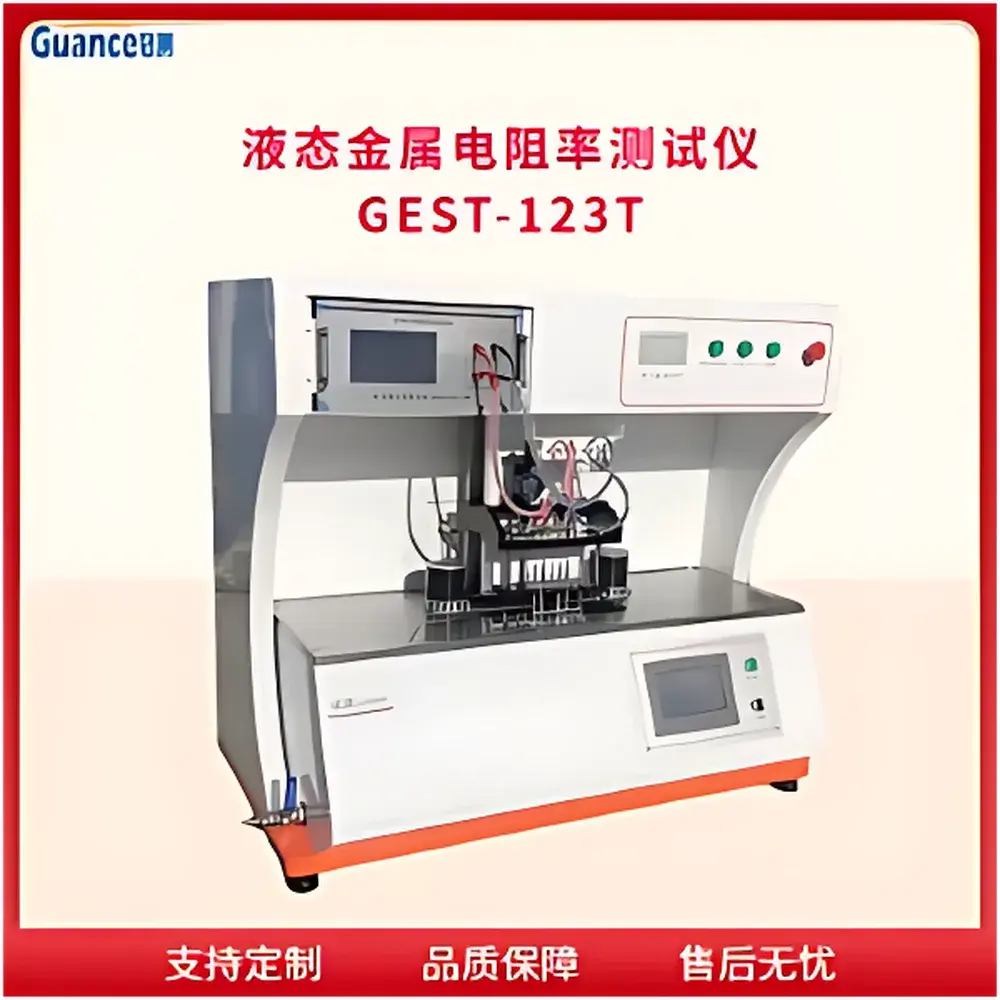
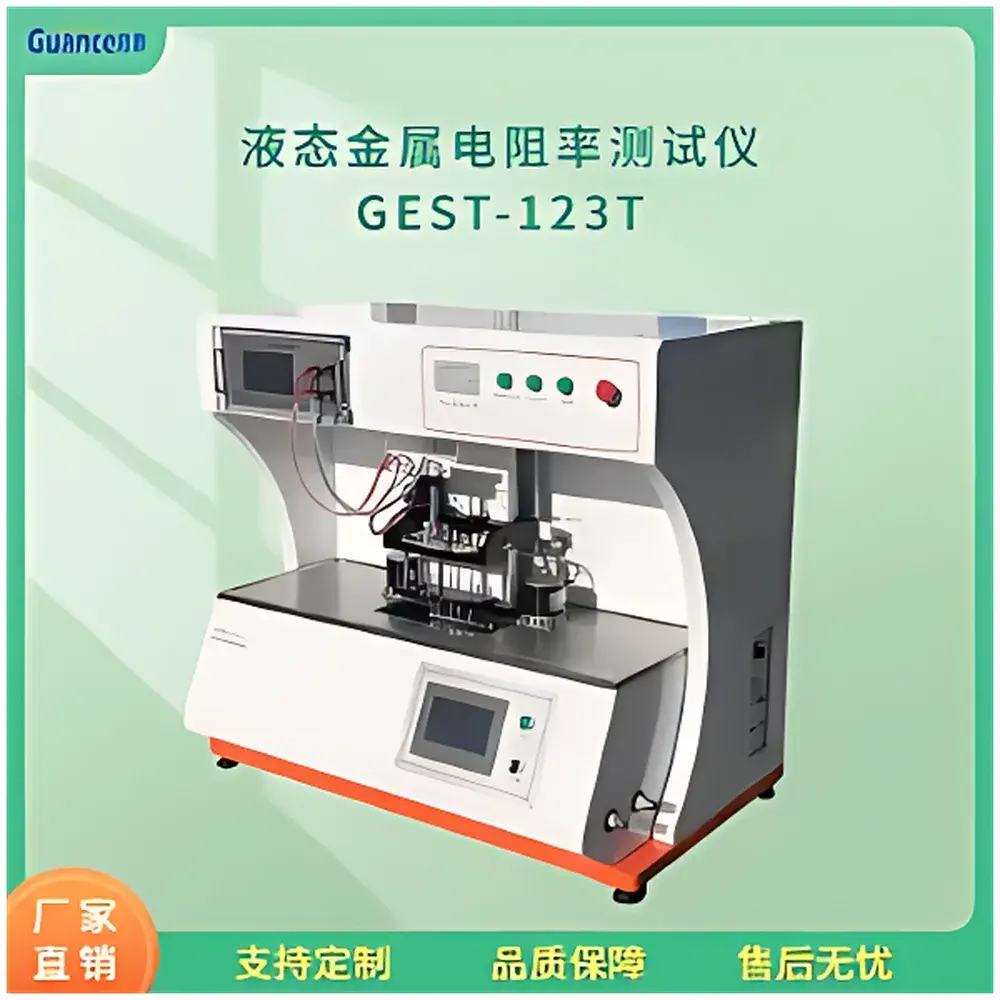
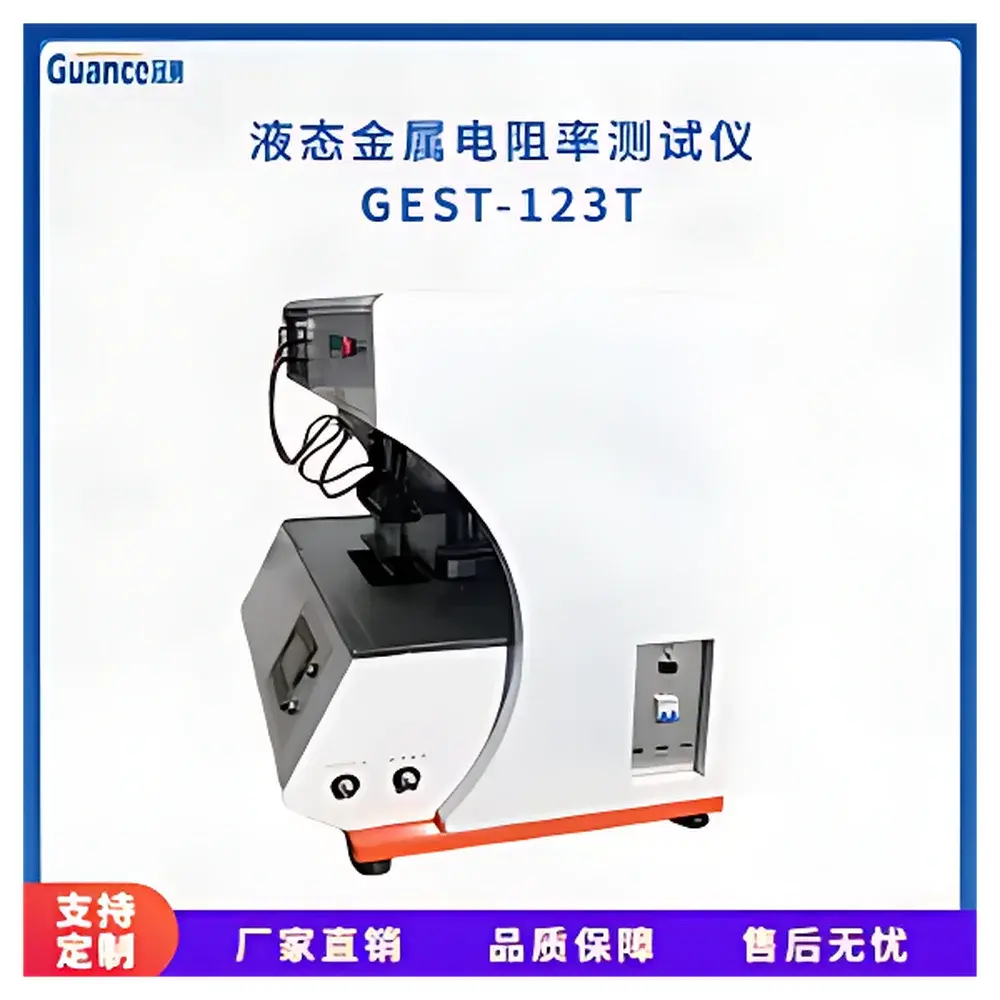
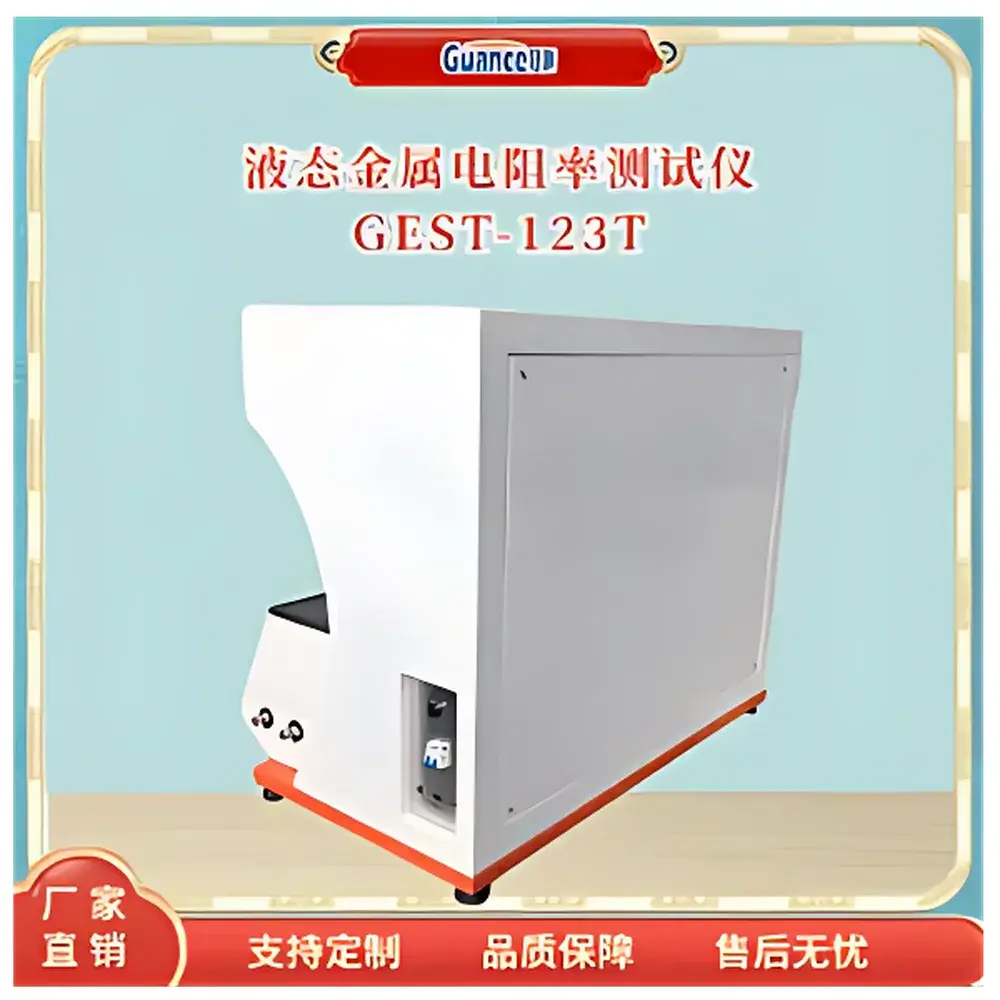
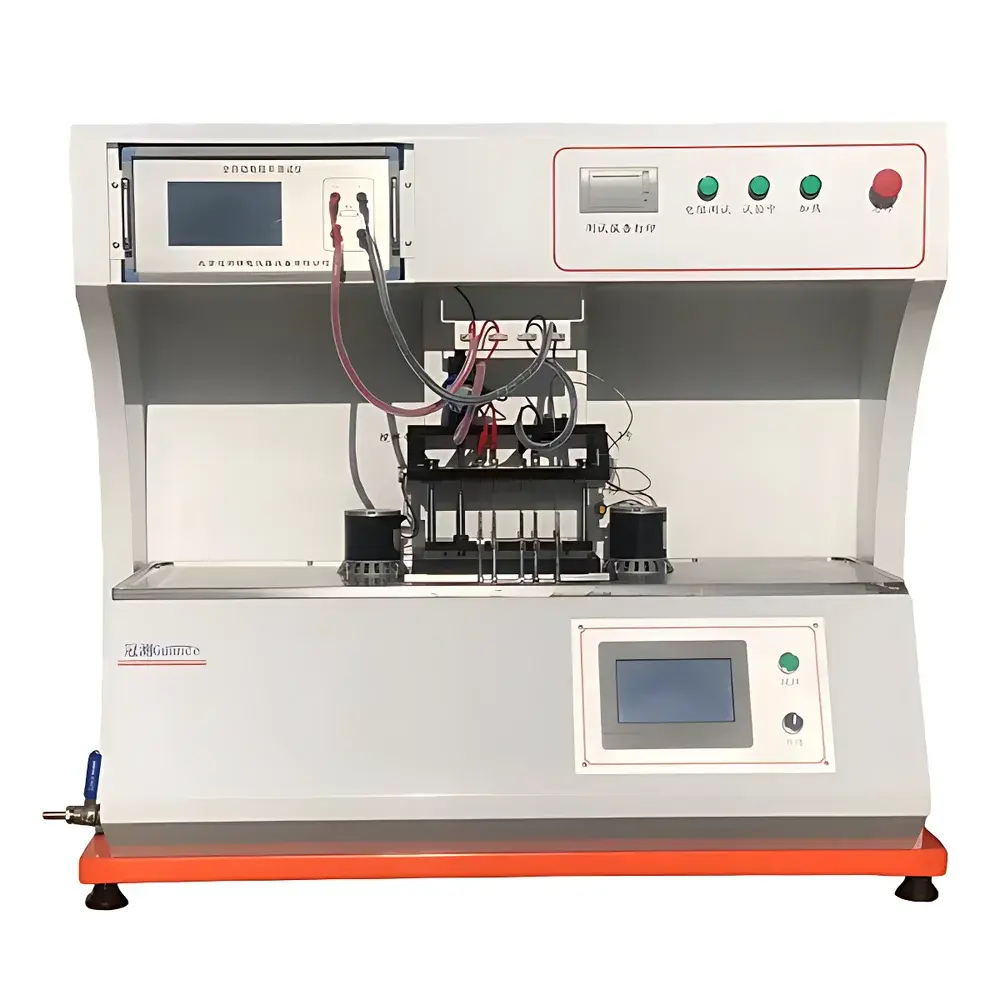
GuanCe Instruments GEST-123T1 Liquid Metal Resistivity Tester
| Brand | GuanCe Instruments |
|---|---|
| Origin | Beijing, China |
| Manufacturer Type | Authorized Distributor |
| Country of Origin | China |
| Model | GEST-123T1 |
| Price | USD 2,950 (FOB Beijing) |
| Temperature Range | Ambient to 300 °C |
| Max. Heating Rate | ≤30 min from ambient to 300 °C |
| Electrode Travel Speed | 0–300 mm/min |
| Resistivity Measurement Range | 10⁻⁴ – 10⁵ Ω·cm |
| Resolution | 10⁻⁶ Ω·cm |
| Current Sources | 10 μA, 100 μA, 1 mA, 10 mA, 100 mA, 1 A |
| Current Accuracy | ±(0.5% of reading + 2 digits) |
| Electrode Material | Tungsten Carbide |
| Cell Material | Fused Quartz |
| Temperature Control Algorithm | AI-enhanced PID |
| Data Acquisition | Real-time logging of temperature, voltage, current, resistance, resistivity, conductivity |
| Compliance | GB/T 41079.2–2022 |
Overview
The GuanCe Instruments GEST-123T1 Liquid Metal Resistivity Tester is a precision-engineered system designed for the accurate determination of electrical resistivity and conductivity in molten metallic samples under controlled elevated-temperature conditions. It operates on the principle of four-terminal (Kelvin) resistance measurement, eliminating lead and contact resistance errors to ensure traceable, high-reproducibility results. The instrument integrates oil-bath thermal management with programmable multi-segment ramp-and-soak temperature profiles, enabling systematic investigation of temperature-dependent electronic transport properties in liquid metals such as gallium-based alloys, sodium-potassium eutectics, and low-melting-point aluminum or zinc derivatives. Its architecture conforms to fundamental metrological requirements for physical property testing—emphasizing thermal stability, electrochemical inertness, and signal integrity across extended operating durations.
Key Features
- Fused quartz electrochemical cell—chemically inert and thermally stable up to 300 °C, resistant to corrosion by reactive liquid metals.
- Tungsten carbide electrodes—high hardness, low thermal expansion, and minimal interfacial polarization at metal–electrode interfaces.
- AI-optimized PID temperature control—synchronized with Siemens PLC for sub-degree thermal uniformity (±0.5 °C typical) across the oil bath.
- Dual independent stirring motors—ensuring homogeneous thermal distribution and minimizing thermal stratification during prolonged holds.
- Computer-controlled electrode positioning—servo-driven vertical translation with 0.001 mm resolution via calibrated digital micrometer feedback linked to PLC.
- Modular constant-current sources—six selectable ranges (10 μA to 1 A), each independently calibrated and verified against NIST-traceable standard resistors.
- Real-time data acquisition—simultaneous logging of temperature (Pt100 sensor), voltage drop, applied current, calculated resistivity, and derived conductivity.
- Comprehensive curve analysis—automated generation and export of ρ(T) and σ(T) plots with slope calculation over user-defined temperature intervals.
Sample Compatibility & Compliance
The GEST-123T1 accommodates a broad spectrum of low-to-medium melting point liquid metals—including Ga, In, Sn, Bi, NaK, and Al–Si eutectics—without degradation of cell integrity or electrode performance. All wetted components meet ISO 8502-3 cleanliness standards for non-contaminating surfaces. The system satisfies the procedural and instrumentation requirements of GB/T 41079.2–2022 (“Determination of Physical Properties of Liquid Metals — Part 2: Electrical Conductivity”), and its measurement traceability chain aligns with ISO/IEC 17025 principles for calibration and uncertainty estimation. While not certified for FDA 21 CFR Part 11, the software architecture supports audit-ready data export (CSV, PDF) with embedded timestamps, operator ID, and version-stamped configuration logs—enabling compliance with GLP and internal QA/QC protocols.
Software & Data Management
Control and analysis are executed via a Windows-based host application communicating with the Siemens S7-1200 PLC through OPC UA. The interface provides full parametric control: temperature ramp rates, dwell times, electrode descent velocity, current source selection, and auto-zeroing sequences. All raw measurements are timestamped and stored in a structured SQLite database with configurable retention policies. Export functions support CSV for third-party statistical analysis (e.g., MATLAB, OriginLab), PDF report generation with embedded curves and metadata, and batch-mode processing of historical datasets. Calibration records—including temperature sensor offset verification and current-source linearity checks—are digitally archived alongside test runs. No cloud connectivity or remote access functionality is implemented, preserving data sovereignty and network isolation per laboratory IT policy.
Applications
This instrument serves research and industrial laboratories engaged in metallurgy, battery materials development (e.g., liquid-metal anodes), thermal interface material characterization, and nuclear coolant evaluation (e.g., liquid sodium behavior). Typical use cases include: quantifying resistivity hysteresis during heating/cooling cycles; evaluating impurity-induced scattering effects via Arrhenius analysis of ln(ρ) vs. 1/T; benchmarking theoretical models of electron–phonon coupling in disordered metallic liquids; and validating thermal stability of encapsulated liquid-metal microstructures under cyclic thermal loading. Its design enables reproducible inter-laboratory comparison when operated within defined environmental constraints (ambient humidity <60% RH, vibration-isolated benchtop).
FAQ
What is the maximum recommended operating temperature for continuous use?
The fused quartz cell and tungsten carbide electrodes are rated for sustained operation up to 300 °C. Prolonged exposure above this threshold may induce quartz devitrification or electrode oxidation in air; inert-atmosphere purging (Ar/N₂) is advised for extended high-temperature runs.
Does the system support automated calibration routines?
Yes—built-in procedures allow two-point temperature sensor calibration and end-to-end current-source validation using certified reference resistors (1 Ω, 100 Ω, 10 kΩ). Calibration logs are saved with digital signatures and timestamps.
Can resistivity data be exported in SI-compliant units only?
All primary outputs default to SI units (Ω·m); however, the software permits on-the-fly unit conversion to Ω·cm, μΩ·cm, or %IACS for comparative reporting—without altering raw acquisition values.
Is the oil bath medium specified or user-selectable?
The system is compatible with standard high-thermal-stability silicone oils (e.g., Dow Corning 200 Fluid, viscosity grade 50 cSt). Users must select oils with flash points >320 °C and thermal decomposition onset >350 °C to ensure safety margin.
How is thermal drift minimized during long-duration measurements?
Thermal drift suppression is achieved via dual-layer stainless steel insulation, active oil circulation, and real-time compensation algorithms that adjust current sourcing based on measured bath temperature gradients detected by redundant Pt100 sensors.



