

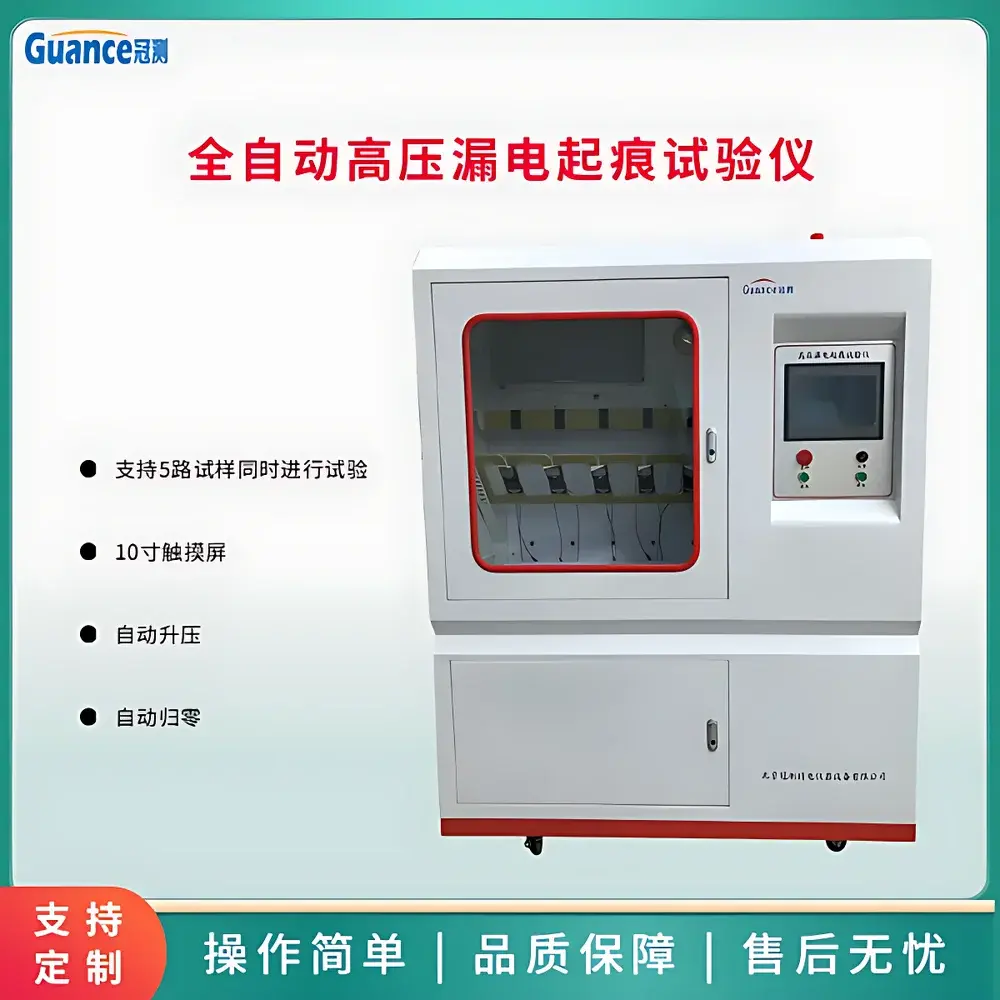
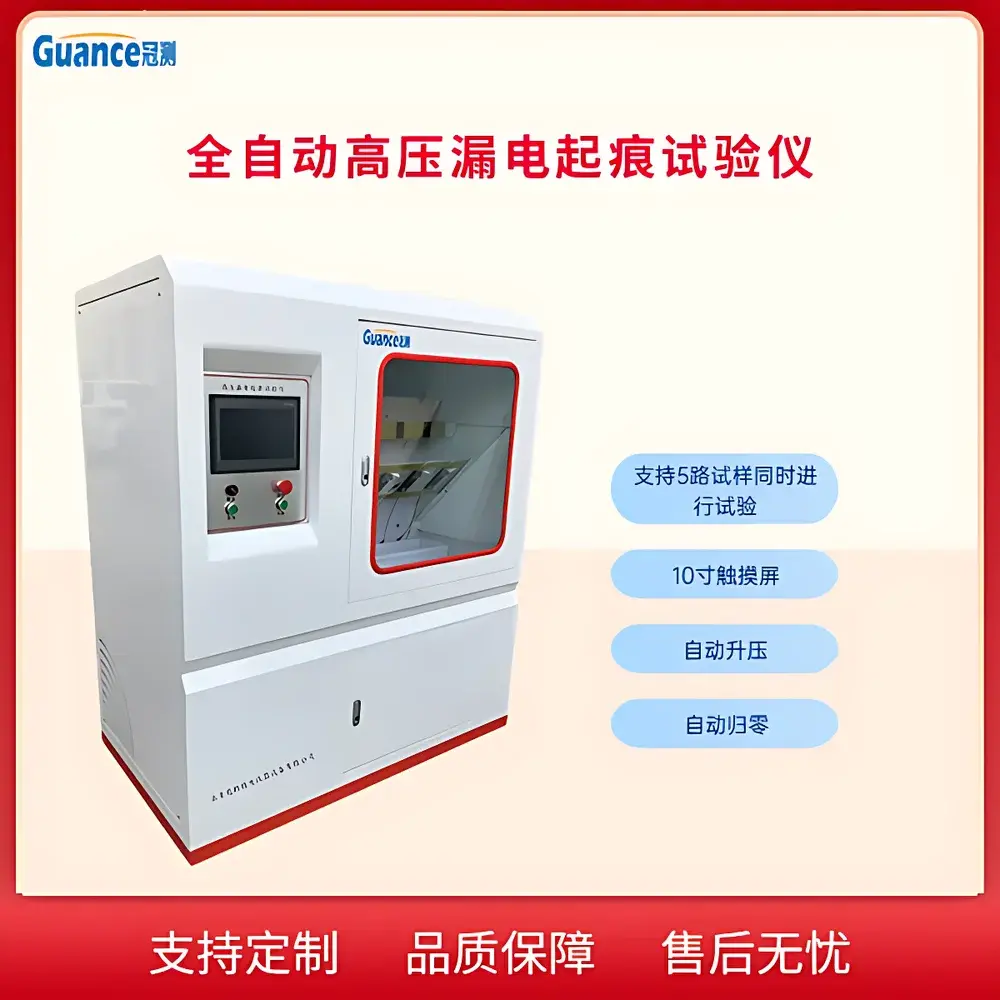
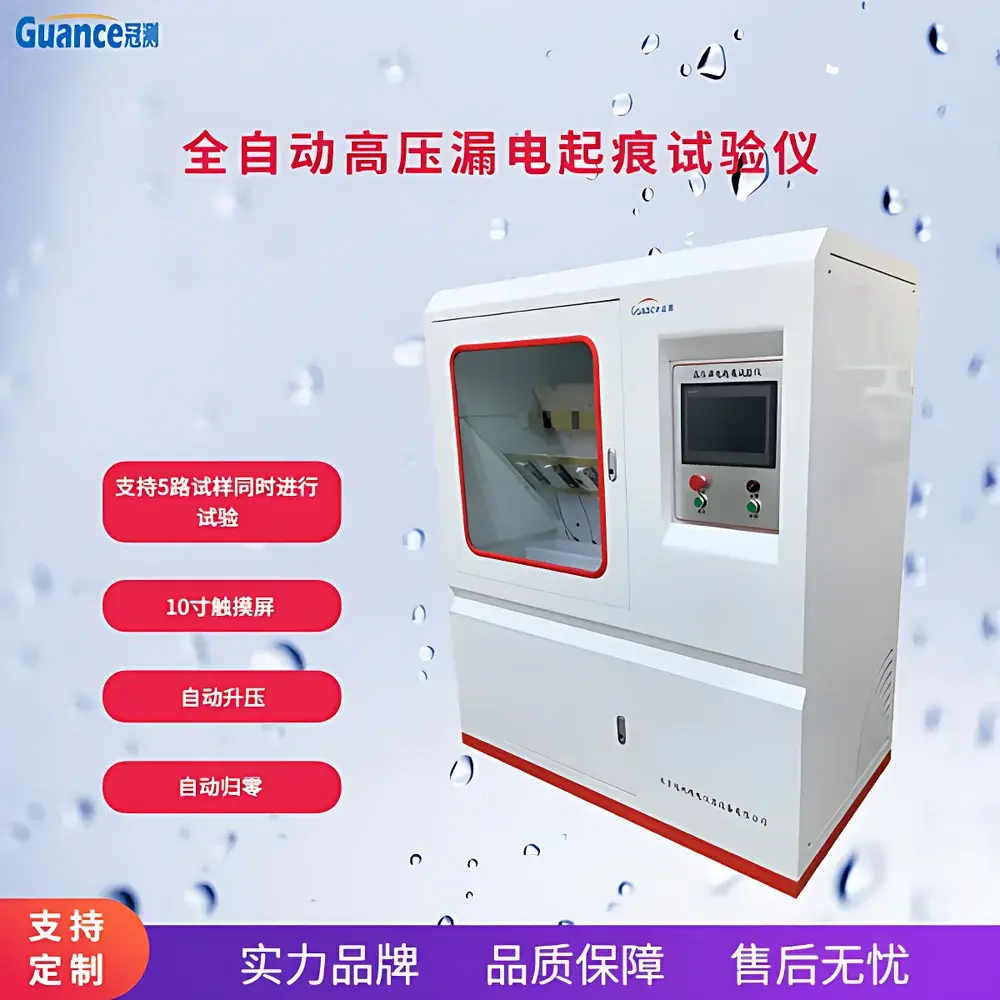
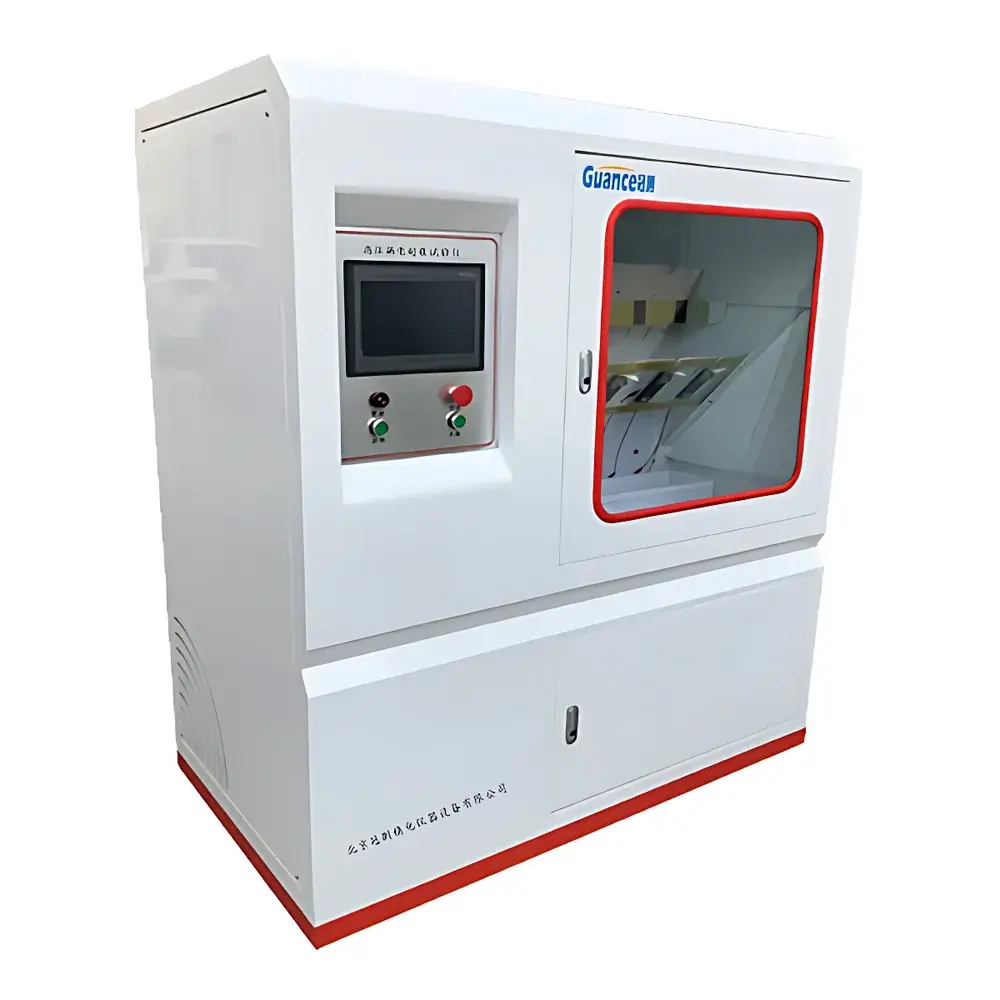
GuanCe NLD-AI.2 Universal Electrical Tracking Resistance Tester
| Brand | GuanCe Instruments |
|---|---|
| Origin | Beijing, China |
| Manufacturer Type | Authorized Distributor |
| Country of Origin | China |
| Model | NLD-AI.2 |
| Instrument Type | Electronic Universal Testing Machine |
| Voltage Output | AC 100–8000 V / DC 100–8400 V |
| Electrical Capacity | 7 kVA |
| Input Power | AC 220 V / 50 Hz |
| Electrode Spacing | (50 ± 0.5) mm |
| Electrode Material | 304 Stainless Steel |
| Sample Capacity | 5 specimens simultaneously |
| Test Methods | Constant Voltage Method & Stepwise Voltage Method |
| Voltage Drop | ≤5% under load |
| Drip Control | Adjustable peristaltic pump with real-time flow display |
| Safety Interlock | Door-activated high-voltage cutoff |
| Compliance | GB/T 6553–2003, IEC 60587:1984 |
Overview
The GuanCe NLD-AI.2 Universal Electrical Tracking Resistance Tester is an engineered solution for evaluating the comparative resistance of solid insulating materials to electrical tracking and erosion under severe environmental stress. It operates on the principle of controlled electrotchemical degradation: a conductive contaminant solution (e.g., ammonium chloride or sodium chloride) is dripped onto an inclined insulating specimen while subjected to a sustained or incrementally increased AC/DC voltage. The resulting leakage current, surface carbonization path formation, and eventual failure (flashover or permanent conductive track) are monitored to determine the material’s Comparative Tracking Index (CTI) or Proof Tracking Index (PTI), as defined in IEC 60587:1984 and GB/T 6553–2003. Designed for laboratories conducting dielectric performance validation in power transmission, rail traction, aerospace wiring harnesses, and high-reliability electronics packaging, the NLD-AI.2 delivers reproducible, standards-compliant test sequences under rigorously controlled electrochemical and thermal conditions.
Key Features
- Parallel 5-channel testing architecture: Enables simultaneous evaluation of five independent specimens—each with dedicated high-voltage output, leakage current monitoring, and programmable control—maximizing throughput without cross-channel interference.
- Industrial-grade Siemens PLC control system: Coupled with opto-isolated voltage and current acquisition circuits to ensure electromagnetic immunity in high-voltage environments, maintaining measurement stability even during arcing events.
- 10-inch industrial HMI touchscreen interface: Provides real-time visualization of per-channel parameters—including instantaneous leakage current, peak current since test initiation, applied voltage, drip rate, and elapsed time—with intuitive navigation and parameter configuration.
- Configurable leakage current alarm & autonomous channel isolation: User-defined threshold (0–100 mA) triggers immediate de-energization of the affected channel only, preserving test continuity for remaining specimens—a critical capability for comparative ranking studies.
- Precision peristaltic drip delivery: Flow rate fully adjustable via HMI; calibrated drip volume displayed continuously to ensure compliance with IEC-specified drop intervals (e.g., 30 ± 5 s per 0.5 mL) and minimize inter-test variability.
- Dual-compartment liquid management: Separates fresh contaminant reservoir from used solution collection, preventing recontamination and supporting repeatable conductivity control across sequential tests.
- Oil-immersed high-voltage transformer with autotransformer regulation: Delivers stable output with ≤5% voltage sag under full 7 kVA load—essential for maintaining field strength integrity across extended duration tests.
- Integrated safety systems: Includes door-actuated HV interlock, forced-air exhaust with external venting capability, and LED task lighting for visual inspection of tracking progression without opening the chamber.
- Post-test auto-zeroing and calibration support: Automatic discharge to 0 V post-test; built-in voltage and current calibration routines accommodate long-term drift compensation per ISO/IEC 17025 metrological traceability requirements.
Sample Compatibility & Compliance
The NLD-AI.2 accommodates rigid flat or curved insulating specimens up to 150 mm × 150 mm × 12 mm, including ceramic insulators, silicone rubber housings, epoxy-molded busbar supports, and polymeric cable jackets. Electrodes are precision-machined from passivated 304 stainless steel and mounted on high-dielectric-strength composite fixtures to prevent flashover along mounting hardware. All operational protocols align strictly with IEC 60587:1984 Annex A (constant voltage method) and Annex B (stepwise voltage method), as well as the national adaptation GB/T 6553–2003. The system supports documentation generation suitable for GLP audits, including timestamped event logs (voltage application, drip initiation, alarm triggers, flashover detection) and raw current/voltage waveform export for third-party analysis.
Software & Data Management
While the NLD-AI.2 operates primarily via embedded HMI firmware, it exports structured CSV files containing time-synchronized records of voltage, leakage current (per channel), drip count, and system status flags. Data timestamps comply with ISO 8601 format and include millisecond resolution. Exported files are compatible with common statistical analysis platforms (e.g., MATLAB, JMP, Minitab) for CTI/PTI calculation per IEC 60112 methodology. For regulated environments, optional USB-locked audit trail modules can be integrated to meet FDA 21 CFR Part 11 requirements—supporting electronic signatures, user access levels, and immutable change logs.
Applications
- Qualification of polymer formulations for outdoor insulators in coastal or industrial pollution zones
- Comparative screening of flame-retardant additives’ impact on tracking resistance
- Validation of conformal coatings on PCB assemblies exposed to condensation and ionic contamination
- Material selection support for EV battery enclosures operating in high-humidity, salt-spray environments
- Root-cause analysis of field failures linked to surface tracking in medium-voltage switchgear
- Supporting UL 746A, UL 746B, and IEC 60695-2-10/11/12 certification testing programs
FAQ
What standards does the NLD-AI.2 directly support?
It is fully configured to execute test protocols defined in IEC 60587:1984 and GB/T 6553–2003, including electrode geometry, inclination angle (45°), contamination solution composition, and pass/fail criteria for tracking failure.
Can the instrument perform both constant-voltage and stepwise-voltage tests?
Yes—both methods are pre-programmed and selectable via the HMI; stepwise mode increments voltage in 25 V or 50 V steps upon specified leakage current thresholds or time intervals.
Is calibration traceable to national standards?
Voltage and current sensors are factory-calibrated against reference standards accredited to CNAS (China National Accreditation Service); users may perform field verification using external high-voltage dividers and shunt resistors per ISO/IEC 17025 guidelines.
How is operator safety ensured during high-voltage operation?
Multiple redundant safeguards include interlocked access door (cuts HV within 100 ms), grounded observation window, audible/visual alarm on overcurrent, and automatic discharge circuitry that verifies 0 V before chamber access is permitted.
Does the system support automated reporting for quality documentation?
Raw data export enables integration with LIMS or custom report generators; optional software add-ons provide PDF report templates compliant with internal QA formats or customer-specific submission requirements.



