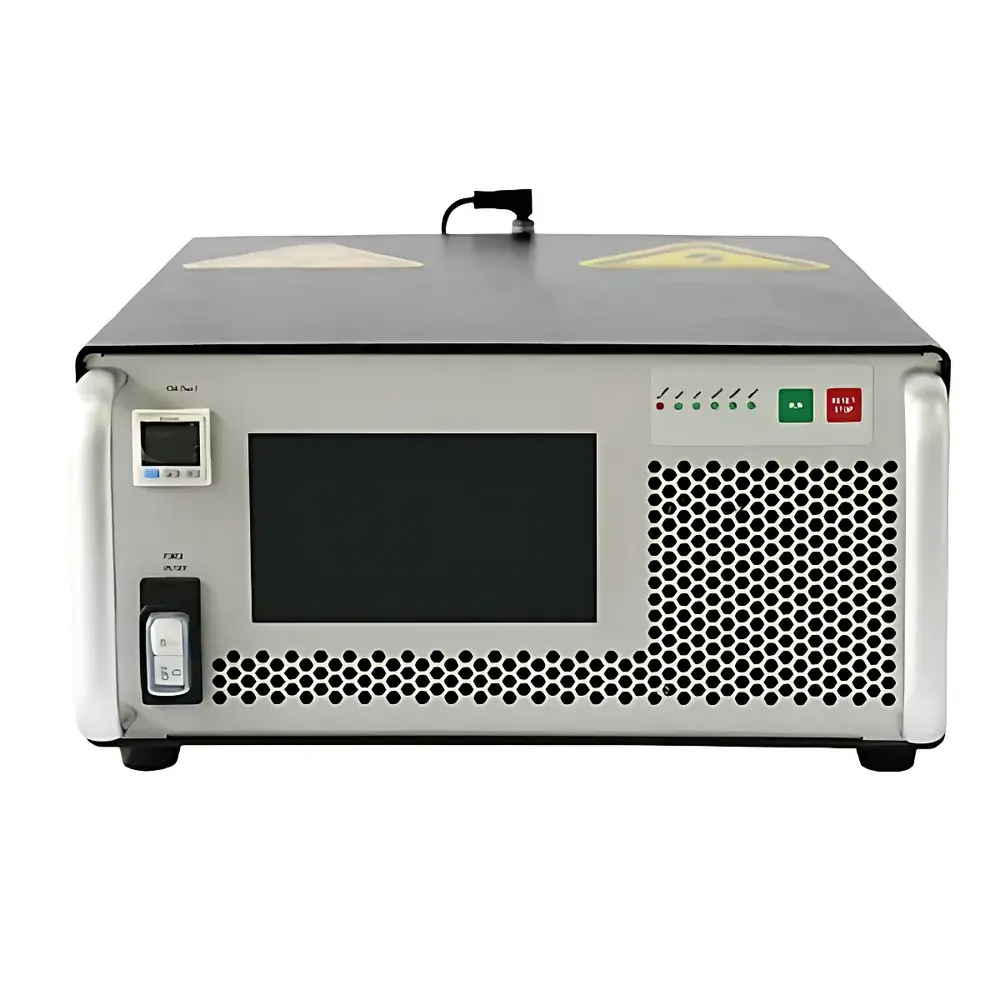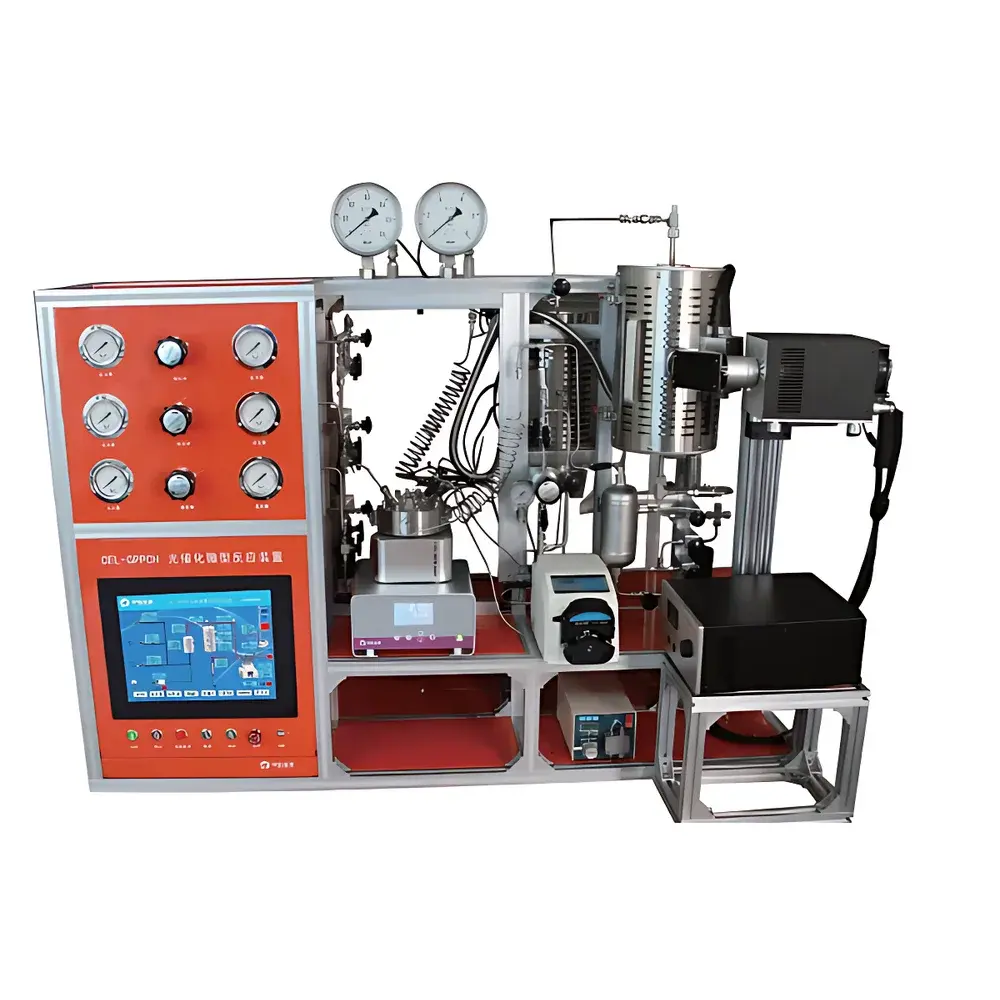
CEL-GPPCT High-Temperature High-Pressure Photothermal Catalytic Microreactor System
| Brand | CEA (China Education Goldsource) |
|---|---|
| Model | CEL-GPPCT |
| Max Operating Pressure | 6 MPa (standard), 10 MPa (optional) |
| Max Operating Temperature | 600 °C (standard), 800 °C (optional) |
| Illumination Zone | Dual-side irradiation, 20 mm diameter, sapphire viewport |
| Heating Zones | 3-zone programmable furnace |
| Temperature Uniformity | ±1 °C in active reaction zone |
| Gas Inlets | 3 independent mass flow-controlled channels (100/100/200 mL/min) |
| Liquid Feed | 1 heated liquid line (<200 °C), optional precision metering pump |
| Preheater | Integrated gas preheater (<600 °C, <10 MPa) |
| Optional GC Configuration | Dual-FID + TCD detectors, VICI autosampler valve (temperature-controlled to 200 °C), dual-detector concurrent analysis capability |
| Compliance | Designed for ASTM E2915, ISO 17025-compliant lab environments |
Overview
The CEL-GPPCT is a fully integrated high-temperature, high-pressure photothermal catalytic microreactor system engineered for rigorous kinetic evaluation and mechanistic study of heterogeneous catalytic processes under industrially relevant conditions. Unlike conventional fixed-bed microreactors limited to thermal activation or ambient-pressure photochemistry, the CEL-GPPCT uniquely enables simultaneous application of intense optical irradiation (via dual-side sapphire windows) and precisely controlled thermal–pressure fields—up to 600 °C and 6 MPa as standard, extendable to 800 °C and 10 MPa with reinforced reactor configuration. Its core architecture features a coaxial double-tube design: an inner quartz reaction tube serving as both catalyst support and optical transmission medium, enclosed within a pressure-rated metal outer jacket equipped with axial light-guiding columns. This patented configuration (CN 110652951 A) eliminates optical path degradation at elevated temperatures while maintaining structural integrity under sustained supercritical gas-phase operation. The system operates on Couette-type flow principles within the annular catalyst bed, ensuring uniform residence time distribution and minimizing axial dispersion—critical for deriving intrinsic rate laws and eliminating transport limitations in structure–activity correlation studies.
Key Features
- Triple-zone programmable furnace with ±1 °C temperature stability across the 20 mm illuminated reaction zone
- Dual-face illumination geometry enabling symmetrical photon flux delivery through radiation-hardened sapphire viewports (transmission >92% from 200–2500 nm)
- Modular pressure containment: Standard configuration rated to 6 MPa / 600 °C; optional heavy-wall reactor assembly certified to ASME B31.3 process piping standards for 10 MPa / 800 °C operation
- Three independently controlled gas mass flow controllers (MFCs) with full-range calibration traceability to NIST standards; configurable for reactive gas mixtures including H₂, CO₂, NH₃, NOₓ, CH₄, and SO₂
- Integrated preheater stage (<600 °C, <10 MPa) upstream of catalyst bed to ensure complete vaporization and homogeneous mixing prior to catalytic contact
- Single heated liquid feed line (max 200 °C), compatible with syringe-type or diaphragm metering pumps for precise liquid dosing in hybrid gas–liquid reactions
- Optional online GC subsystem featuring dual-FID and TCD detectors, VICI 10-port high-temp autosampler (200 °C), and chromatographic data system with EPA Method 18–compliant peak integration algorithms
Sample Compatibility & Compliance
The CEL-GPPCT accommodates powdered, pelletized, or monolithic catalysts loaded into standardized quartz or Inconel reaction tubes (ID 8 mm, length 150 mm). It supports continuous-flow operation with real-time effluent sampling via heated transfer lines (maintained >150 °C) to prevent condensation or adsorption artifacts. All wetted surfaces comply with ASTM F899 stainless steel specifications; quartz components meet SEMI F57 purity requirements. The system satisfies essential safety and metrological criteria for ISO/IEC 17025-accredited laboratories, including documented uncertainty budgets for temperature (±0.5 °C), pressure (±0.25% FS), and flow (±0.8% reading). Optional 21 CFR Part 11–compliant software adds electronic signature, audit trail, and role-based access control for regulated environments.
Software & Data Management
Control and data acquisition are managed via a deterministic real-time OS platform (Linux RT kernel) with sub-second I/O cycle times. The native interface provides synchronized logging of 48+ process variables—including individual MFC setpoints, furnace zone temperatures, backpressure regulator output, lamp intensity (via calibrated photodiode feedback), and GC detector signals—with timestamp resolution of 10 ms. Raw datasets export in HDF5 format for direct import into MATLAB, Python (Pandas/H5Py), or Aspen Custom Modeler. Optional add-ons include kinetic modeling plug-ins (e.g., Langmuir–Hinshelwood parameter estimation), thermodynamic equilibrium calculators (based on NASA polynomials), and automated DOE (Design of Experiments) script generation aligned with ICH Q5 guidelines.
Applications
- Ammonia synthesis kinetics under realistic Haber–Bosch conditions (N₂/H₂, 400–550 °C, 5–10 MPa)
- CO₂ hydrogenation to methanol or methane over Cu/ZnO/Al₂O₃ catalysts with simultaneous UV–vis irradiation
- Steam/dry reforming of methane with in situ product analysis of H₂, CO, CO₂, and C₂+ hydrocarbons
- Low-temperature SCR (selective catalytic reduction) of NOₓ using NH₃ or urea under simulated flue gas composition
- Photothermally enhanced desulfurization of model diesel fractions (e.g., dibenzothiophene oxidation)
- Catalyst deactivation profiling via accelerated aging protocols with periodic GC–MS coupling
FAQ
What is the maximum allowable pressure for the standard CEL-GPPCT configuration?
The base system is rated for continuous operation at ≤6 MPa and ≤600 °C. Higher ratings require the optional reinforced reactor assembly and associated safety interlocks.
Can the system perform simultaneous gas and liquid phase reactions?
Yes—the single heated liquid feed line (up to 200 °C) integrates seamlessly with the three-gas manifold; co-feeding of volatile organics (e.g., methanol, ethanol) with syngas or flue gas simulants is routinely validated.
Is the GC subsystem capable of quantifying permanent gases and hydrocarbons in one run?
Affirmative. The dual-FID/TCD configuration enables concurrent detection: TCD for H₂, O₂, N₂, CO, CO₂, CH₄; FID for C₂–C₆ hydrocarbons and oxygenates—with retention time locking and internal standard calibration per ASTM D1945.
How is temperature uniformity verified across the catalyst bed?
Each unit undergoes factory calibration using embedded thermocouple mapping at five axial positions under steady-state conditions; a certificate of conformance documents ΔT ≤1.0 °C across the 20 mm active zone.
Does the system support remote operation and data export for LIMS integration?
All process data streams expose OPC UA endpoints; CSV, JSON, and HDF5 exports are script-triggered or scheduled, enabling direct ingestion into laboratory information management systems compliant with ISO 15197 and CLIA requirements.
Related Products