




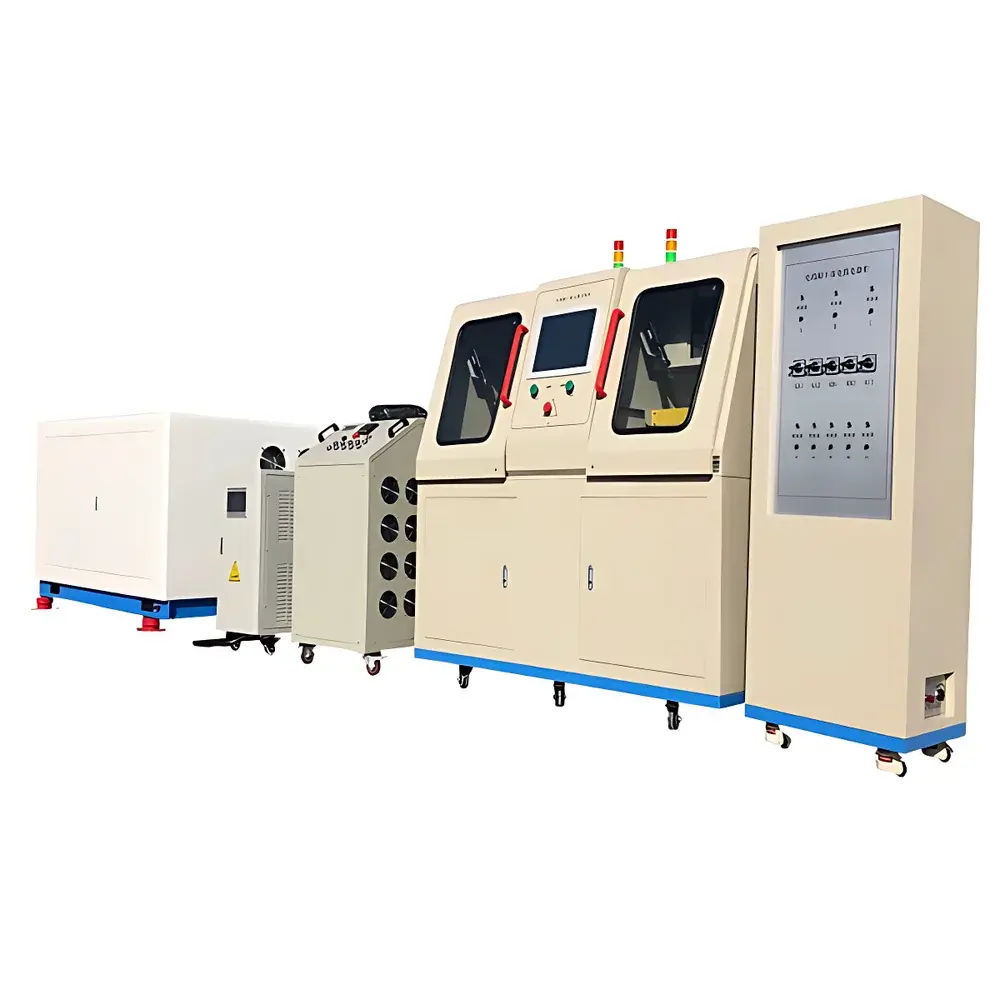
GuanCe YHT-RC100 Dry/Wet Arc Resistance Tester for Aerospace Wiring
| Brand | GuanCe Instruments |
|---|---|
| Origin | Beijing, China |
| Model | YHT-RC100 |
| Instrument Type | Electronic Universal Testing Machine |
| Control System | Siemens Original PLC |
| Human-Machine Interface | Moxa 10-inch HD Capacitive Touchscreen |
| Compliance | AS4373D, GJB773A, ASD-STAN PRF-6059-502 |
| Test Modes | Dry Arc & Wet Arc (electrolyte-dripped) |
| Voltage Accuracy | ±1% (0.1 V resolution) |
| Current Accuracy | ±1% (0.01 A resolution) |
| Timing Range | 1–99,999,999 s (programmable) |
| Electrode Travel Stroke | 1–10 cm (std. 3.81 ± 0.3 cm) |
| Electrode Reciprocating Speed | 0.5 ± 0.05 cycles per second |
| Electrode Load Mass | 250 ± 25 g |
| Dropping Rate | 100 ± 10 mg/min (8–10 drops/min, via Lead Fluid BV-100 peristaltic pump) |
| Power Supply | AC 220 V ±10%, 50 Hz, 2 kW |
| Generator Output | 20 kVA, 400/230 V, 400 Hz (via integrated frequency converter) |
| Short-Circuit Protection | 30 A breaker |
| Overcurrent Protection | Five 7.5 A breakers |
| Ground Resistance | <1 Ω |
| Dimensions (L×W×H) | 1400 × 830 × 1500 mm |
| Weight | 300 kg |
Overview
The GuanCe YHT-RC100 Dry/Wet Arc Resistance Tester is a purpose-built, standards-compliant evaluation system engineered to quantify the arc resistance performance of aerospace-grade wire insulation under both dry and electrolyte-wetted conditions. Unlike general-purpose dielectric testers, the YHT-RC100 replicates the critical failure mechanisms observed in real-world avionics environments—specifically, surface tracking, carbonization, and insulation breakdown initiated by sustained low-energy electric arcs in the presence or absence of conductive fluid contamination. The system integrates a high-fidelity 400 Hz power train (derived from an onboard 20 kVA generator and frequency-conversion subsystem), precision-controlled electrode motion (servo-driven reciprocation with calibrated load mass), and programmable electrolyte dosing—enabling repeatable simulation of arc-induced degradation per AS4373D Clause 5.3.2, GJB773A Method 3017, and ASD-STAN PRF-6059-502. Its architecture conforms to laboratory-grade instrumentation requirements for traceability, reproducibility, and operational safety—including grounded chassis design (<1 Ω earth impedance), redundant overcurrent protection, and forced ventilation for hazardous fume extraction.
Key Features
- Siemens-certified original PLC control core ensuring deterministic real-time logic execution, I/O synchronization, and audit-ready event logging.
- 10-inch Moxa capacitive touchscreen HMI with intuitive parameter configuration, live waveform overlay (V/I/time), and multi-language UI support (English default).
- Dual-mode test capability: Dry arc testing (no fluid exposure) and wet arc testing (controlled electrolyte drip at 100 ± 10 mg/min using Lead Fluid BV-100 peristaltic pump with stainless-steel needle positioning).
- Electromechanical actuation subsystem featuring servo motor +滚珠丝杠 + linear guide rail assembly, delivering precise 1–10 cm stroke adjustment and stable 0.5 ± 0.05 cps reciprocation frequency.
- Integrated metrology chain: High-accuracy voltage transducer (±1%, 0.1 V res.) and current transducer (±1%, 0.01 A res.), both outputting 4–20 mA analog signals to PLC for closed-loop monitoring.
- Onboard conductivity verification module enables pre-test validation of electrolyte resistivity (per AS4373D Table 1: 0.5–1.0 mS/cm), ensuring solution consistency across test batches.
- Full-spectrum electrical protection: Five independent 7.5 A circuit breakers for branch-level overcurrent isolation; one dedicated 30 A short-circuit breaker; thermal cutoffs on generator and motor windings.
Sample Compatibility & Compliance
The YHT-RC100 accommodates standard aerospace wire specimens per AS4373D Annex A: up to seven parallel conductors mounted on dedicated dry/wet fixtures—five active (energized) and two floating (non-energized reference). Specimen geometry (e.g., AWG 20–26 stranded or solid-core fluoropolymer-insulated wires) is secured via adjustable clamping brackets compatible with nominal outer diameters from 0.8 to 3.2 mm. All mechanical interfaces—including electrode holder, drip needle mount, and waste collection tray—are constructed from non-tracking, arc-resistant materials (e.g., ceramic-coated aluminum and PTFE-lined stainless steel). The system fully satisfies electromagnetic compatibility (EMC) requirements per IEC 61326-1 for industrial laboratory use and meets mechanical safety provisions of ISO 12100:2012. Calibration documentation supports GLP-compliant operation, and firmware logs retain full timestamped records of voltage, current, time-to-failure, and operator inputs—facilitating FDA 21 CFR Part 11–aligned data integrity workflows when paired with validated LIMS integration.
Software & Data Management
No proprietary PC software is required for basic operation—the embedded PLC and HMI handle all sequencing, data acquisition, and alarm management autonomously. However, optional RS485/Modbus RTU or Ethernet/IP interfaces enable bidirectional communication with external SCADA systems or laboratory information management systems (LIMS). Test parameters (voltage setpoint, dwell time, stroke length, drip rate) are stored in non-volatile memory with version-stamped configuration files. Each test run generates a CSV-formatted report containing: start/stop timestamps, real-time V/I traces sampled at 100 Hz, cumulative arc duration, number of recorded interruptions, and final pass/fail status relative to predefined failure criteria (e.g., continuity loss >100 ms or leakage current >1 A). Audit trails include operator ID (via optional RFID badge reader), calibration due dates, and firmware revision history—all exportable without modification for regulatory review.
Applications
- Evaluation of polyimide, ETFE, FEP, and PTFE-based wire insulation systems used in MIL-STD-2000A, SAE AS50881, and Boeing D6-17487 wiring harnesses.
- Qualification testing of new insulation formulations prior to FAA TSO-C90 or EASA ETSO-C90 certification.
- Root-cause analysis of field-reported arc tracking failures in flight control or engine monitoring circuits.
- Comparative lifetime modeling under accelerated arc stress (ASTM D495 ramped voltage protocol adaptations).
- Supporting DoD Reliability Growth Testing (RGT) programs requiring statistically significant failure mode datasets under controlled environmental stressors.
FAQ
What standards does the YHT-RC100 directly support?
AS4373D (Method 503), GJB773A (Method 3017), ASD-STAN PRF-6059-502, and indirectly supports ASTM D495 and IEC 60587 for comparative arc tracking index (CTI) derivation.
Can the system operate without external PC connectivity?
Yes—the PLC and touchscreen provide fully autonomous control, data logging, and result reporting. PC connectivity is optional for centralized fleet monitoring or LIMS integration.
Is the 400 Hz power supply internally generated or externally sourced?
The unit includes an integrated 20 kVA generator with dedicated frequency converter, eliminating dependency on external 400 Hz utility feeds—critical for lab portability and test repeatability.
How is electrolyte concentration verified before testing?
An onboard conductivity meter measures solution resistivity in real time; readings are displayed on the HMI and must fall within the AS4373D-specified range (0.5–1.0 mS/cm) to enable test initiation.
What maintenance intervals are recommended for long-term reliability?
Per manufacturer guidelines: quarterly inspection of electrode wear and needle alignment; biannual calibration of voltage/current transducers; annual verification of PLC firmware checksums and backup retention integrity.



