
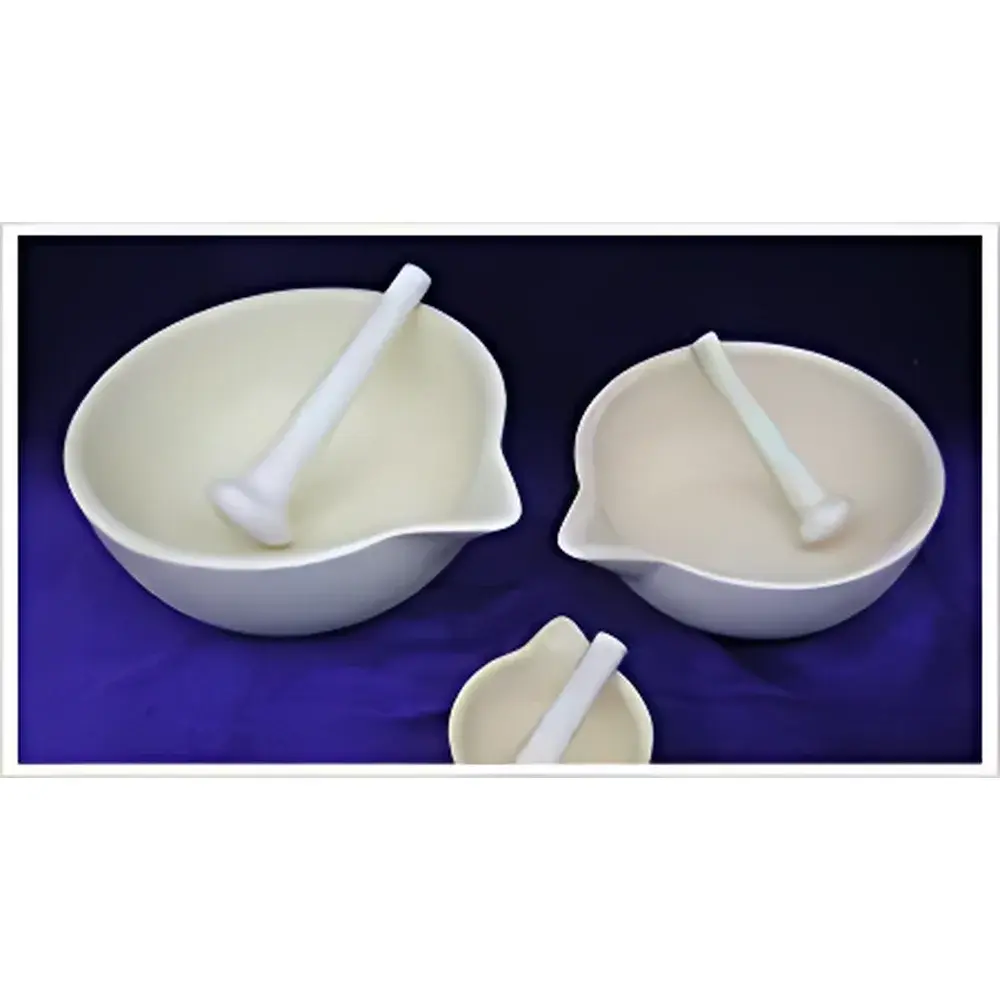
Zhongke Aobo Mortar Bowl (Alumina Ceramic, ∅100–∅300 mm)
| Brand | Zhongke Aobo |
|---|---|
| Origin | Beijing, China |
| Model | ∅100–∅300 mm |
| Material | 99% Al₂O₃ High-Purity Alumina Ceramic |
| Bulk Density | ≥3.80 g/cm³ |
| Apparent Porosity | <1% |
| Flexural Strength | >350 MPa |
| Compressive Strength | >12,000 MPa |
| Dielectric Constant (1 MHz) | ~9.8 |
| Vickers Hardness | ≥1,400 HV (equivalent to HRA 88) |
| Chemical Purity | Al₂O₃ ≥99.0 wt%, R₂O ≤0.2 wt%, Fe₂O₃ ≤0.1 wt%, SiO₂ ≤0.2 wt% |
Overview
The Zhongke Aobo Mortar Bowl is a high-performance laboratory mortar engineered for precision sample preparation in demanding analytical and research environments. Constructed from 99% high-purity alumina ceramic (Al₂O₃), it operates on the fundamental principle of mechanical attrition—transferring controlled kinetic energy via manual or assisted pestle motion to fracture, homogenize, and reduce particle size without introducing metallic or organic contamination. Unlike stainless steel or agate mortars, this alumina variant offers exceptional chemical inertness across acidic, alkaline, and oxidizing media, making it indispensable for trace-level analysis, pharmaceutical development, and advanced materials synthesis where elemental purity and batch-to-batch reproducibility are critical.
Key Features
- Ultra-high purity alumina composition (Al₂O₃ ≥99.0 wt%) ensures minimal leaching and background interference in ICP-MS, XRF, and elemental impurity testing.
- Exceptional mechanical robustness: compressive strength exceeding 12,000 MPa and flexural strength >350 MPa enable reliable use with hard, brittle samples—including fused salts, refractory oxides, and sintered ceramics—without chipping or microcracking.
- Extremely low apparent porosity (<1%) and high bulk density (≥3.80 g/cm³) minimize liquid absorption and prevent cross-contamination between sequential samples.
- Surface hardness rated at ≥1,400 HV (HRA 88) provides superior wear resistance during repetitive grinding cycles, preserving dimensional stability and surface finish over extended service life.
- Available in standardized diameters from ∅100 mm to ∅300 mm, accommodating both small-scale analytical prep (e.g., 0.1–5 g samples) and larger-volume formulation trials (up to 50 g).
- Smooth, non-porous, and autoclavable surface supports GLP-compliant cleaning protocols and meets ISO 17025 requirements for equipment qualification in accredited laboratories.
Sample Compatibility & Compliance
This mortar bowl is validated for processing high-purity inorganic powders (e.g., LiCoO₂, Y₂O₃, SiC), pharmaceutical actives (APIs) and excipients, catalyst precursors, geological standards (e.g., NIST SRMs), and nanomaterial dispersions. Its inertness eliminates catalytic side reactions common with metal mortars during mechanochemical synthesis. The material complies with USP for pharmaceutical contact surfaces and satisfies ISO 13485 Annex A.2 criteria for cleanability in medical device R&D. While not certified under FDA 21 CFR Part 11, its physical traceability (batch-coded upon request) and compatibility with documented SOPs support audit readiness for GMP and GLP environments.
Software & Data Management
As a passive, manually operated tool, the mortar bowl requires no embedded software or firmware. However, its use integrates seamlessly into digital lab workflows: sample IDs, grinding duration, pestle material, and environmental conditions (e.g., humidity, glovebox O₂ level) can be logged within LIMS platforms such as LabVantage or Thermo Fisher SampleManager. For automated systems, it is compatible with motorized pestle actuators (e.g., Retsch MM 500) when mounted on standardized holders—enabling timestamped, parameter-controlled grinding protocols with full electronic record retention per ALCOA+ principles.
Applications
- Pretreatment of samples prior to X-ray diffraction (XRD) and SEM-EDS analysis, ensuring homogeneous particle distribution and minimizing preferred orientation artifacts.
- Homogenization of certified reference materials (CRMs) for calibration curve preparation in atomic spectroscopy.
- Low-energy milling of heat-sensitive APIs to achieve target particle size distributions (PSD) without thermal degradation.
- Preparation of fused bead samples for wavelength-dispersive XRF, where contamination from crucible or mortar residue must be below detection limits.
- Mechanochemical activation of solid-state battery cathode precursors, leveraging alumina’s dielectric stability (εᵣ ≈ 9.8 at 1 MHz) to avoid arcing or localized heating.
FAQ
Is this mortar suitable for cryogenic grinding?
Yes—alumina retains mechanical integrity down to –196°C (liquid nitrogen temperature); however, thermal shock must be avoided by gradual cooling and use of compatible cryo-pestles.
Can it be cleaned in an ultrasonic bath?
Yes, using neutral pH aqueous or ethanol-based solvents; avoid HF-containing solutions or strong alkalis above 100°C.
What pestle material is recommended for maximum compatibility?
Alumina pestles are optimal; silicon carbide or tungsten carbide may cause abrasive wear over time due to hardness mismatch.
Does the bowl require calibration or periodic verification?
No formal calibration is required, but dimensional inspection (diameter, depth tolerance ±0.2 mm) and visual crack assessment should be performed quarterly per internal QA procedures.
Is documentation available for material traceability?
Batch-specific CoA (Certificate of Analysis) including XRF assay data and mechanical test reports can be provided upon order confirmation.



