
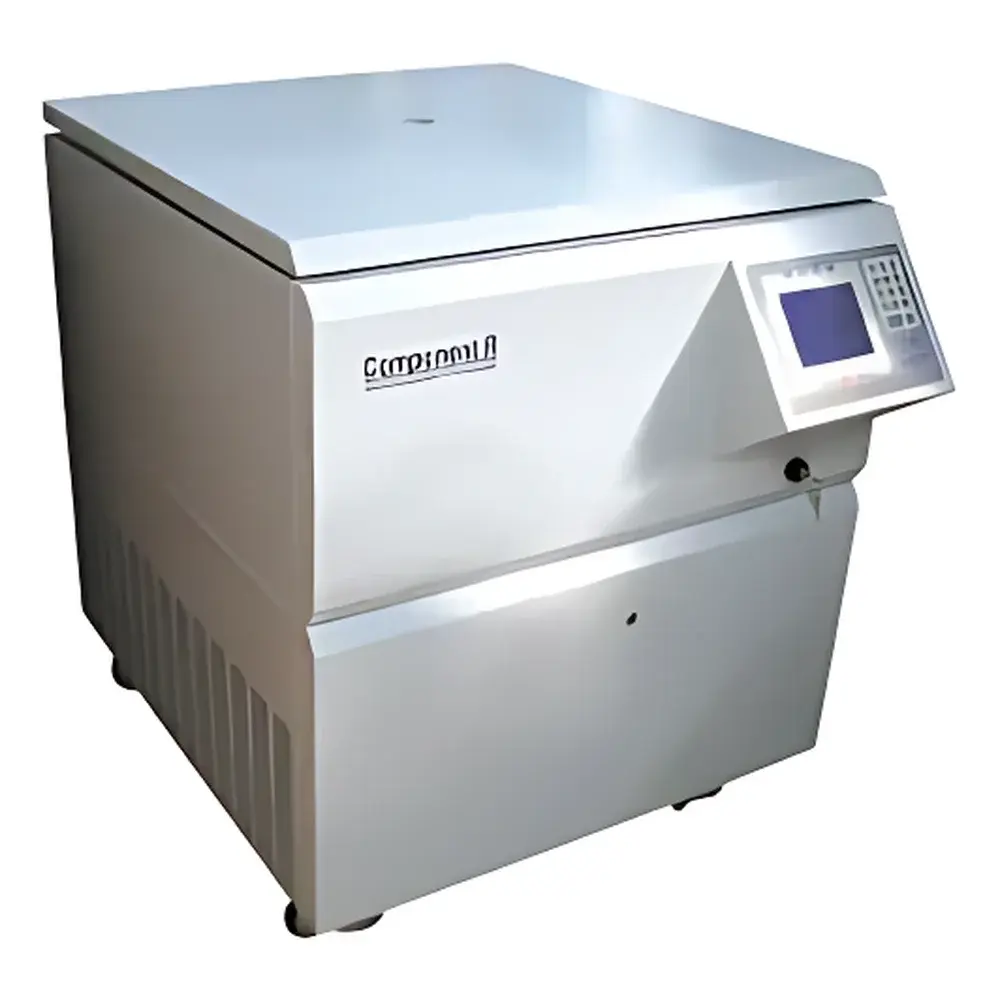
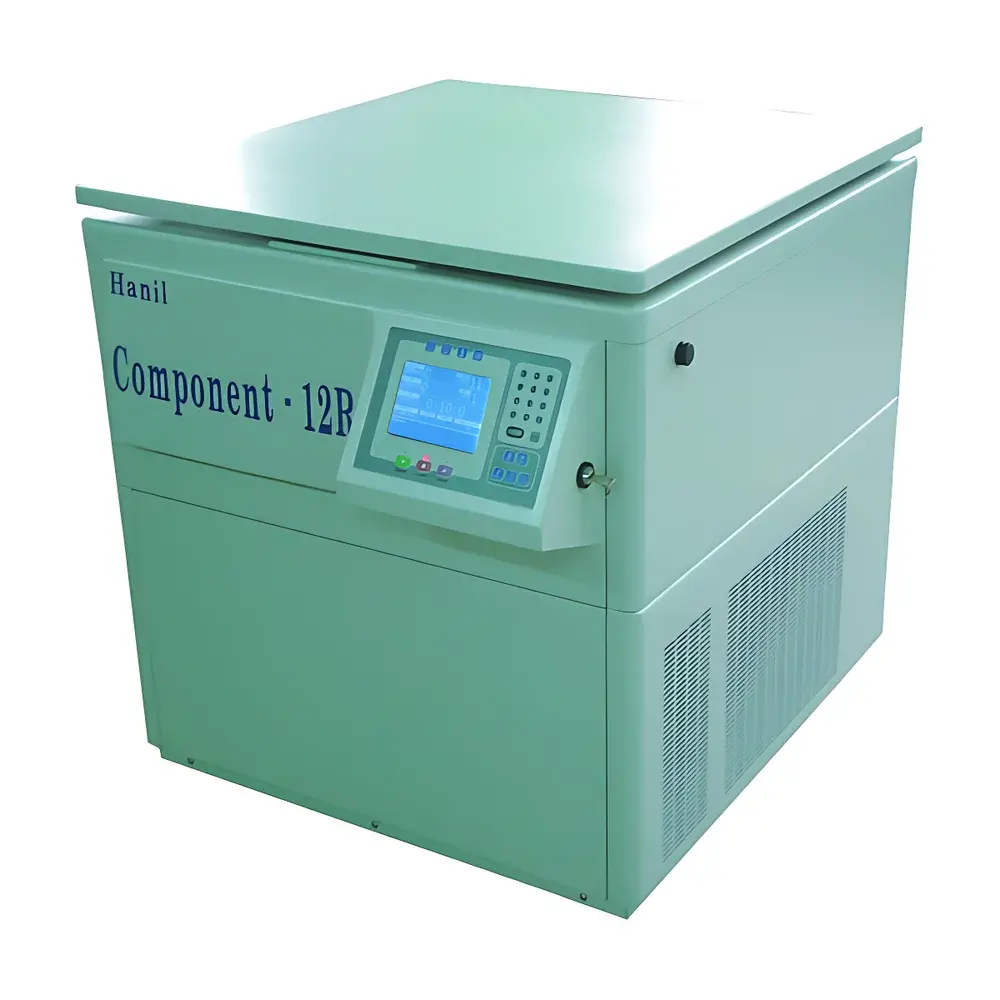
Hanil Component R Blood Bag Centrifuge
| Brand | Hanil |
|---|---|
| Origin | South Korea |
| Model | Component R |
| Max Speed | 6,000 rpm |
| Max RCF | 9,660 × g |
| Max Capacity | 6 × 1000 mL |
| Temperature Range | −20°C to +40°C |
| Temp Setting Range | 0°C to ±30°C |
| Timer Range | 9 h 59 min 59 sec |
| Acceleration/Deceleration Curves | 10 |
| Stored Programs | 20 |
| Minimum Speed Increment | 1 rpm |
| Display | Graphic LCD |
| Rotor Options | 10 |
| Power Supply | AC 220 V, 60 Hz, 3.4 kW |
| Dimensions (W×D×H) | 700 × 807 × 858 mm |
| Weight | 380 kg |
Overview
The Hanil Component R Blood Bag Centrifuge is a purpose-engineered, high-capacity refrigerated centrifuge designed specifically for the safe, reproducible, and compliant separation of blood components in transfusion medicine, blood banking, and clinical laboratory environments. It operates on the principle of sedimentation-based separation under controlled gravitational force (RCF), enabling precise stratification of whole blood into packed red blood cells (RBCs), platelet-rich plasma (PRP), platelet-poor plasma (PPP), and cryoprecipitate — all within standardized blood bag systems. Its robust mechanical architecture, integrated refrigeration, and programmable rotor dynamics meet the stringent operational requirements of ISO 13485-certified blood processing facilities and align with AABB (American Association of Blood Banks) and EU Directive 2004/33/EC standards for blood component preparation.
Key Features
- Microprocessor-based control system with real-time monitoring of speed, RCF, temperature, elapsed time, program status, and acceleration/deceleration profile;
- Brushless AC motor ensuring maintenance-free operation, low acoustic emission (<65 dB(A) at 6,000 rpm), and extended service life under continuous clinical duty cycles;
- Active refrigeration system maintaining temperature stability within ±0.5°C across the full operating range (−20°C to +40°C), critical for preserving platelet viability and coagulation factor integrity;
- 10 independently selectable acceleration and deceleration profiles, allowing optimization for fragile blood bags (e.g., soft PVC or polyolefin) to minimize hemolysis and bag deformation;
- Interlocked safety door with automatic rotor brake engagement upon lid opening; failsafe detection of imbalance, overspeed, temperature deviation, and lid-open faults;
- Graphic LCD interface supporting multilingual operation (English, Spanish, French, Korean), intuitive navigation, and real-time graphical display of run progress;
- 20 user-programmable protocols with non-volatile memory retention, enabling SOP-driven workflows compliant with GLP and blood bank accreditation requirements;
- Single-rpm speed resolution (1 rpm increment) and precise RCF calculation per IEC 61010-2-020, supporting traceable calibration and audit-ready documentation.
Sample Compatibility & Compliance
The Component R accommodates standard blood bag configurations including single-, double-, triple-, and quadruple-bag sets (up to 1000 mL per bag), compatible with both sterile-docking and satellite-bag systems. Rotor configurations include fixed-angle and horizontal swing-out options certified for use with major global blood bag manufacturers (e.g., Fresenius Kabi, Macopharma, Terumo BCT). The unit complies with IEC 61010-1 (Safety Requirements for Electrical Equipment for Measurement, Control, and Laboratory Use), IEC 61000-6-3 (EMC Emission Standard), and carries CE marking under the EU In Vitro Diagnostic Medical Devices Regulation (IVDR) Annex XVI classification for blood component processors. It supports 21 CFR Part 11-compliant data logging when integrated with Hanil’s optional CentriLog™ software suite.
Software & Data Management
While the Component R operates as a standalone instrument, its embedded firmware supports RS-232 and optional Ethernet connectivity for integration into laboratory information systems (LIS) or hospital blood bank management platforms. Audit-trail functionality records operator ID (via optional RFID badge reader), start/stop timestamps, parameter changes during runtime, error logs, and temperature history — all timestamped and digitally signed. Data export is supported in CSV and XML formats, facilitating alignment with CAP (College of American Pathologists) checklist COM.42550 and CLIA-mandated record retention policies.
Applications
- Preparation of leukoreduced red blood cells (LR-RBCs) and washed RBCs per AABB Standards for Blood Banks and Transfusion Services;
- Platelet harvesting via soft-spin protocols (e.g., 2200 rpm, 5 min, 22°C) followed by hard-spin for PRP separation;
- Plasma freezing support: rapid chilling and controlled sedimentation prior to −30°C storage;
- Processing of autologous stem cell harvests in cord blood banks (validated for 25–50 mL cryobags with appropriate adapters);
- QC testing of blood bag integrity and anticoagulant mixing efficiency through post-centrifugation visual inspection and hematocrit verification.
FAQ
Is the Component R suitable for processing platelet concentrates in open-system environments?
Yes — its tightly controlled temperature ramping and low-vibration deceleration profiles minimize platelet activation and aggregation, making it suitable for both open and closed-system platelet preparations when used with validated rotors and bag sets.
Can existing Hanil rotors be retrofitted onto newer Component R units?
Rotor compatibility is model-specific and governed by mechanical interface certification; only rotors explicitly listed in the Component R’s Type Examination Certificate (TEC) may be used. Cross-model usage voids safety certification.
Does the centrifuge support remote diagnostics or predictive maintenance alerts?
The base configuration does not include cloud connectivity, but Hanil’s CentriLink™ OEM module enables remote firmware updates, vibration spectrum analysis, and motor current trending for preventive maintenance scheduling.
What validation documentation is provided with shipment?
Each unit ships with Factory Acceptance Test (FAT) report, IQ/OQ protocol templates aligned with ISO 13485, and a NIST-traceable temperature and speed calibration certificate issued by Hanil’s ISO/IEC 17025-accredited metrology lab.



