
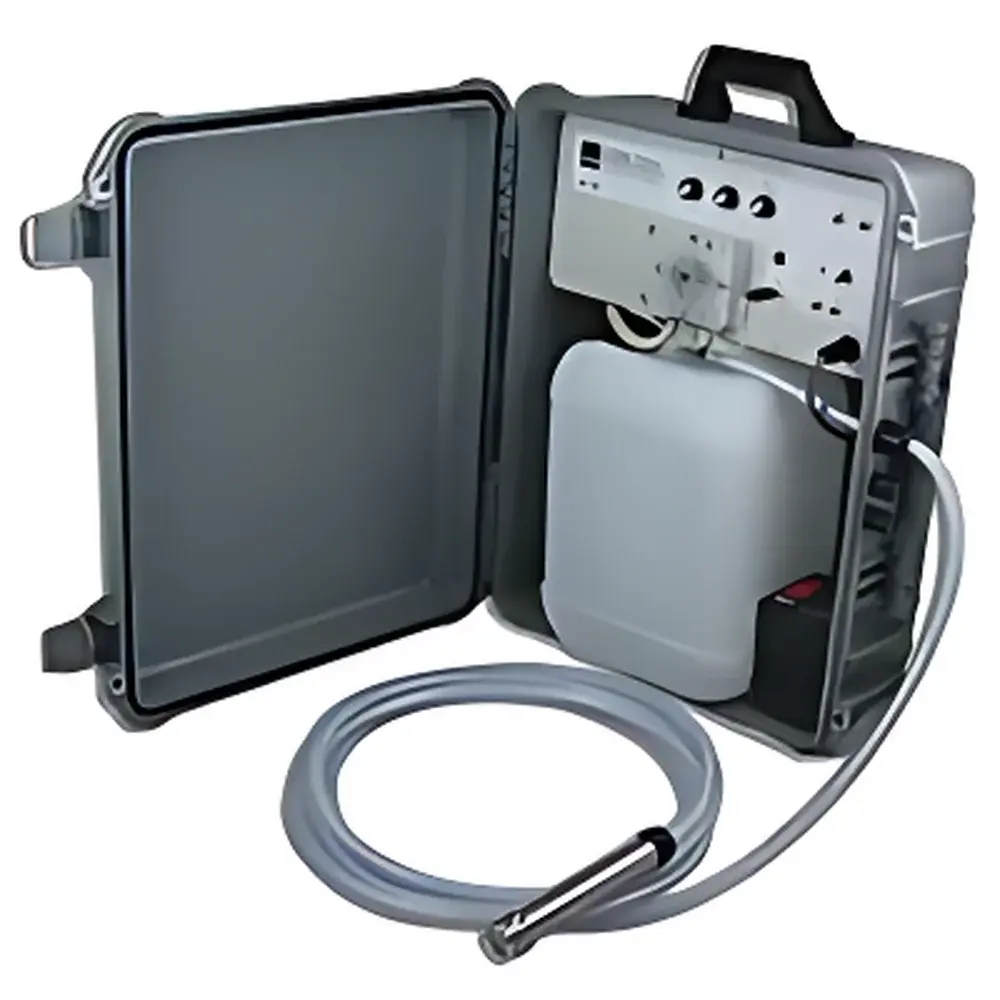
GW WS700 Portable Wastewater Sampler
| Brand | GW |
|---|---|
| Origin | USA |
| Model | WS700 |
| Sampling Pump Type | Peristaltic |
| Max Flow Rate | 1000 mL/min (at 4 ft head) |
| Max Suction Lift | 20 ft (6 m) |
| Operating Temperature | 0–70 °C |
| Enclosure Material | UV-resistant PVC |
| Sample Bottle | 2.5-gallon (9.5 L) polyethylene |
| Sampling Tubing | 4.6 m reinforced PVC-PE composite, ID 1/4″, with inlet filter |
| Pump Tubing | Wear-resistant peristaltic tubing, ID 1/4″, OD 7/16″ |
| Battery | Rechargeable 5 Ah sealed lead-acid, 1 hr continuous operation, 3-month standby |
| Delayed Start | 16 preset intervals (0, 10 min … 12 hr) |
| Sampling Interval | 15 presets (5, 10 min … 12 hr) + external pulse trigger mode |
| Sample Volume | 15 presets (50–2000 mL) + full-bottle mode |
| External Trigger Input | Closure contact or 4–24 VDC pulse, min. width 250 ms |
| Pulse Output | 5 VDC, 1 s duration |
| Bottle Switch Input | Contact closure, integrated float switch |
| Optional Sensors | Rain/water detection (humidity sensor or contact closure) |
| Dimensions | 560 × 430 × 230 mm |
| Weight | 9 kg |
Overview
The GW WS700 Portable Wastewater Sampler is an engineered field-deployable solution for automated, programmable sampling of wastewater, stormwater, industrial effluents, and municipal collection systems. Based on positive-displacement peristaltic pumping technology, it ensures sample integrity by eliminating cross-contamination—no wetted metal parts contact the sample stream. The device operates under variable hydraulic conditions, delivering consistent 1000 mL/min flow at up to 4 ft (1.2 m) static head and maintaining reliable suction lift up to 20 ft (6 m), enabling deployment in deep manholes, lift stations, and elevated discharge points. Its robust UV-stabilized PVC housing and sealed electronics meet IP65-equivalent environmental protection standards, supporting extended unattended operation in outdoor, high-humidity, or temperature-variable settings (0–70 °C). Designed for compliance-driven environments, the WS700 supports time-weighted composite sampling, discrete event-based collection, and flow-proportional sampling—enabling representative integration of dynamic discharge profiles for regulatory reporting under EPA Method 1664, ISO 5667-10, and ASTM D3370.
Key Features
- Peristaltic pump architecture with chemically inert, wear-resistant tubing—eliminates sample carryover and corrosion risk
- Three sampling modes: programmable time-based (interval/delay), volume-triggered discrete collection, and external pulse-synchronized flow-proportional sampling
- Intuitive rotary dial interface—no software programming or PC required; all parameters set manually via tactile controls
- Integrated float-switch bottle detection with full-bottle auto-termination and status feedback
- Dual power options: rechargeable 5 Ah SLA battery (1 hour continuous runtime, 3-month shelf-life in standby) or universal AC adapter (100–240 VAC, 50/60 Hz)
- Pulse output (5 VDC, 1 s) compatible with industry-standard data loggers (e.g., Campbell Scientific CR1000X, Onset HOBO U12) for synchronized metadata tagging
- Modular tubing and filter assembly—field-replaceable 4.6 m reinforced PVC-PE suction line with 1/4″ ID and integrated particulate filter
- Optional rain/water presence detection via humidity sensor or dry-contact input for event-triggered stormwater sampling
Sample Compatibility & Compliance
The WS700 accommodates a broad range of aqueous matrices—including raw sewage, treated effluent, combined sewer overflows (CSOs), industrial process water, and stormwater runoff—with minimal preconditioning. Its 2.5-gallon (9.5 L) FDA-compliant polyethylene sample bottle meets EPA storage requirements for volatile organic analysis (VOA) when used with appropriate preservatives and cold-chain protocols. All wetted components (tubing, filter, bottle) comply with USP Class VI and NSF/ANSI Standard 61 for potable water contact. The instrument’s timing accuracy (±0.5% over 24 hr) and volume repeatability (±2% RSD across 100–2000 mL range) support data defensibility in GLP and GMP-aligned monitoring programs. It satisfies functional requirements outlined in EPA Guidance Document QA/G-5 and aligns with ISO/IEC 17025 clause 7.5.2 for sampling equipment verification.
Software & Data Management
The WS700 operates autonomously without embedded firmware updates or cloud connectivity—ensuring deterministic behavior and audit-trail simplicity. All configuration parameters (delay start, interval, volume, trigger mode) are retained in non-volatile memory during power loss. Pulse output signals provide traceable timestamps for external data loggers, enabling synchronized correlation of flow, rainfall, pH, or turbidity measurements. For laboratories requiring electronic records under FDA 21 CFR Part 11, the device supports integration into validated LIMS workflows via its hardware-level trigger I/O—no software validation burden is imposed on the sampler itself. Calibration logs, maintenance records, and sampling event summaries are maintained externally per laboratory SOPs.
Applications
- Regulatory compliance sampling at NPDES outfalls and POTW influent/effluent points
- Stormwater quality assessment during precipitation events using optional rain sensor input
- Industrial pretreatment program monitoring per 40 CFR Part 403
- Wastewater treatment process optimization—sampling from aeration basins, clarifiers, and disinfection channels
- Sanitary sewer overflow (SSO) characterization and event-response deployment
- Research-grade longitudinal studies requiring high-temporal-resolution composites (e.g., diurnal nutrient cycling)
FAQ
What sampling modes does the WS700 support?
It supports time-proportioned composite sampling, discrete volume-based sampling, and external pulse-triggered flow-proportional sampling.
Can the WS700 be powered solely by battery in remote locations?
Yes—the 5 Ah rechargeable battery provides up to 60 minutes of continuous pumping; low-power standby extends operational readiness to three months.
Is the 2.5-gallon bottle suitable for EPA Method 525.3 (pesticides) analysis?
When used with sodium thiosulfate quenching and chilled transport (<4 °C), the polyethylene bottle meets preservation and container requirements specified in the method.
How is sample contamination prevented between events?
The peristaltic pump isolates the sample path; automatic reverse-flush cycles (configurable) clear residual liquid from the tubing and inlet filter prior to each new sample.
Does the WS700 require annual calibration?
No routine calibration is mandated; however, users should verify flow rate and volume delivery annually against gravimetric or volumetric standards per ISO 5667-10 Annex B.
Related Products







