
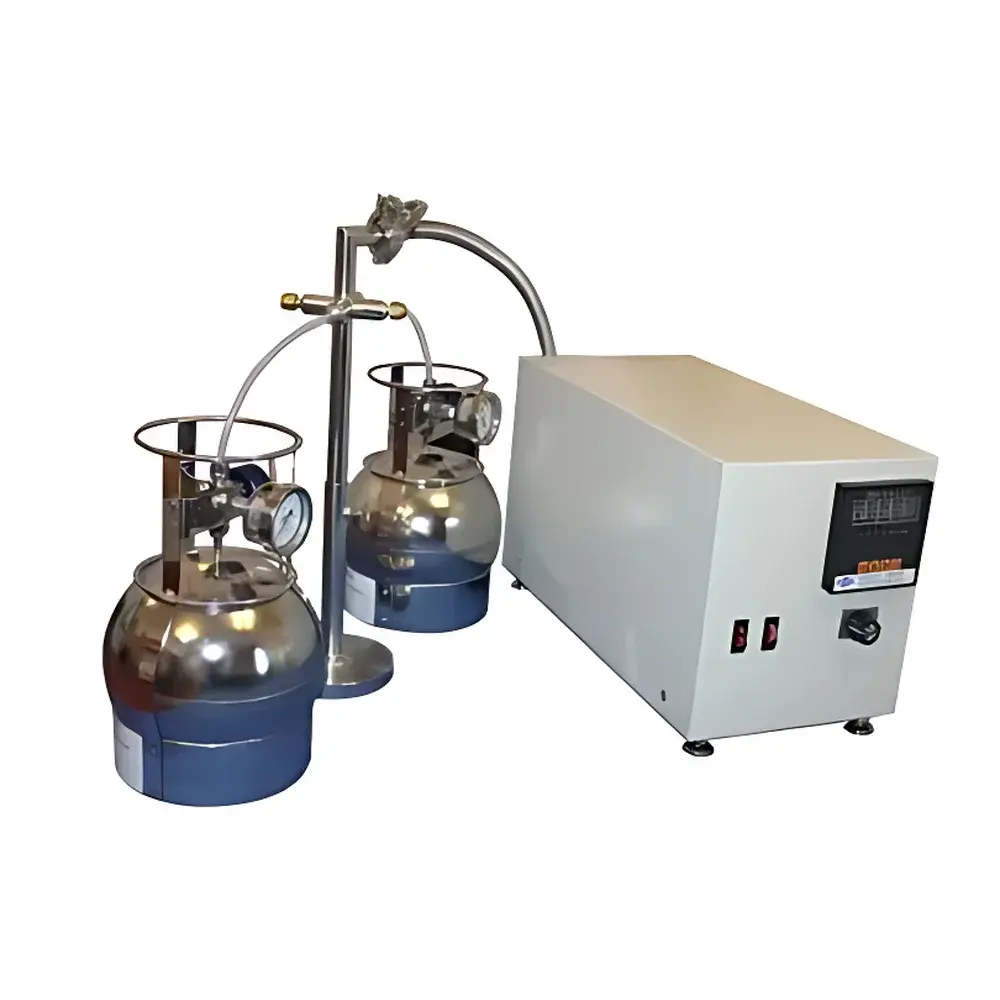
H300 Automated Canister Cleaning System
| Brand | MNK |
|---|---|
| Model | H300 |
| Origin | Beijing, China |
| Manufacturer Type | Authorized Distributor |
| Country of Manufacture | China |
| Canister Capacity | 1–4 (optional upgrade to 8–16) |
| Ultimate Vacuum | ≤ 0.007 mbar (≤ 0.05 torr) |
| Vacuum Pump | Edwards nXDSi 15i Dry Scroll Pump |
| Pump Displacement | 12.7 m³·h⁻¹ |
| Pump Ultimate Suction Speed | 11.4 m³·h⁻¹ |
| Cleaning Mode | Manual or Fully Automated Sequence |
| Optional Feature | Repetitive Thermal Desorption Cleaning Cycle |
Overview
The H300 Automated Canister Cleaning System is an engineered solution for the rigorous decontamination and preparation of electropolished stainless-steel sampling canisters used in ambient air, stack emission, and indoor air quality monitoring. Designed to meet the stringent conditioning requirements of EPA Method TO-14A, TO-15, and ASTM D6196, the system employs a precisely controlled thermal-vacuum cleaning protocol—comprising sequential evacuation, high-purity inert gas purge, and programmable heating—to eliminate residual organic compounds, moisture, and adsorbed contaminants from canister interiors. Its architecture integrates industrial-grade vacuum integrity, calibrated temperature ramping (up to 120 °C), and real-time pressure monitoring to ensure consistent, trace-level cleanliness essential for VOC and SVOC analysis by GC-MS or GC-FID.
Key Features
- Modular canister handling platform supporting 1–4 standard 6-L or 11-L SUMMA®-style canisters per cycle; optional expansion to 8–16 positions for high-throughput laboratory environments.
- Integrated Edwards nXDSi 15i dry scroll vacuum pump delivering ultimate vacuum ≤ 0.007 mbar (≤ 0.05 torr) with zero oil contamination risk—critical for low-part-per-trillion (pptv) background stability.
- Programmable cleaning sequences with user-defined hold times, purge cycles (N₂ or zero-air), and multi-step thermal profiles—including pre-conditioning, main bake-out, and final stabilization phases.
- Dual-mode operation: manual step-by-step control for method development and full automation via embedded microprocessor with password-protected parameter storage and cycle logging.
- Stainless-steel vacuum manifold with VCR fittings, helium-leak-tested to <1×10⁻⁹ mbar·L·s⁻¹, ensuring long-term system integrity and compatibility with EPA-compliant leak-check protocols.
- Front-panel touchscreen interface with real-time graphical display of pressure decay curves, temperature ramps, and elapsed cycle time—enabling immediate verification of cleaning efficacy.
Sample Compatibility & Compliance
The H300 accommodates standard EPA-certified canisters including SilcoCan®, Summa®, and custom electropolished 316L stainless-steel vessels (6 L, 11 L, and 30 L configurations). All cleaning parameters are traceable to NIST-calibrated pressure transducers and PT100 temperature sensors. The system supports GLP/GMP documentation workflows through optional CSV export of cycle logs (timestamp, setpoints, actuals, operator ID). It is fully compatible with regulatory validation frameworks including ISO/IEC 17025:2017 (clause 5.5.2 on equipment qualification) and satisfies the preconditioning requirements outlined in US EPA Compendium Method TO-15 Appendix B and ASTM D6196-22 Section 7.2.
Software & Data Management
The embedded firmware provides non-volatile storage for ≥1,000 completed cleaning cycles with full audit trail capability—including date/time stamp, operator login, selected program ID, vacuum curve snapshots, and pass/fail status per canister. Optional Ethernet connectivity enables remote monitoring via secure HTTP interface and integration into LIMS environments using RESTful API endpoints. All data exports comply with FDA 21 CFR Part 11 requirements when paired with validated electronic signature modules and role-based access control (RBAC) configuration.
Applications
- Preparation of canisters prior to field deployment in ambient VOC monitoring networks (e.g., Photochemical Assessment Monitoring Stations – PAMS).
- Reconditioning of returned canisters in central analytical laboratories performing compliance testing under 40 CFR Part 63 and EU Directive 2004/107/EC.
- Method validation studies requiring documented blank performance at sub-pptv levels for carbonyls, halocarbons, and oxygenated VOCs.
- Support of reference material certification programs where certified canister blanks serve as matrix-matched calibration standards.
- Research applications involving reactive species (e.g., isoprene, NOₓ-adducts) demanding ultra-low background integrity and thermal stability verification.
FAQ
What vacuum level is required to meet EPA TO-15 specifications for canister cleaning?
EPA TO-15 requires conditioning to ≤ 0.01 mbar; the H300 achieves ≤ 0.007 mbar, exceeding this threshold with margin for aging and altitude compensation.
Can the H300 be validated for GMP-regulated environmental testing labs?
Yes—when deployed with IQ/OQ documentation packages and configured with audit-trail-enabled firmware, it fulfills equipment qualification requirements under Annex 11 and ISO 17025 clause 5.5.2.
Is the Edwards pump serviceable on-site, and what is its typical maintenance interval?
The nXDSi 15i dry scroll pump requires no oil changes; scheduled maintenance includes filter replacement every 6 months and scroll inspection every 2 years—both supported by MNK-certified field service engineers.
Does the system support custom cleaning protocols beyond the factory presets?
Yes—users may define up to 32 unique programs with variable temperature ramps, dwell times, purge gas flow rates, and vacuum hold durations via the intuitive touchscreen editor.
How is leak integrity verified during and after each cleaning cycle?
The system performs automated pressure-rise tests (PRT) post-evacuation, calculating leak rate in mbar·L·s⁻¹; results are logged and compared against user-defined acceptance criteria (default: <5×10⁻⁸ mbar·L·s⁻¹).







