
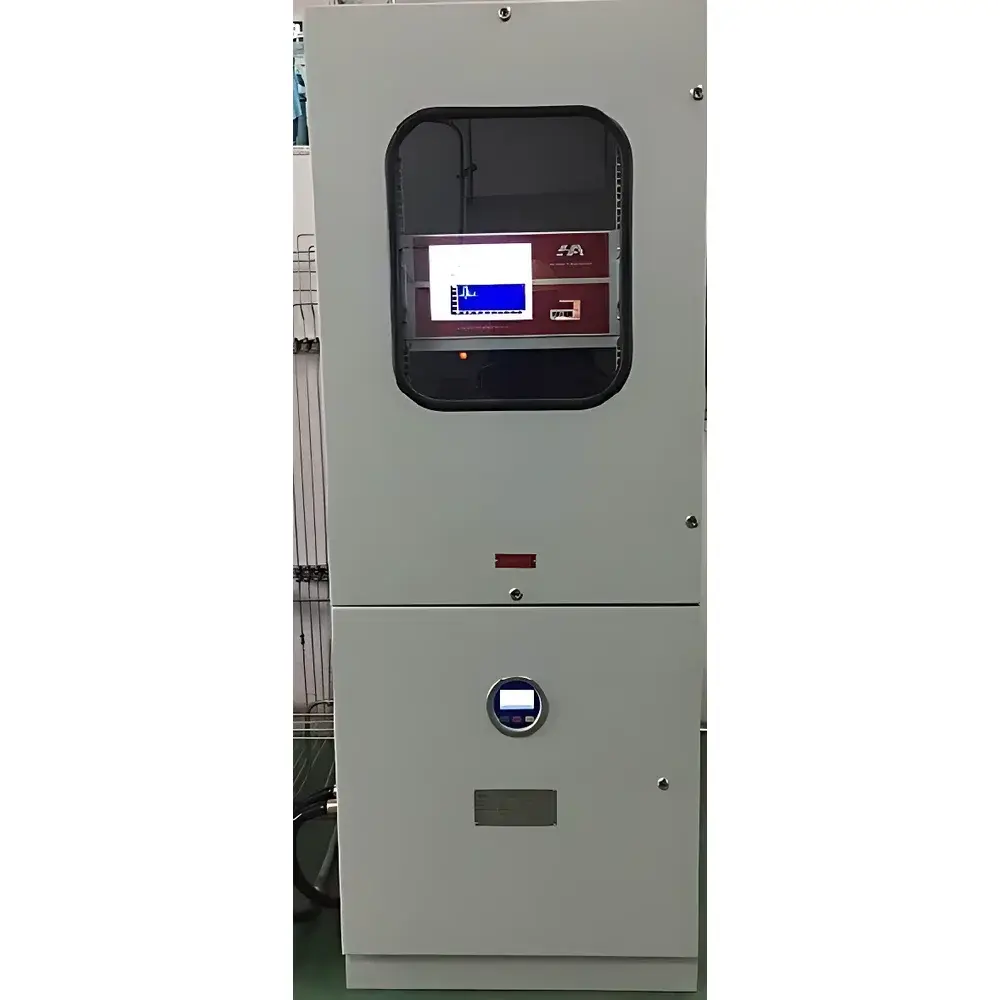
HA-9660-VOCs Continuous Emission Monitoring System (CEMS)
| Brand | Huaai |
|---|---|
| Origin | Shanghai, China |
| Manufacturer Type | OEM Manufacturer |
| Model | HA-9660-VOCs |
| Pricing | Upon Request |
| Compliance | HJ 1013–2018, HJ 1010–2018, HJ 1012–2018, GB 16297–1996, DB32/2862–2016, GB 18580–2017, HJ/T 400–2007 |
| Detection Principle | Gas Chromatography with FID/TCD/PDD Detectors |
| Sample Throughput | 50 mL/min |
| Carrier Gas | N₂/H₂/Ar/He (150 mL/min, 0.4 MPa) |
| Analysis Cycle | ≤2 min |
| LOD (NMHC) | ≤0.8 mg/m³ (≈0.13 µmol/mol) |
| Repeatability (RSD) | ≤2% |
| Linearity Error | ±2% F.S. |
| 24-h Drift | ±3% F.S. |
| Power | AC 220 V, 50–60 Hz, 400 W |
| Dimensions | 482 mm (W) × 222 mm (H) × 400 mm (D), 5U Rack-Mountable |
| Weight | 20 kg |
| Data Interface | RS-232/RS-485, Modbus RTU |
Overview
The HA-9660-VOCs Continuous Emission Monitoring System (CEMS) is an industrial-grade, rack-mounted gas chromatographic analyzer engineered for unattended, real-time quantification of volatile organic compounds (VOCs) and non-methane hydrocarbons (NMHC) in fixed-source exhaust streams. It operates on the principle of separation by capillary or packed column gas chromatography (GC), coupled with selective detection via flame ionization (FID), thermal conductivity (TCD), or pulsed discharge helium ionization (PDD) — enabling trace-level measurement across a broad spectrum of target analytes including benzene, toluene, xylene (BTX), formaldehyde, acetaldehyde, acrylonitrile, methanol, anilines, chlorobenzenes, nitrobenzenes, vinyl chloride, and total volatile organic compounds (TVOCs). Designed in strict conformance with Chinese environmental regulatory standards — notably HJ 1013–2018 (NMHC-CEMS technical requirements), HJ 1010–2018 (ambient air VOCs GC-CEMS), and HJ 1012–2018 (portable NMHC analyzers) — the system delivers high reproducibility and long-term stability under fluctuating field conditions, including variable inlet pressure, ambient temperature shifts (±5% F.S. impact tolerance), and ±10% mains voltage deviation.
Key Features
- Embedded industrial control computer with Linux-based firmware for autonomous operation, local data logging, and remote diagnostics via serial interface.
- Dual-stage electronic mass flow control for both sample gas (50 mL/min at 0.1 MPa) and carrier gas (150 mL/min at 0.4 MPa), ensuring precise retention time stability and quantitative accuracy.
- Multi-detector compatibility: configurable FID (detection limit ≤8×10⁻¹² g/s for n-hexadecane), TCD (sensitivity ≥1×10⁻¹⁰ g/mL), and PDD (detection limit ≤0.1 nmol/mol) — selectable per application requirements.
- High-precision oven architecture: column oven and detector zones independently controlled from ambient +8 °C to 400 °C (FID/TCD/Ni-catalyst furnace) or 350 °C (PDD), with temperature uniformity ±0.1 °C and programmable 8-step ramping (1–40 °C/min).
- Rack-integrated 5U mechanical design (482×222×400 mm), stainless steel Swagelok fittings (¼″ for sample, ⅛″ for carrier), LED status display, and 400 W power consumption optimized for continuous 24/7 deployment.
- Compliant analog/digital signal outputs and dual RS-232/RS-485 ports supporting Modbus RTU protocol for integration into DCS, SCADA, or EMS platforms.
Sample Compatibility & Compliance
The HA-9660-VOCs CEMS is validated for gaseous matrices from stationary emission sources such as coating lines, chemical synthesis reactors, printing facilities, and automotive paint booths. It meets mandatory performance criteria defined in HJ 1013–2018 for NMHC-CEMS, including analysis cycle ≤2 minutes, instrument detection limit ≤0.8 mg/m³ (equivalent to ~0.13 µmol/mol), repeatability ≤2% RSD, linearity error ±2% F.S., and 24-hour zero/span drift ≤±3% F.S. The system satisfies parallelism requirements (<5% deviation between duplicate channels), conversion efficiency ≥95% for catalytic oxidation of NMHC, and immunity to O₂ interference (±2% F.S. effect). It further aligns with GB 16297–1996 (Comprehensive Emission Standard for Air Pollutants), DB32/2862–2016 (VOCs limits for auto manufacturing), GB 18580–2017 (formaldehyde in wood-based panels), and HJ/T 400–2007 (in-vehicle VOC sampling methodology). All calibration, validation, and maintenance procedures are documented to support GLP-compliant audit trails.
Software & Data Management
Data acquisition and reporting are managed through embedded firmware with timestamped raw chromatograms, peak integration parameters, and calibrated concentration outputs stored locally on internal flash memory (≥30 days at 1-min intervals). The system supports automated zero/span checks, multi-point calibration curves (linear or quadratic), and user-defined alarm thresholds for exceedance events. Export formats include CSV and XML for ingestion into enterprise environmental data management systems. While native cloud connectivity is not integrated, the Modbus interface enables seamless mapping of real-time measurements (e.g., NMHC, CH₄, TVOC, individual aromatics) into third-party historian databases compliant with ISO 50001 or EPA Method 25A workflows. Audit logs record all operator actions, calibration events, and system faults — satisfying basic requirements for data integrity under China’s MEP supervision framework.
Applications
- Continuous compliance monitoring of VOC emissions from surface coating operations in automotive and aerospace manufacturing.
- Real-time tracking of NMHC breakthrough in activated carbon or regenerative thermal oxidizer (RTO) exhaust stacks.
- Quality assurance of solvent recovery units by measuring residual acetone, MEK, or toluene concentrations pre- and post-treatment.
- Verification of abatement efficiency in plasma or photocatalytic oxidation systems treating formaldehyde and aldehydes.
- Supporting environmental impact assessments (EIA) and permit renewal documentation under China’s “Blue Sky Defense Campaign” regulatory enforcement regime.
FAQ
What regulatory standards does the HA-9660-VOCs CEMS formally comply with?
It is designed and verified to meet HJ 1013–2018 (fixed-source NMHC-CEMS), HJ 1010–2018 (ambient air VOCs GC-CEMS), HJ 1012–2018 (portable NMHC), GB 16297–1996, DB32/2862–2016, and GB 18580–2017.
Can the system quantify individual VOC species, or only total NMHC?
Yes — when configured with appropriate GC columns (e.g., DB-VRX, HP-PONA) and FID/PDD detection, it resolves and quantifies >30 priority VOCs specified in HJ 1010–2018, including benzene, toluene, ethylbenzene, xylenes, styrene, and C2–C12 aliphatics.
Is the analyzer suitable for high-humidity or particulate-laden flue gas?
The system requires upstream conditioning — including heated sample probe, PTFE membrane filtration, and permeation dryer — to maintain dew point 1 µm; direct installation into raw stack gas is not recommended.
Does the HA-9660-VOCs support remote calibration and diagnostics?
Remote zero/span verification is possible via Modbus command; however, physical standard gas introduction and detector optimization require on-site technician intervention.
What is the typical service interval and consumables requirement?
Carrier gas filters and septa should be replaced every 3 months; GC columns every 12–18 months depending on matrix cleanliness; FID jet cleaning and electrode inspection recommended quarterly.
Related Products







