
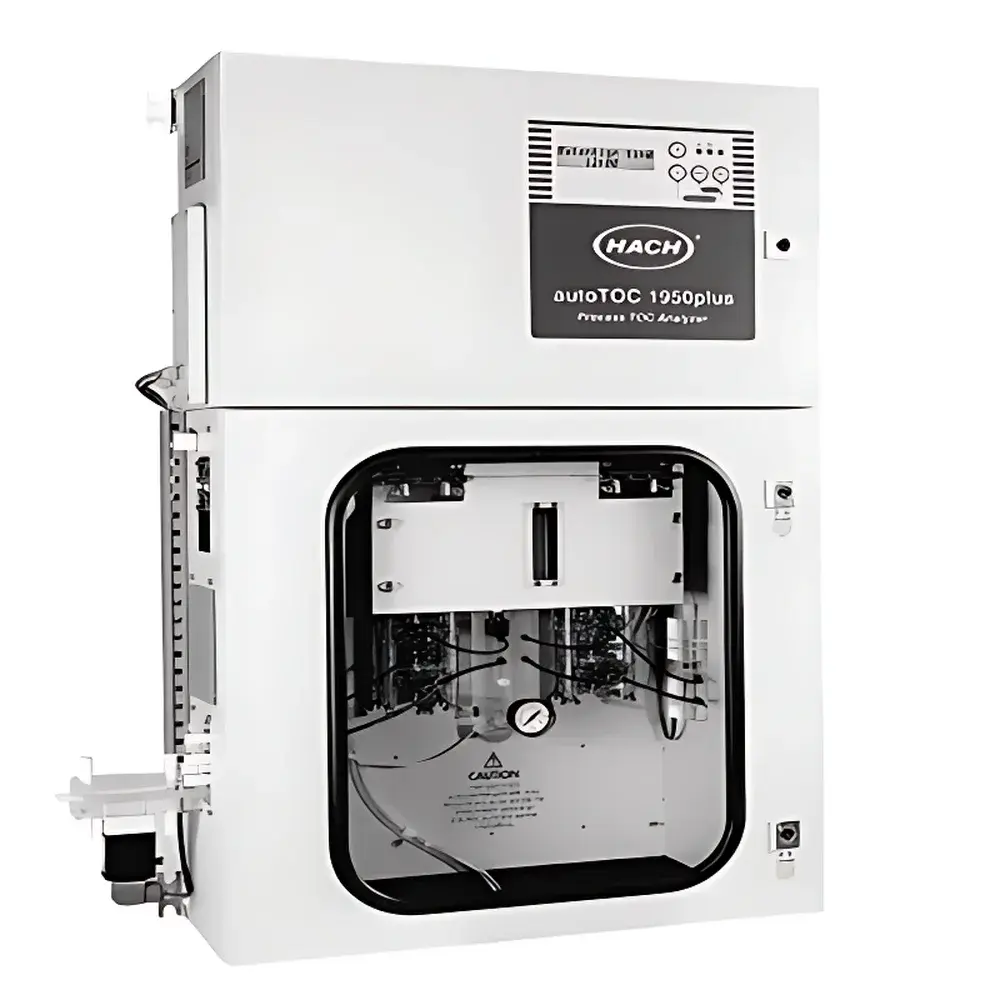
HACH 1950Plus Total Organic Carbon Analyzer
| Brand | HACH |
|---|---|
| Origin | Imported |
| Manufacturer Status | Manufacturer |
| Instrument Type | Online TOC Analyzer |
| Oxidation Method | UV/Persulfate |
| Measurement Principle | NDIR Detection of CO₂ after Acidification and Catalytic Oxidation |
| Measurement Range | 0–5 mg/L to 0–20,000 mg/L (multi-range) |
| Accuracy | ±2% of reading (non-diluted), ±4% (diluted) |
| Detection Limit | ≤0.015 mg/L at 25°C (0–5 mg/L range) |
| Response Time | T₉₀ ≤ 8 min, T₂₀ ≤ 3 min |
| Sample Pressure | 0.15–6 bar (2–87 psig) |
| Flow Rate | 25–200 mL/min |
| Operating Temperature | 2–70°C (sample), 5–40°C (ambient) |
| Humidity | ≤80% RH at 31°C |
| Communication | RS232/RS485 (optional) |
| Analog Output | Dual 4–20 mA |
| Power Supply | 115/230 VAC, 50/60 Hz |
| Dimensions | 981 × 675 × 20 mm |
| Weight | 54 kg |
| Compliance | USEPA Method 415.1, Standard Methods 5310C, ISO 8027 |
Overview
The HACH 1950Plus Total Organic Carbon (TOC) Analyzer is a robust, online analytical instrument engineered for continuous, real-time monitoring of organic carbon content in municipal drinking water distribution systems and treatment plant effluents. It operates on the fundamental principle of catalytic oxidation followed by non-dispersive infrared (NDIR) detection—a method validated under internationally recognized regulatory frameworks including USEPA Method 415.1, Standard Methods 5310C, and ISO 8027. The analyzer employs a two-stage oxidation protocol: first, acidification and sparging remove inorganic carbon (TIC) as CO₂; second, UV-activated persulfate oxidation converts all remaining organic carbon species quantitatively into CO₂. The liberated CO₂ is then swept by carrier gas (air or nitrogen, conditioned via integrated gas purifier) through a high-stability NDIR detector, enabling precise, interference-resistant quantification across a broad dynamic range.
Key Features
- Automated multi-point calibration and system verification with onboard reagent management
- Integrated auto-dilution capability for seamless handling of samples exceeding upper measurement limits—ensuring full-range linearity without manual intervention
- Dual-channel sampling architecture supporting simultaneous analysis of primary and backup streams or parallel process points
- Programmable discrete grab sampling mode for compliance verification, validation studies, or troubleshooting
- Comprehensive self-diagnostic suite with real-time status reporting for critical consumables: sample flow interruption, reagent depletion, carrier gas failure, and wash solution exhaustion
- Modular hardware design with field-replaceable oxidizer modules, NDIR cells, and fluidic manifolds—minimizing downtime during routine maintenance or component replacement
- Robust environmental rating suitable for deployment in utility control rooms, pump stations, and outdoor kiosks with climate-controlled enclosures
Sample Compatibility & Compliance
The 1950Plus is optimized for low-conductivity, low-particulate aqueous matrices typical of finished drinking water, filtered surface water, and membrane-treated effluents. It accommodates variable inlet pressures (0.15–6 bar) and flow rates (25–200 mL/min), making it compatible with standard municipal sampling skids and pressure-regulated sidestreams. Its methodological alignment with USEPA 415.1 ensures data defensibility for regulatory reporting under the U.S. Safe Drinking Water Act (SDWA). The system supports audit-ready operation through configurable event logging—including calibration history, alarm triggers, and maintenance timestamps—consistent with GLP and GMP documentation requirements. While not inherently 21 CFR Part 11 compliant out-of-the-box, its digital I/O architecture permits integration with validated LIMS or SCADA platforms that enforce electronic signature and data integrity controls.
Software & Data Management
Control and configuration are managed via an embedded web interface accessible over local Ethernet, eliminating dependency on proprietary PC software. All operational parameters—including measurement range selection, dilution factor, calibration frequency, and alarm thresholds—are programmable through intuitive HTML5 forms. Raw NDIR absorbance values, calculated TOC concentrations, and diagnostic flags are timestamped and exportable via RS232/RS485 serial protocols using Modbus RTU or ASCII command sets. Dual isolated 4–20 mA analog outputs provide direct connectivity to DCS or PLC systems for trend visualization and automated process feedback loops. Data retention includes 30 days of high-resolution operational logs stored in non-volatile memory, with optional external storage via USB or network share for long-term archiving.
Applications
- Real-time TOC monitoring at drinking water treatment plant final effluent points to verify disinfection byproduct (DBP) precursor removal efficiency
- Performance validation of advanced oxidation processes (AOP), activated carbon adsorption, and nanofiltration membranes
- Source water quality trending in reservoirs and groundwater wells to support watershed protection initiatives
- Regulatory compliance reporting for utilities subject to EPA Stage 2 Disinfectants and Disinfection Byproducts Rule (Stage 2 DBPR)
- Supporting ISO 22000 and NSF/ANSI 61 certification audits through traceable, method-validated measurements
- Research applications requiring high-frequency TOC profiling in pilot-scale treatment studies
FAQ
What carrier gases are compatible with the 1950Plus?
Nitrogen (≥99.998% purity) or compressed air (oil-free, dew point ≤ –40°C) may be used—both require conditioning through the factory-supplied gas purifier to remove CO₂ and moisture.
Does the analyzer require daily operator intervention?
No—fully unattended operation is supported for up to 30 days with standard reagent packs; scheduled maintenance intervals are defined by usage volume and regulatory requirements.
Can the 1950Plus measure TOC in wastewater or seawater?
It is not recommended for high-salinity, high-TDS, or highly turbid matrices without pretreatment; its design targets potable water applications per Standard Methods 5310C.
How is accuracy verified during routine operation?
Through periodic bracketing with certified TOC standards (e.g., potassium hydrogen phthalate), system blank checks, and automated zero/scale verifications triggered before each measurement cycle.
Is remote firmware update supported?
Yes—firmware upgrades can be deployed securely via HTTPS-connected web interface using signed .bin files, with rollback capability and version-locked configuration preservation.
Related Products







