
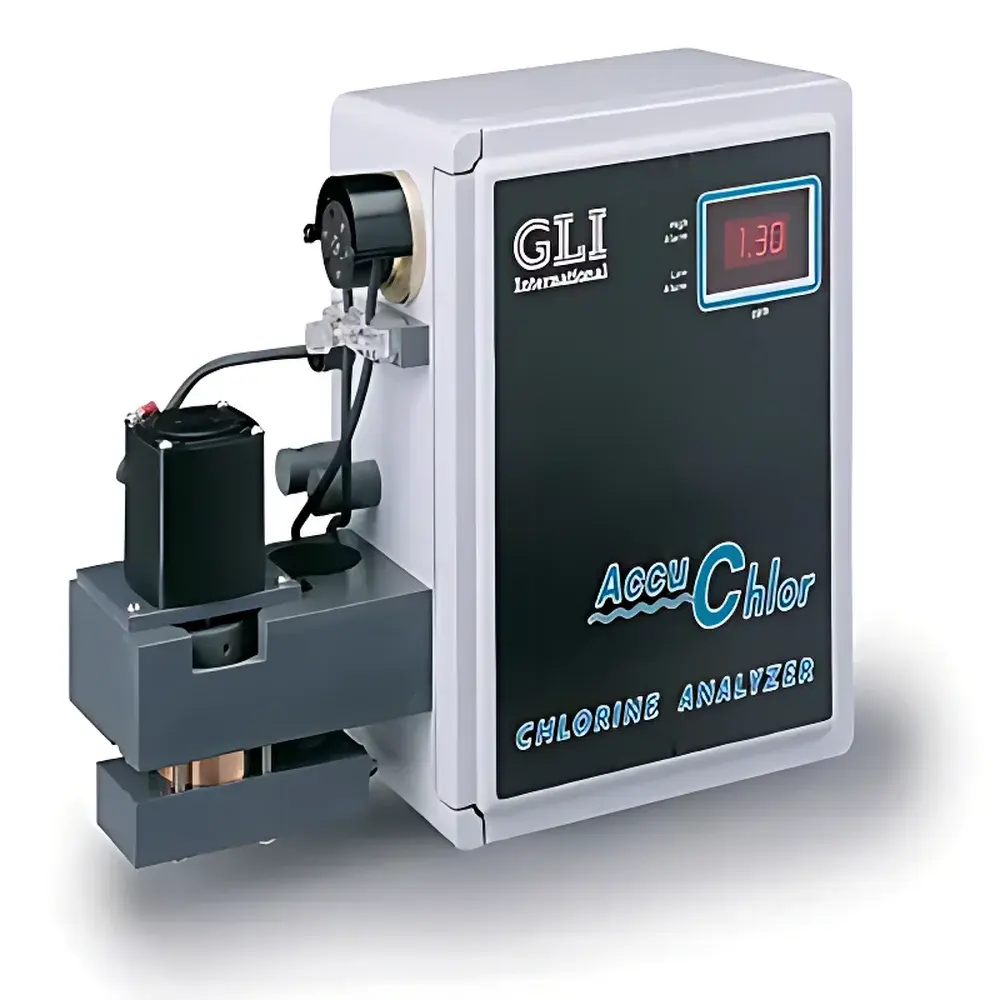
HACH AccuChlor2 Online Residual and Total Chlorine Analyzer
| Brand | HACH |
|---|---|
| Origin | Imported |
| Manufacturer Type | Manufacturer |
| Model | AccuChlor2 |
| Instrument Type | Online Analyzer |
| Measurement Principle | Amperometric Electrochemical Sensor Method |
| Measured Parameters | Residual Chlorine (Free & Total) |
| Sample Temperature Range | 0–49 °C |
| Flow Rate | 150–600 mL/min (recommended: 500 mL/min) |
| Sample pH Range | 3.0–10.0 |
| Sample Alkalinity Range | 0.05–300 mg/L as CaCO₃ |
| Sample Turbidity Limit | < 252 NTU |
| Electrode Materials | Cathode – Gold |
| Buffer Solution | For Free Chlorine – distilled 5% food-grade white vinegar |
| Display | Graphical dot-matrix LCD (128 × 64 pixels), LED backlight, character height up to 13 mm |
| Measurement Range | Auto-ranging: 0–60.0 mg/L |
| Resolution | 0.001 mg/L (0–9.999 mg/L), 0.01 mg/L (10.0–60.0 mg/L) |
| Fixed-range mode | 0–60.0 mg/L, resolution 0.01 mg/L |
| Relay Outputs | 3 electromechanical relays |
| Analog Outputs | Two independent 4–20 mA outputs |
| Power Supply | 230 VAC ±10%, 50 Hz |
| Accuracy | ±0.1% of full scale |
| Sensitivity | ±0.05% of full scale |
| Repeatability | ±0.05% of full scale |
| Enclosure Rating | NEMA 4X / IP65 |
Overview
The HACH AccuChlor2 Online Residual and Total Chlorine Analyzer is an amperometric electrochemical measurement system engineered for continuous, real-time monitoring of free chlorine and total chlorine concentrations in potable water, wastewater, and industrial cooling water applications. It operates on a well-established current-generation principle: two dissimilar metal electrodes—gold (cathode) and copper (anode)—are immersed in a buffered sample stream. When chlorine species are present, they undergo reduction at the gold surface, generating a measurable current proportional to the active chlorine concentration. This amperometric response is inherently stable, linear over wide concentration ranges, and unaffected by common interferences such as color or turbidity (within specified limits). The analyzer integrates sample conditioning, reaction control, and signal processing into a single compact platform, eliminating the need for external reagent dosing pumps or complex auxiliary hardware. Its design complies with U.S. EPA Method 334.0 for amperometric residual chlorine measurement, supporting regulatory reporting requirements in drinking water utilities and municipal treatment facilities.
Key Features
- EPA-compliant amperometric detection for both free and total chlorine—no colorimetric reagents or photometric optics required
- Integrated, self-contained measurement cell with gold/copper electrode pair and passive overflow weir for precise flow control (150–600 mL/min)
- Onboard buffer delivery system using low-cost, food-grade distilled white vinegar (5%)—for free chlorine; supplemented with potassium iodide for total chlorine conversion
- Automatic range selection (0–60.0 mg/L) with dual-resolution output: 0.001 mg/L below 10 mg/L, 0.01 mg/L above—optimized for both trace-level disinfection control and high-dose process monitoring
- NEMA 4X/IP65-rated enclosure suitable for outdoor or wet industrial environments, including pump stations and chlorination contact tanks
- Low-maintenance architecture featuring self-cleaning sample chamber and extended electrode service intervals—typically >6 months between calibrations under normal operation
- Two isolated 4–20 mA analog outputs assignable to free chlorine, total chlorine, or diagnostic signals (e.g., flow fault, low buffer level)
Sample Compatibility & Compliance
The AccuChlor2 accommodates a broad operational envelope: samples from 0 to 49 °C, pH 3.0–10.0, alkalinity 0.05–300 mg/L as CaCO₃, and turbidity up to 252 NTU. Its electrochemical sensing mechanism ensures immunity to optical interference, making it robust in applications where spectrophotometric analyzers fail—such as highly colored wastewater effluents or iron-rich groundwater. Buffer chemistry is intentionally simplified and non-hazardous, reducing regulatory burden associated with chemical handling and disposal. The system supports GLP-compliant data integrity through timestamped event logging (relay actuations, calibration events, sensor faults) and meets foundational requirements for FDA 21 CFR Part 11 readiness when deployed with HACH’s compatible SCADA integration modules. It is widely deployed in facilities subject to Safe Drinking Water Act (SDWA) compliance and ISO 24510/24511 frameworks for water service management.
Software & Data Management
The AccuChlor2 features an embedded microprocessor with non-volatile memory for storing configuration parameters, calibration history, and up to 30 days of 1-minute interval trend data. Local interface includes a backlit graphical LCD (128 × 64 pixels) with intuitive menu navigation and real-time display of measured values, status icons, and diagnostic alerts. Remote access is supported via Modbus RTU (RS-485) or optional Ethernet/IP protocol adapters, enabling seamless integration into plant-wide DCS or SCADA systems. All analog and digital outputs are fully configurable—including alarm hysteresis, relay latching behavior, and mA scaling—without requiring firmware updates. Audit trails record user-initiated actions (e.g., zero/span calibration, range change) with operator ID and timestamp, satisfying basic GMP documentation expectations for routine water quality monitoring.
Applications
- Real-time chlorine residual control at drinking water treatment plant clearwells and distribution system entry points
- Disinfection validation in wastewater reuse facilities complying with Title 22 or similar reclaimed water standards
- Process optimization of chlorine dosing in HVAC cooling towers to maintain biocide efficacy while minimizing corrosion risk
- Monitoring of chlorine decay kinetics in pilot-scale membrane filtration studies
- Regulatory compliance reporting for state primacy agencies requiring continuous chlorine data submission
- Integration into automated feed-forward/feed-back control loops with chlorine gas or sodium hypochlorite dosing systems
FAQ
Does the AccuChlor2 require daily maintenance or frequent recalibration?
No. Under typical municipal water conditions, calibration is recommended every 4–8 weeks. Electrode cleaning is rarely needed due to the self-rinsing flow path and vinegar-based buffering, which inhibits oxide buildup and biofilm formation.
Can the analyzer distinguish between free chlorine and total chlorine without hardware modification?
Yes. A single instrument measures both parameters by switching between two pre-programmed analysis modes: one using only vinegar buffer (free chlorine), and another adding potassium iodide to convert combined chlorine species (total chlorine).
Is the 4–20 mA output intrinsically safe for hazardous area installation?
The standard output is non-intrinsically safe. For Class I, Div 1 or ATEX Zone 1 environments, HACH recommends coupling the analyzer with an approved galvanic isolator or barrier module certified to IECEx/UL standards.
What happens if sample flow drops below 150 mL/min?
The unit triggers a flow fault alarm and holds the last valid reading. Continuous low-flow operation may cause drift due to insufficient electrode renewal—system logic enforces minimum residence time in the measurement chamber for reliable amperometric response.
Are replacement electrodes field-serviceable?
Yes. Gold and copper electrodes are user-replaceable as a matched pair using standard Torx tools. No soldering or factory recalibration is required; the analyzer auto-detects electrode type and applies stored sensitivity coefficients.







