
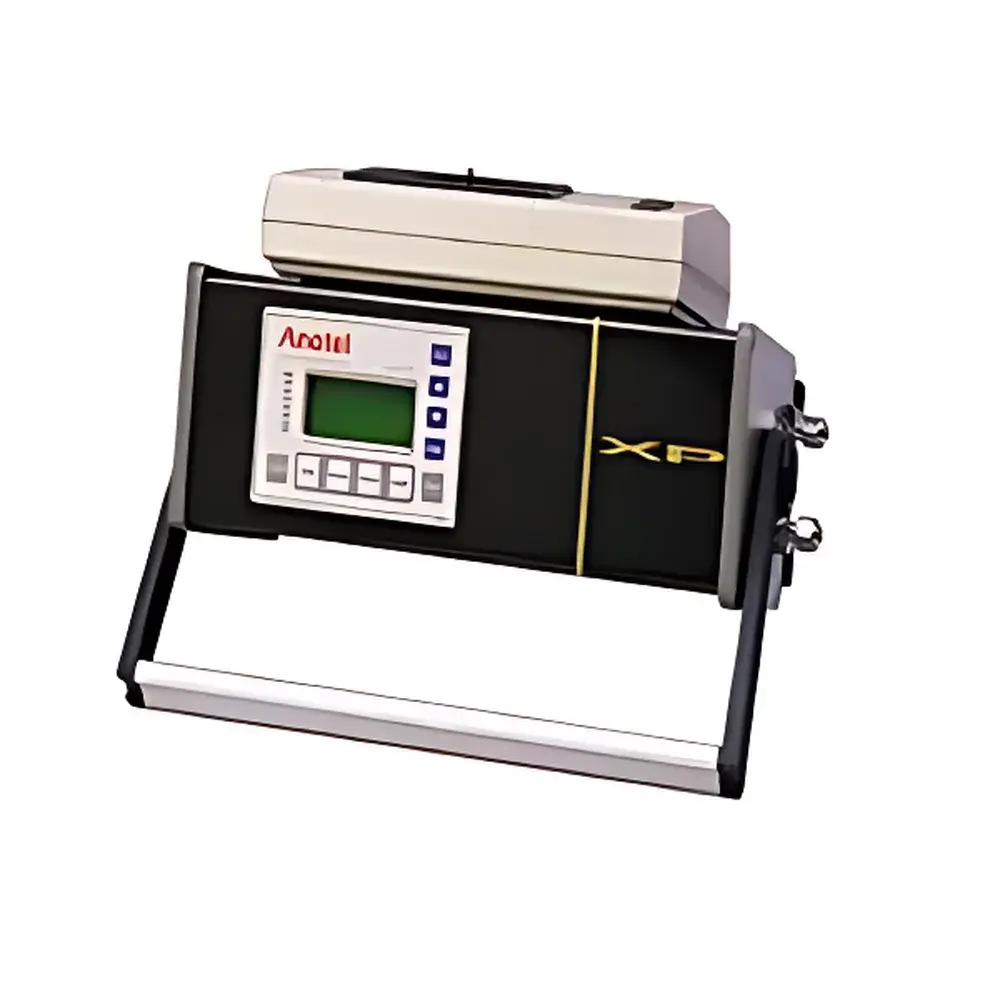
HACH Anatel A-1000XP Online Total Organic Carbon (TOC) Analyzer
| Brand | HACH |
|---|---|
| Origin | Imported |
| Manufacturer Type | Manufacturer |
| Instrument Type | Online TOC Analyzer |
| Model | A-1000XP |
| Detection Principle | Direct Conductivity Measurement |
| Oxidation Method | UV Photolysis (185/254 nm) |
| Measurement Range | 0.05–1999 ppb C |
| Accuracy | ±0.05 ppb (MDL to 0.999 ppb) |
| Detection Limit | 0.02 ppb C |
| Conductivity Cell Temperature Control | ±0.01 °C |
| Inlet Water Resistivity Requirement (Auto Mode) | 15.0–18.2 MΩ·cm |
| Inlet Conductivity Range (Clean Mode) | 0.05–100 µS/cm |
| Max Inlet Pressure | 100 psig (690 kPa) |
| Display Resolution | 0.001 ppb C |
| Communication Interfaces | RS-232 (local printing), RS-485 (modbus RTU, up to 1200 m) |
Overview
The HACH Anatel A-1000XP Online Total Organic Carbon (TOC) Analyzer is an engineered solution for real-time, ultra-trace organic carbon monitoring in high-purity and ultrapure water systems. Designed specifically for critical applications in semiconductor fabrication, pharmaceutical water-for-injection (WFI) distribution loops, and biotechnology clean utilities, the A-1000XP employs direct conductivity detection following low-energy ultraviolet (UV) photolysis at dual wavelengths (185 nm and 254 nm). This oxidation method converts non-conductive organic molecules into CO2, which dissolves to form carbonic acid and increases solution conductivity proportionally to the carbon concentration. Unlike NDIR-based systems, the direct conductivity architecture eliminates optical path drift, calibration gas dependency, and membrane fouling—delivering stable baseline performance with minimal maintenance overhead. The analyzer operates continuously without reagents or consumables beyond standard calibration standards, supporting unattended 24/7 operation in GMP-compliant environments.
Key Features
- Ultra-low detection capability: validated limit of detection (LOD) of 0.02 ppb C, with display resolution down to 0.001 ppb C for precise trend analysis of sub-part-per-trillion fluctuations
- Dual-mode operation: Auto mode optimized for ultrapure water (15.0–18.2 MΩ·cm resistivity) and Clean mode enabling robust measurement across broader conductivity ranges (0.05–100 µS/cm), facilitating system qualification and recovery validation
- Thermally stabilized conductivity cell with ±0.01 °C temperature control ensures metrological consistency under variable ambient conditions
- Integrated pressure regulation and flow optimization for inlet pressures up to 100 psig (690 kPa), compatible with pressurized distribution loops without external back-pressure valves
- Modular communication architecture supporting RS-232 for local thermal printing and RS-485 (Modbus RTU) for integration into SCADA, DCS, or MES platforms over distances up to 1200 meters
- Compliant with ASTM D5997, USP , EP 2.2.44, and ISO 8573-7 for TOC measurement in purified water and WFI systems
Sample Compatibility & Compliance
The A-1000XP is validated for continuous online analysis of Type I ultrapure water per ISO 3696 and ASTM D1193, as well as pharmacopeial-grade Purified Water (PW) and Water for Injection (WFI). Its oxidation efficiency exceeds 95% for common low-molecular-weight organics (e.g., methanol, acetone, formaldehyde) and maintains linearity across the full 0.05–1999 ppb range per ICH Q5C guidance. System design adheres to FDA 21 CFR Part 11 requirements for electronic records and signatures when paired with compliant LIMS or data acquisition software. Audit trail functionality—including operator ID, method version, calibration history, and event timestamps—is fully configurable and exportable in CSV format for regulatory review. All wetted materials meet USP Class VI biocompatibility and 3-A Sanitary Standards for hygienic process interfaces.
Software & Data Management
The embedded firmware supports configurable data logging intervals (1 second to 24 hours), automatic zero/scale verification cycles, and user-defined alarm thresholds with relay outputs for process interlocks. Raw conductivity and temperature values are retained alongside calculated TOC results, enabling retrospective root-cause analysis. When integrated via RS-485 into enterprise systems, the analyzer transmits timestamped data packets containing measurement status flags (e.g., “oxidation complete”, “cell out-of-range”, “calibration due”) to support automated deviation management per ALCOA+ principles. Optional C80 Controller enables centralized supervision of up to eight A-1000XP units, providing synchronized calibration scheduling, cross-unit trending, and consolidated report generation aligned with ISO/IEC 17025 documentation requirements.
Applications
- Semiconductor fab UPW main distribution loops and point-of-use monitoring for particle-sensitive lithography tools
- Pharmaceutical WFI storage and distribution systems requiring continuous compliance with EU GMP Annex 1 and FDA Aseptic Guidance
- Biotech upstream purification skids where TOC excursions may indicate resin leaching or cleaning agent carryover
- Power generation condensate polishing systems monitoring for organic degradation products from turbine oil or amine treatment
- Research laboratories validating deionization performance and evaluating new membrane or electrodeionization technologies
FAQ
What sample conductivity range is supported in Clean Mode?
The A-1000XP accepts inlet water with conductivity between 0.05 µS/cm and 100 µS/cm during Clean Mode operation—enabling verification of system sanitization efficacy and post-purge residual organics assessment.
Is UV lamp lifetime monitored internally?
Yes. The instrument tracks cumulative UV exposure time and triggers a service alert when lamp output falls below 85% of initial intensity, ensuring consistent oxidation efficiency per USP validation criteria.
Can the A-1000XP be used for wastewater or industrial effluent?
No. This analyzer is purpose-built for ultrapure and purified water matrices. For higher-concentration samples (>2 ppm TOC), offline laboratory analyzers with catalytic combustion or high-intensity UV/persulfate oxidation are recommended.
Does the system require daily calibration?
Calibration frequency is application-dependent but typically performed weekly using certified potassium hydrogen phthalate (KHP) standards; automated verification checks occur every 24 hours to confirm system integrity without manual intervention.
How is data integrity ensured during power interruption?
Non-volatile memory retains all configuration parameters, calibration coefficients, and the last 30 days of logged data—even during extended power loss—supporting uninterrupted continuity of GxP audit trails.
Related Products







