
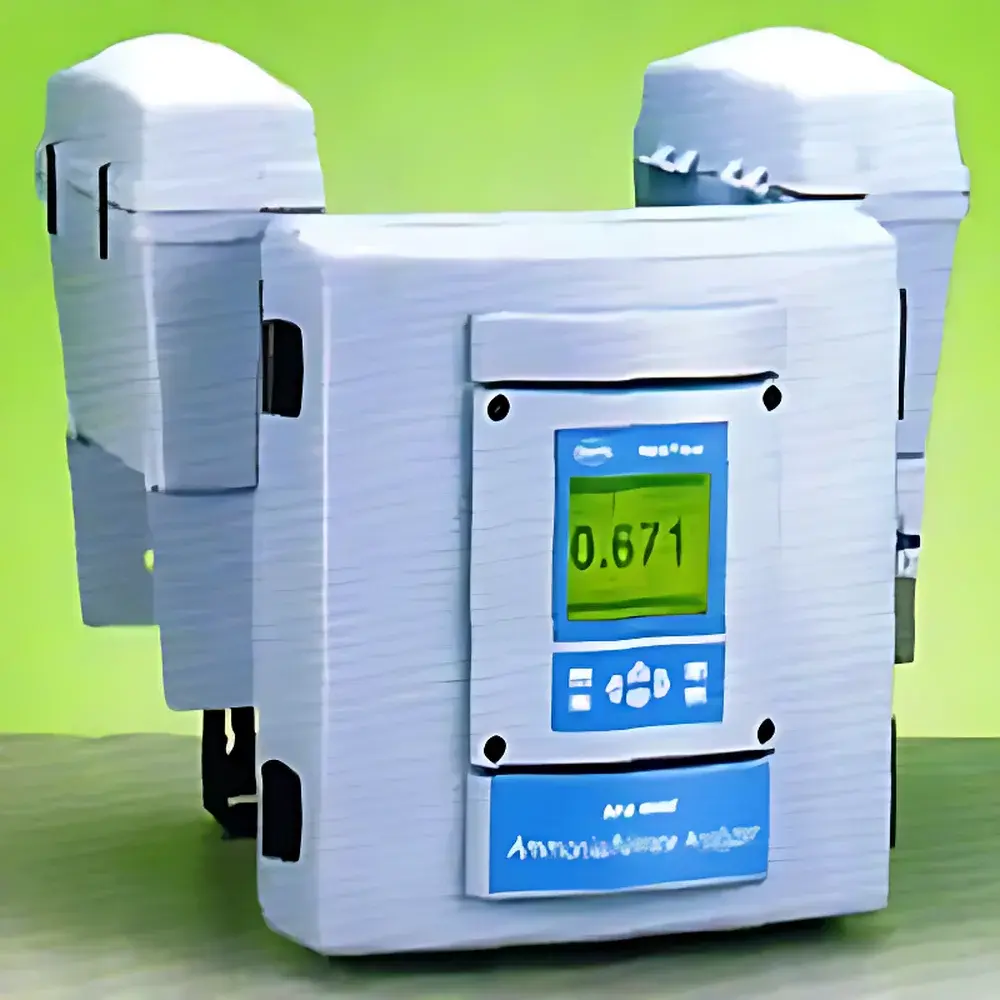
HACH APA6000 Ammonia and Monochloramine Online Analyzer
| Brand | HACH |
|---|---|
| Model | APA 6000 |
| Measurement Principle | Modified Phenol-Hypochlorite Colorimetry (ASTM D1426, ISO 7150-1) |
| Range | 0.02–2 mg/L as N (0.1–10 mg/L as Cl₂) |
| Accuracy | ±5% of reading or ±0.02 mg/L as N (whichever is greater) |
| Repeatability | ±3% of reading or ±0.01 mg/L as N (whichever is greater) |
| Detection Limit | 0.01 mg/L as N (0.05 mg/L as Cl₂) |
| Response Time (90%) | <5 min per cycle |
| Cycle Time | 5.0 min (average) |
| Sample Pressure | 0.03–2.04 bar |
| Sample Temperature | 5–50 °C |
| Sample Flow Rate | 100–2000 mL/min |
| Power Supply | 95–240 VAC, 50/60 Hz ±2 Hz |
| Enclosure Rating | NEMA 4X / IP66 (with air purge interface) |
| Dimensions (W×H×D) | 522 × 627 × 526 mm |
| Weight | 25.5 kg |
| Mounting Options | Wall-mounted, benchtop, or panel-integrated |
| Analog Outputs | 2 × 4–20 mA (expandable to 14) |
| Relay Outputs | 2 alarm relays (expandable to 14) |
| Data Storage | 30-day internal logging with trend and graphical analysis capability |
| Automation | Fully autonomous operation for ≥30 days with auto-calibration, auto-cleaning, and reagent dosing control |
| Sample Channels | Dual independent sample inlets (optional) |
Overview
The HACH APA 6000 Ammonia and Monochloramine Online Analyzer is an industrial-grade, colorimetric process analyzer engineered for continuous, unattended monitoring of ammonia species in chloraminated drinking water distribution systems. It employs a dual-step modified phenol-hypochlorite reaction—fully compliant with ASTM D1426 and ISO 7150-1—to selectively quantify monochloramine (NH₂Cl), free ammonia (NH₃), and total ammonia (NH₃ + NH₂Cl) in real time. Unlike conventional ammonia analyzers, the APA 6000 eliminates interference from residual chlorine through controlled pH adjustment and stoichiometric hypochlorite addition, ensuring measurement integrity even under dynamic disinfection conditions. Its robust architecture integrates thermally stabilized reaction chambers, precision fluidic metering, and sealed optical detection pathways—designed to maintain analytical consistency across fluctuating temperature, pressure, and flow regimes typical of municipal water infrastructure.
Key Features
- Dual-species quantification: Simultaneous reporting of monochloramine, free ammonia, and total ammonia concentrations on a single instrument platform.
- Interference-resistant chemistry: Proprietary adaptation of the phenol-hypochlorite method prevents false positives from free chlorine, chlorite, or bromide—an essential requirement for chloraminated system compliance.
- Thermally regulated reaction zone: Maintains constant incubation temperature (±0.3 °C) to ensure kinetic reproducibility and minimize drift over extended operational cycles.
- Autonomous operation: Integrated reagent management, self-cleaning valves, and scheduled calibration routines support uninterrupted 30-day deployment without manual intervention.
- Modular I/O expansion: Standard 2-channel 4–20 mA analog output and relay alarm interfaces are field-upgradeable to 14 channels each, enabling integration into SCADA, DCS, or PLC-based supervisory networks.
- NEMA 4X/IP66-rated enclosure with optional air purge: Certified for indoor installation in humid, dust-laden, or chemically aggressive environments; includes drip-proof reagent cabinet and vertical drainage design per ANSI/AWWA C651.
Sample Compatibility & Compliance
The APA 6000 is validated for use with potable water matrices meeting EPA Method 350.1 and AWWA Standard B100-2022 specifications. It accommodates variable inlet pressures (0.03–2.04 bar) and temperatures (5–50 °C), with flow-rate tolerance from 100 to 2000 mL/min—enabling direct connection to low-flow bypass streams or high-capacity mainline samplers. All wetted components are constructed from chemically inert materials (e.g., PTFE, PVDF, borosilicate glass) to resist degradation by oxidants and ammonia derivatives. The analyzer conforms to electromagnetic compatibility requirements per IEC 61326-1 and carries CE marking for EMC and LVD directives. Its data handling architecture supports audit-ready traceability aligned with GLP and GMP frameworks, including timestamped event logs, reagent lot tracking, and change-history records.
Software & Data Management
The embedded firmware provides local configuration via intuitive web-based HMI (HTTP/HTTPS-enabled), supporting secure remote access with role-based authentication (admin/operator/viewer). Internal non-volatile memory stores up to 30 days of high-resolution measurement data (per parameter), including raw absorbance values, calibration coefficients, and diagnostic flags. Export options include CSV via USB port or Modbus TCP for integration with enterprise-level historian systems (e.g., OSIsoft PI, Inductive Automation Ignition). Trend visualization tools enable real-time overlay of multiple parameters, deviation alerts, and rate-of-change analytics—facilitating proactive response to nitrification onset or disinfectant decay events. All data exports retain ISO 8601 timestamps and comply with FDA 21 CFR Part 11 requirements when paired with external electronic signature validation modules.
Applications
- Real-time optimization of chloramine formation ratios at water treatment plant clearwells and booster stations.
- Early detection of nitrification in distribution networks through sustained free ammonia elevation trends.
- Regulatory reporting for EPA Stage 2 Disinfectants and Disinfection Byproducts Rule (DBPR) compliance monitoring.
- Validation of breakpoint chlorination transitions during maintenance or source water shifts.
- Support for asset performance management programs by correlating ammonia dynamics with pipe material corrosion rates (e.g., lead/copper solubility modeling).
FAQ
How does the APA 6000 differentiate monochloramine from free ammonia?
It performs two sequential colorimetric assays: first, direct measurement of monochloramine using selective phenol-hypochlorite reaction at pH 7.5; second, oxidation of all free ammonia to monochloramine via excess hypochlorite at pH 8.3, followed by identical detection. Free ammonia concentration is derived by subtraction.
Can the APA 6000 operate on raw surface water or wastewater effluent?
No—it is specifically designed and validated for filtered, disinfected potable water applications. Turbidity >5 NTU, suspended solids >10 mg/L, or organic loading exceeding 5 mg/L DOC may impair accuracy and require pre-filtration.
What reagents are consumed during operation, and what is their shelf life?
Primary reagents include sodium phenolate, sodium nitroprusside, and buffered hypochlorite solution. Unopened reagent kits maintain stability for 12 months at 4–25 °C; in-use stability is 30 days under ambient instrument conditions.
Is remote diagnostics supported?
Yes—via embedded SNMP v2c/v3 agents and HTTP-based status polling. Firmware updates, log retrieval, and alarm acknowledgment can be performed over secure TLS connections.
Does the analyzer meet drinking water regulatory reporting requirements?
It satisfies data integrity and record retention expectations under US EPA 40 CFR Part 136 and EU Directive 98/83/EC Annex II, provided site-specific QA/QC protocols (e.g., daily blanks, weekly standards, monthly recovery checks) are implemented and documented.
Related Products







