
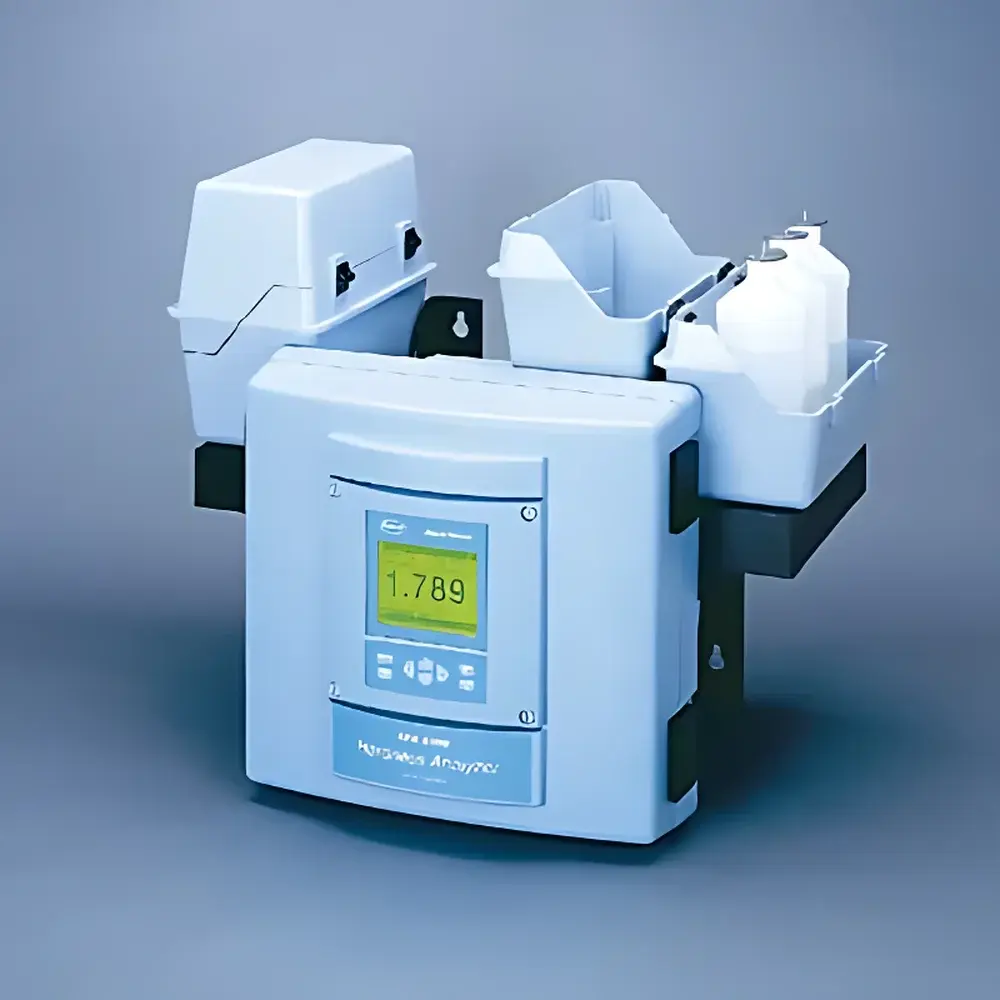
HACH APA6000 Online Alkalinity Analyzer
| Brand | HACH |
|---|---|
| Origin | Imported |
| Manufacturer Type | Manufacturer |
| Model | APA6000 |
| Measurement Principle | Flow Injection Analysis (FIA) with Photometric Detection at 600 nm |
| Range | Total Alkalinity: 0–500 mg/L as CaCO₃ |
| Phenolphthalein Alkalinity | 0–250 mg/L as CaCO₃ |
| Accuracy | ±5% of reading or ±1.0 mg/L (whichever is greater) |
| Repeatability | ±3% of reading or ±0.6 mg/L (whichever is greater) |
| Response Time (90%) | <10 min |
| Analysis Cycle | 8 min |
| Auto-Calibration Interval | 60 min |
| Sample Temperature | 5–50 °C |
| Analog Outputs | Two isolated 4–20 mA outputs, fully configurable across full scale |
| Alarm Outputs | Two SPDT relays (230 VAC, 5 A) |
| Power Supply | 95–240 VAC, 50/60 Hz ±2 Hz |
| Enclosure Rating | NEMA 4X (indoor) / IEC 529 IP66 with air-purge interface |
| Drain Connection | Vertical orientation recommended |
| Sample Flow Rate | 100–2000 mL/min |
| Inlet/Outlet Fittings | 1/4" NPT inlet, 3/4" NPT drain |
| Sample Pressure | 0.03–2.04 bar |
| Dimensions (W×H×D) | 522 × 627 × 526 mm |
| Mounting Options | Wall-mounted, benchtop, or panel-mounted |
| Weight | 25.5 kg |
| Data Storage | 30 days of timestamped results with trend/graphing capability |
| Key Features | Fully automated calibration, reagent replenishment, and system cleaning |
Overview
The HACH APA6000 Online Alkalinity Analyzer is an industrial-grade, photometric flow injection analyzer engineered for continuous, unattended measurement of total alkalinity and phenolphthalein alkalinity in water streams. It operates on a validated flow injection analysis (FIA) principle: sample and standardized acid titrant are precisely metered into a mixing coil, where pH-sensitive indicator reagent is introduced. The resulting colorimetric change—quantified by absorbance measurement at 600 nm—is correlated to alkalinity concentration via calibrated photometric endpoints. This method complies with standard titrimetric definitions (e.g., ASTM D1067, ISO 9963-1) while eliminating manual intervention, electrode drift, and endpoint subjectivity associated with classical potentiometric titration. Designed for deployment in boiler feedwater, cooling tower circulation, drinking water treatment, and wastewater effluent monitoring, the APA6000 delivers traceable, GLP-aligned data under variable field conditions.
Key Features
- Fully automated operation: integrated reagent delivery, system flushing, zero/slope calibration, and diagnostic self-checks reduce operator dependency.
- Dual-channel configuration supports concurrent analysis of two independent sample streams—ideal for comparative process monitoring or redundancy-critical applications.
- Thermostatically regulated reaction manifold maintains constant temperature (±0.5 °C) during titration and color development, minimizing thermal artifacts and ensuring metrological stability.
- Low-consumption fluidics design uses ≤1.2 mL per analysis cycle for both sample and reagents, reducing waste generation, lowering operational cost, and preventing carryover or memory effects between measurements.
- NEMA 4X/IP66-rated enclosure with integrated air-purge port enables reliable operation in humid, dusty, or chemically aggressive environments—including outdoor shelters and utility corridors.
- Onboard data logger retains 30 days of high-resolution results (timestamped, with alarm flags), supporting local trend visualization and export-ready CSV generation via RS-232 or optional Ethernet module.
Sample Compatibility & Compliance
The APA6000 accepts raw, filtered, or clarified aqueous samples within 5–50 °C and 0.03–2.04 bar pressure range. It accommodates turbidities up to 100 NTU and suspended solids ≤50 mg/L without clogging, thanks to its large-bore fluid path and pulse-free peristaltic pumping system. All wetted materials—including tubing, valves, and reaction coils—are chemically resistant (EPDM, PTFE, borosilicate glass) to withstand repeated exposure to sulfuric acid titrant, bromocresol green–methyl red indicator, and common water matrix constituents. The analyzer meets electromagnetic compatibility requirements per IEC 61326-1 and conforms to safety standards IEC 61010-1. Its measurement methodology aligns with EPA Method 310.1 and supports audit readiness for ISO/IEC 17025-accredited laboratories and FDA 21 CFR Part 11–governed facilities when paired with HACH’s compliant software suite.
Software & Data Management
The APA6000 embeds a real-time operating system supporting configurable analog output scaling, relay logic programming (e.g., high/low alarms, maintenance alerts), and user-defined calibration schedules. Data integrity is preserved through time-stamped event logging—including calibration events, error codes, reagent depletion warnings, and power interruptions. Optional connectivity modules enable Modbus TCP or Profibus DP integration into DCS/SCADA platforms. When used with HACH’s INsite™ or SCADAlink™ software, the analyzer supports electronic signature workflows, audit trail generation, and secure remote configuration—fully satisfying ALCOA+ (Attributable, Legible, Contemporaneous, Original, Accurate, Complete, Consistent, Enduring, Available) data governance principles.
Applications
- Boiler water conditioning: real-time control of neutralizing amine dosing and prevention of caustic embrittlement via precise total alkalinity tracking.
- Cooling water management: optimization of acid feed rates to maintain Langelier Saturation Index (LSI) targets and inhibit scale formation.
- Drinking water treatment: verification of lime-soda softening efficiency and compliance with WHO/US EPA secondary maximum contaminant levels (SMCLs) for alkalinity.
- Effluent compliance monitoring: continuous reporting for NPDES permits requiring alkalinity thresholds to protect aquatic buffering capacity.
- Pharmaceutical water systems: routine verification of purified water (PW) and water for injection (WFI) alkalinity per USP conductivity correlation protocols.
FAQ
What standards does the APA6000 comply with for alkalinity measurement?
It implements titrimetric alkalinity determination per ASTM D1067 (Standard Test Methods for Acidity or Alkalinity of Water) and ISO 9963-1 (Water Quality — Determination of Alkalinity — Part 1: Determination of Total and Carbonate Alkalinity), with photometric endpoint detection replacing manual burette reading.
Can the APA6000 operate without daily operator intervention?
Yes—its 30-day reagent autonomy, scheduled auto-calibration (every 60 minutes), and self-cleaning cycles enable true unattended operation in continuously flowing applications, provided ambient temperature remains within specification and drain lines remain unobstructed.
Is the instrument suitable for high-turbidity wastewater samples?
While optimized for clarified streams, the APA6000 tolerates moderate turbidity (≤100 NTU) and low suspended solids (<50 mg/L); for raw wastewater, inline filtration (e.g., 50 µm cartridge) upstream of the analyzer inlet is recommended to ensure long-term valve and photometer reliability.
How is data security and traceability ensured?
All measurements and system events are permanently logged with UTC timestamps and user-accessible audit trails; when integrated with HACH’s validated software, it supports electronic signatures, role-based access control, and 21 CFR Part 11-compliant archiving.
What maintenance is required beyond reagent replacement?
Annual verification of photometer linearity, pump tube wear inspection, and calibration verification using NIST-traceable alkalinity standards constitute the preventive maintenance schedule—no routine optical alignment or electrode servicing is needed.
Related Products







