
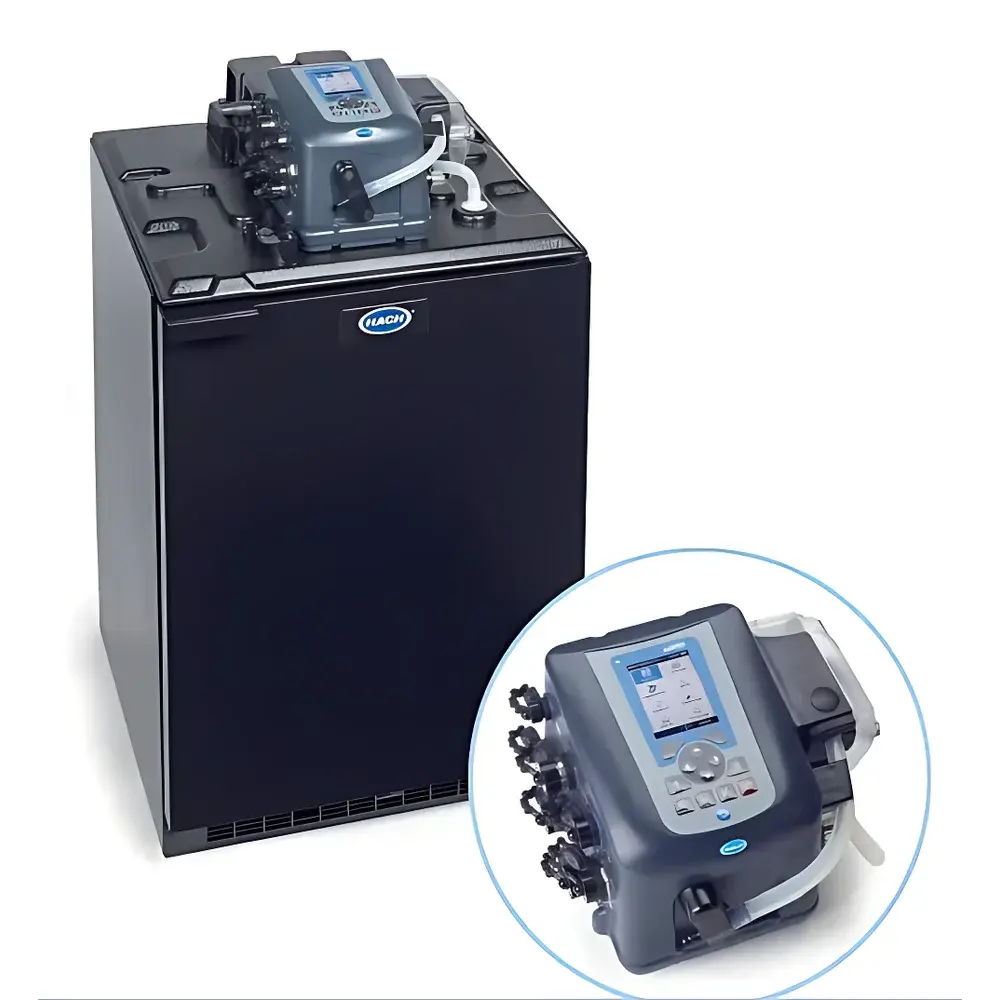
Hach AS950 All-Weather Refrigerated Sampler
| Brand | Hach |
|---|---|
| Origin | Imported |
| Manufacturer Type | Manufacturer |
| Model | AS950 |
| Pricing | Upon Request |
Overview
The Hach AS950 All-Weather Refrigerated Sampler (AWRS) is an industrial-grade, programmable composite and discrete water sampling system engineered for long-term, unattended operation in demanding environmental monitoring applications. It employs precision-controlled refrigeration (4 ± 0.8 °C) and robust physical architecture to preserve sample integrity under variable ambient conditions—critical for compliance with U.S. EPA Method 1664, ISO 5667-3, and ASTM D3370 requirements for preserved aqueous samples. Designed for wastewater treatment plants, combined sewer overflow (CSO) sites, surface water stations, and regulatory compliance monitoring, the AS950 integrates compressor-based cooling, NEMA 4X/6/IP68-rated controller housing, and IP24-rated refrigerated cabinet to withstand high humidity, corrosive atmospheres, freeze-thaw cycles, and rodent intrusion. Its dual-program architecture enables simultaneous execution of independent sampling logic—including time-weighted, flow-proportional, event-triggered, and schedule-driven protocols—ensuring adaptability across complex regulatory sampling plans.
Key Features
- Refrigerated cabinet with rapid thermal recovery: ≤5 minutes to re-stabilize at 4 °C after 1-minute door opening at 24 °C ambient; full cooldown from 24 °C to 4 °C in ≤20 minutes.
- NEMA 4X/6 and IP68-rated controller enclosure fabricated from UV-stabilized PC/ABS, featuring a 1/4 VGA color LCD with intuitive menu-driven interface and multilingual support (English, Spanish, French, German, Italian, Portuguese, Chinese).
- Dual independent sampling programs: Supports concurrent time-based, flow-proportional (via 0–20 mA or pulse input), and event-triggered sampling—each with configurable start/stop windows, volume increments (10–10,000 mL), and interval resolution (1 min to 9999 min or 1–9999 flow pulses).
- High-reliability peristaltic pump system: Dual-roller design with silicone tubing (9.5 mm ID × 15.9 mm OD); vertical lift capacity up to 8.8 m at sea level; typical volumetric repeatability ±5% for 200 mL samples under standard field conditions.
- Comprehensive diagnostics and audit-ready data logging: Stores 4,000 sample history records, 325,000 channel measurement entries (e.g., pH, level, voltage), and 2,000 event log entries—including power loss, pump fault, arm error, cooling failure, and user-initiated actions—with timestamping and source attribution.
- USB-native configuration and data transfer: Enables program cloning between units, firmware updates, and export of raw logs without proprietary software; optional RS485 Modbus RTU interface for SCADA integration.
Sample Compatibility & Compliance
The AS950 accommodates a broad range of container configurations—including single-bottle (10 L glass or PE; 21 L PE), multi-bottle (2×10 L, 4×10 L, 8×2.3 L, 12×2 L, or 24×1 L PE/glass), and composite mixing vessels—enabling adherence to EPA-approved preservation protocols for BOD, metals, nutrients, and organic analytes. Its air-sensing thermostat and insulated cabinet (3″ side / 5″ top / 6″ bottom rigid foam) meet U.S. EPA guidance for cold-chain maintenance during transport and holding. The system supports GLP/GMP-aligned workflows via tamper-resistant program lock (PIN-protected), non-volatile memory retention, and full diagnostic logging—facilitating FDA 21 CFR Part 11 readiness when deployed with validated procedures and change control documentation.
Software & Data Management
All operational logic is configured locally via the onboard touchscreen interface—no external PC required. Sample metadata (timestamp, bottle ID, status flags) and sensor measurements are stored internally with microsecond-level clock accuracy (±1 s/day at 25 °C). USB mass storage mode allows direct drag-and-drop export of CSV-formatted logs for LIMS ingestion or QA/QC review. Optional IO9004 module adds four isolated 4–20 mA analog inputs/outputs and four dry-contact relays for interfacing with external analyzers (e.g., Hach AV9000 flow meters, US9000 ultrasonic level sensors) and automated alarm escalation. Event logs include full context—such as sensor communication failures, thermal deviation events, and battery health warnings—to support root-cause analysis during regulatory audits.
Applications
- Wastewater influent/effluent monitoring per NPDES permit requirements
- Combined sewer overflow (CSO) and sanitary sewer overflow (SSO) event-triggered sampling
- Surface water quality assessment under Clean Water Act Section 304(h) protocols
- Drinking water source protection and groundwater recharge zone surveillance
- Industrial pretreatment compliance sampling with flow-proportioned compositing
- Long-term ecological studies requiring temperature-stable preservation of microbial or nutrient-sensitive matrices
FAQ
What refrigeration standard does the AS950 comply with for sample preservation?
The AS950 maintains samples at 4 ± 0.8 °C using a hermetically sealed, oil-lubricated compressor with air-cooled condenser—meeting U.S. EPA Method 1664 and ISO 5667-3 requirements for cold preservation of aqueous environmental samples.
Can the AS950 operate autonomously during extended AC power outages?
Yes. A 6 Ah rechargeable gel-cell battery powers the controller and pump continuously during AC failure; the integrated charger maintains full state-of-charge when mains power is restored.
Is remote configuration supported without physical USB access?
No native Ethernet or cellular interface is included; remote management requires local USB connection or integration via optional RS485 Modbus RTU into existing telemetry infrastructure.
How is sample contamination prevented between collection events?
Each sampling cycle includes automatic air-purge (duration dynamically adjusted for inlet line length) and 1–3 pre-sample rinses using process water—minimizing carryover and ensuring analytical validity for sequential discrete sampling.
Does the AS950 support regulatory audit trails for data integrity?
Yes. All user actions (program edits, manual triggers, configuration changes), system faults, and sensor events are time-stamped and logged with immutable attribution—enabling full traceability per ISO/IEC 17025 and EPA SW-846 Chapter One requirements.







