
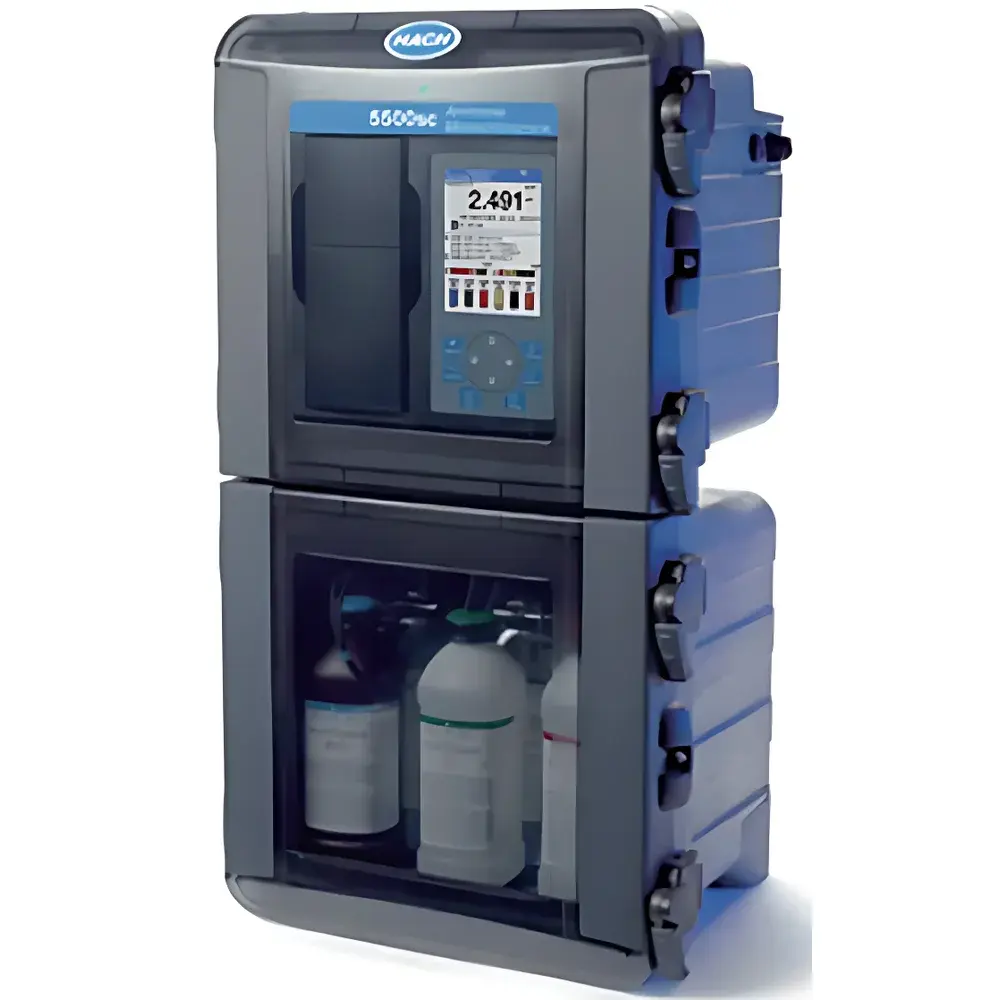
HACH BIOTECTOR B3500e Total Organic Carbon (TOC) Analyzer
| Brand | HACH |
|---|---|
| Origin | Imported |
| Manufacturer | HACH Company |
| Model | BIOTECTOR B3500e TOC |
| Instrument Type | Online TOC Analyzer |
| Oxidation Method | Two-Stage Advanced Oxidation (TSAO) using hydroxyl radicals |
| Measurement Principle | NDIR detection of CO₂ after acidification and purge |
| Measurement Range (Standard) | 0–250 mg C/L |
| Extended Range (with Overrange Tracking) | 0–1,000 mg C/L |
| Accuracy | ±3% of reading or ±0.45 mg C/L (whichever is greater) for standard range |
| Repeatability | Same as accuracy specification |
| Detection Limit | Not specified |
| Resolution | Not specified |
| Sample Inlet Temperature | 0–60 °C |
| Operating Ambient Temperature | 0–45 °C |
| Relative Humidity | 5–85% non-condensing |
| Chloride Tolerance | Up to 30% w/w |
| Particle Size Limit | ≤100 µm |
| Cycle Time | Typically 7.5 minutes |
| Data Storage | 9,999 reaction records + 99 error logs |
| Display | 40×16 high-contrast LED-backlit LCD |
| Communication Protocols | Modbus®, PROFIBUS |
| Power Supply | 115/220 VAC |
| Dimensions (H×W×D) | 750 × 500 × 320 mm |
| Weight | 46 kg |
| Languages | English, Spanish, French (others available on request) |
| Auto-Cleaning | Integrated TSAO-based self-cleaning per cycle |
| Calibration | Fully automated |
| TIC Measurement | Acidification + sparging prior to NDIR detection |
| TC Measurement | Sum of TOC + TIC |
Overview
The HACH BIOTECTOR B3500e Total Organic Carbon (TOC) Analyzer is an online, real-time environmental monitoring instrument engineered for continuous, reliable quantification of organic carbon in aqueous matrices. It operates on a validated two-stage advanced oxidation (TSAO) principle, generating hydroxyl radicals (•OH) via ozone-enhanced alkaline oxidation to achieve complete mineralization of refractory organic compounds—including humic substances, surfactants, and complex polymers—into carbon dioxide. The liberated CO₂ is then selectively measured using a proprietary non-dispersive infrared (NDIR) detector following acidification and inert gas sparging. This methodology ensures compliance with international regulatory expectations for TOC measurement integrity, particularly where robustness against chloride interference, particulate load, and variable matrix composition is required. Designed for unattended operation in demanding industrial and municipal environments, the B3500e delivers trace-level sensitivity and long-term stability without compromising on footprint or operational simplicity.
Key Features
- Two-Stage Advanced Oxidation (TSAO): Patented hydroxyl radical–driven oxidation system enables full conversion of recalcitrant organics, minimizing incomplete oxidation artifacts common in UV/persulfate or high-temperature catalytic methods.
- Integrated Self-Cleaning Architecture: Full-system automatic cleaning occurs during every measurement cycle, significantly reducing manual intervention and extending service intervals to six months under typical operating conditions.
- Compact Industrial Design: Occupying only one-third the volume and half the mass of the legacy B7000 platform, the B3500e optimizes space-constrained installations—ideal for retrofitting into existing analyzer shelters or modular skids.
- Dual-Range NDIR Detection: Standard 0–250 mg C/L range supports routine effluent compliance monitoring; optional overrange tracking extends capability to 0–1,000 mg C/L for shock-load events or industrial influent screening.
- Multi-Parameter Output: Simultaneously reports TOC, total inorganic carbon (TIC), and total carbon (TC) by sequential acidification, sparging, and oxidation steps—enabling accurate background correction and method validation.
- Robust Matrix Tolerance: Certified for operation in chloride concentrations up to 30% w/w and suspended solids ≤100 µm, making it suitable for seawater, brackish estuaries, and high-salinity industrial wastewaters.
Sample Compatibility & Compliance
The BIOTECTOR B3500e is validated for direct analysis of raw and treated wastewater, surface water, river water, seawater, and process water streams without pre-filtration in most applications. Its TSAO chemistry eliminates the need for aggressive acid pretreatment or high-temperature reactors, thereby reducing corrosion risk and reagent consumption. The analyzer meets functional requirements aligned with ISO 8245:1999 (Water quality — Guidelines for the determination of total organic carbon), ASTM D5905-22 (Standard Test Method for Total Organic Carbon in Water), and US EPA Method 415.3. While not certified to FDA 21 CFR Part 11 out-of-the-box, its audit-trail-capable data logging and user-access-controlled firmware support GxP-aligned deployment when integrated into validated laboratory information management systems (LIMS) or distributed control systems (DCS).
Software & Data Management
Data acquisition and remote supervision are managed via BioTector Network Control—a secure, web-enabled interface supporting role-based access over Ethernet. Operators can monitor live TOC/TIC/TC values, review historical trends, acknowledge alarms, and initiate diagnostics from any standards-compliant browser or mobile device. All measurements are timestamped and stored locally in non-volatile memory (9,999 reaction records + 99 error logs), with export capabilities via Modbus RTU/TCP or PROFIBUS DP for integration into SCADA, MES, or enterprise analytics platforms. Firmware updates and configuration changes require authenticated login, ensuring data integrity and traceability in regulated environments.
Applications
- Municipal wastewater treatment plants: Continuous compliance monitoring of discharge permits (e.g., EU Urban Wastewater Treatment Directive, US Clean Water Act NPDES).
- Industrial pretreatment facilities: Real-time tracking of organic loading from pharmaceutical, food & beverage, pulp & paper, and chemical manufacturing effluents.
- Drinking water distribution networks: Early detection of organic contamination events or biofilm-related carbon release.
- Desalination and power plant cooling water: Monitoring for organic fouling potential and membrane protection strategies.
- Environmental research stations: Long-term trend analysis of anthropogenic carbon inputs in rivers, estuaries, and coastal zones.
FAQ
What oxidation method does the B3500e use, and how does it differ from conventional UV/persulfate systems?
The B3500e employs Two-Stage Advanced Oxidation (TSAO), which generates hydroxyl radicals electrochemically via ozone-enhanced sodium hydroxide oxidation—achieving >98% oxidation efficiency across diverse organic structures without requiring acidic reagents or elevated temperatures.
Can the B3500e measure TOC in high-chloride seawater samples?
Yes. It is specifically engineered for chloride tolerance up to 30% w/w and includes built-in compensation algorithms to suppress chloride-derived CO₂ interference during sparging and detection.
How frequently does the system require preventive maintenance?
Under normal operating conditions, scheduled maintenance is recommended every six months—primarily involving consumables replacement (e.g., reagent cartridges, sparger filters) and optical path verification.
Is the B3500e compatible with existing plant automation infrastructure?
Yes. Native Modbus RTU/TCP and PROFIBUS DP protocols enable seamless integration with PLCs, DCS, and central SCADA systems without middleware.
Does the analyzer support regulatory audit trails for GLP/GMP environments?
While the base firmware provides time-stamped event logging and user-access controls, full 21 CFR Part 11 compliance requires integration with third-party electronic lab notebook (ELN) or LIMS solutions that enforce digital signature, change control, and retention policies.







