
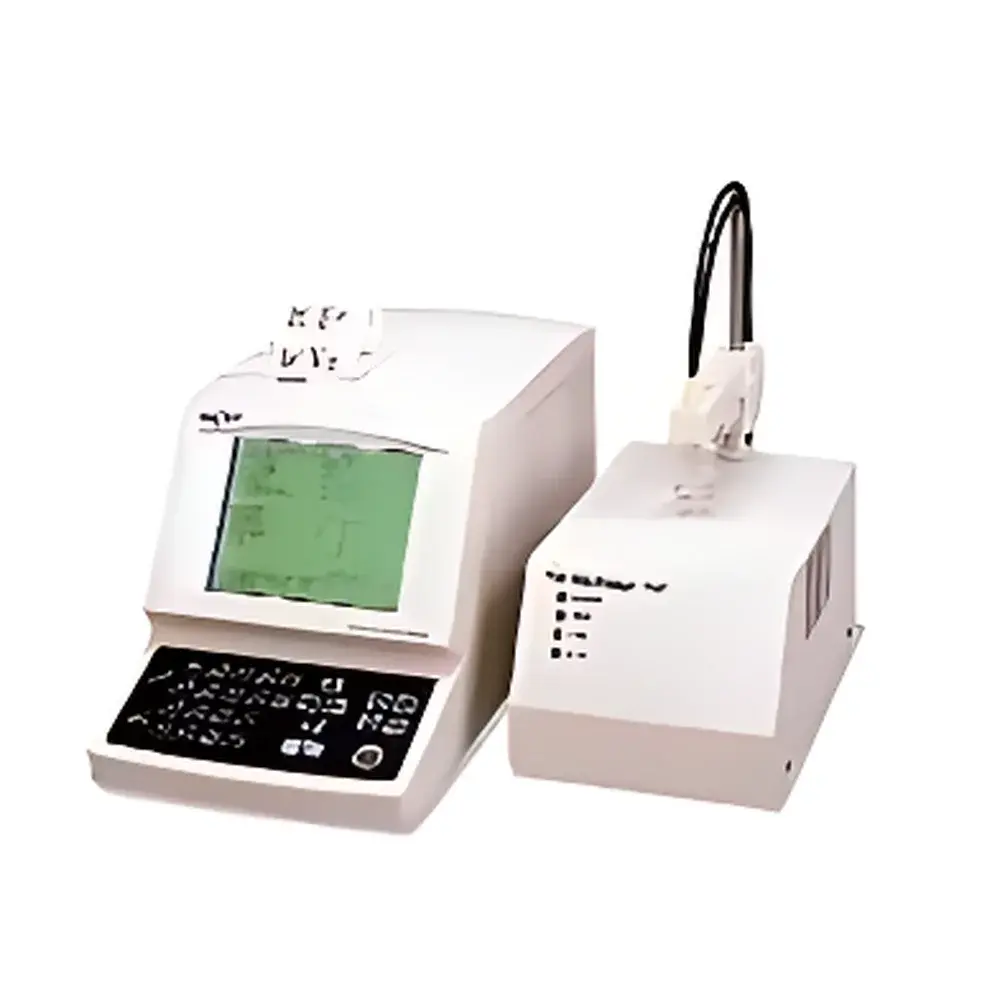
Hach COD-60A Permanganate Index (CODMn) Analyzer
| Brand | Hach |
|---|---|
| Origin | Imported |
| Manufacturer Type | Manufacturer |
| Instrument Type | Portable |
| Measurement Principle | Coulometric Titration (Acidic/Alkaline KMnO₄ Method) |
| Measurement Range | 0–5000 mg/L as O₂ |
| Accuracy | ±2% of full scale |
| Repeatability | ±2% of full scale |
| Detection Limit | 0.2 mg/L |
| Typical Analysis Time | 15 minutes |
| Batch Capacity | Single-sample per run |
Overview
The Hach COD-60A Permanganate Index (CODMn) Analyzer is a fully automated, portable instrument engineered for rapid, reliable determination of oxygen demand in water samples using the standardized acidic or alkaline potassium permanganate oxidation method. Unlike conventional spectrophotometric or dichromate-based COD analyzers, the COD-60A implements coulometric titration—a precise electrochemical endpoint detection technique—eliminating volumetric glassware dependency and human titration variability. The system integrates heating, oxidation, and titration into a single, thermally controlled reaction chamber, enabling consistent 100 °C thermal activation with programmable digestion duration (10–800 seconds). Designed to align with international standard methods—including ISO 8467 (Water quality — Determination of permanganate index), ASTM D1253, and China’s GB 11892–1989—the COD-60A delivers traceable, laboratory-grade results in field or benchtop environments without requiring manual reagent addition or endpoint judgment.
Key Features
- Fully automated coulometric titration with self-cleaning platinum indicator electrode, ensuring high reproducibility and minimal maintenance.
- Integrated heating-digestion-titration module with PID-controlled temperature regulation (±0.5 °C accuracy at 65 °C for post-digestion titration step).
- Adjustable digestion time (10–800 s) and dual-mode operation (acidic or alkaline KMnO₄ protocol) to accommodate diverse sample matrices including seawater, groundwater, and industrial effluents.
- Direct readout functionality: user-defined dilution factors enable automatic calculation and display of undiluted sample CODMn values—no manual unit conversion required.
- Onboard calibration and correlation workflow: supports linear regression input (y = ax + b) to convert instrument-specific results to reference laboratory values per GB 11892 or ISO 8467.
- Embedded real-time clock, non-volatile data storage (100 measurement records), and integrated thermal printer for GLP-compliant reporting.
Sample Compatibility & Compliance
The COD-60A is validated for use with potable water, surface water, groundwater, seawater, and low-COD industrial process streams. It complies with regulatory frameworks governing environmental monitoring in North America, EU, and APAC regions. Its coulometric endpoint detection satisfies the performance criteria outlined in ISO/IEC 17025 for method validation, and its audit-trail-capable operation supports GLP and GMP-aligned quality systems. While not FDA 21 CFR Part 11–certified out-of-the-box, the instrument’s fixed firmware logic, immutable result logging, and timestamped printouts meet baseline data integrity requirements for routine environmental compliance testing.
Software & Data Management
The COD-60A operates via an embedded microcontroller with dedicated firmware—no external PC or proprietary software required. All operational parameters (digestion time, mode selection, dilution factor, calibration coefficients) are configured via intuitive front-panel keypad navigation. Measurement data—including date/time stamp, sample ID, raw coulomb count, calculated CODMn, and method flag (acidic/alkaline)—are stored in non-volatile memory. Printed reports include instrument serial number, firmware version, and operator ID field (manually entered), facilitating traceability during internal audits. Export to external systems is supported via RS-232 interface (optional cable), enabling integration into LIMS platforms where ASCII-formatted output is accepted.
Applications
- Routine surveillance of drinking water treatment plants for compliance with WHO and national permanganate index limits (e.g., ≤2 mg/L for finished water).
- Field-based assessment of organic load in rivers, lakes, and reservoirs under EPA Region 10 or EU WFD monitoring programs.
- Process control in food & beverage, pharmaceutical, and semiconductor industries where low-level oxidizable carbon must be quantified without chloride interference.
- Educational laboratories conducting comparative method validation between classical titrimetric protocols and automated coulometric approaches.
- Emergency response teams performing rapid on-site screening following accidental spills or algal bloom events.
FAQ
What principle does the COD-60A use for endpoint detection?
It employs coulometric titration based on controlled electrolytic generation of ferrous ions (Fe²⁺) to reduce excess permanganate; the endpoint is determined by a sharp potential shift detected via dual platinum electrodes.
Can the COD-60A measure samples containing high chloride concentrations?
Yes—the acidic KMnO₄ method used by the COD-60A exhibits significantly lower chloride interference compared to dichromate-based COD assays, making it suitable for brackish and coastal waters.
How is calibration performed?
Calibration is conducted using certified potassium hydrogen phthalate (KHP) or oxalic acid standards; the instrument calculates and stores slope/intercept values for subsequent linear conversion of coulomb counts to mg/L O₂ equivalents.
Is method validation documentation available?
Hach provides a technical validation report outlining precision, linearity, limit of detection (LOD), and inter-laboratory comparison data against ISO 8467—available upon request with proof of instrument registration.
Does the instrument support alkaline digestion for highly saline samples?
Yes—switching between acidic and alkaline modes is configurable via menu; alkaline digestion minimizes manganese dioxide precipitation in high-salinity matrices.







