
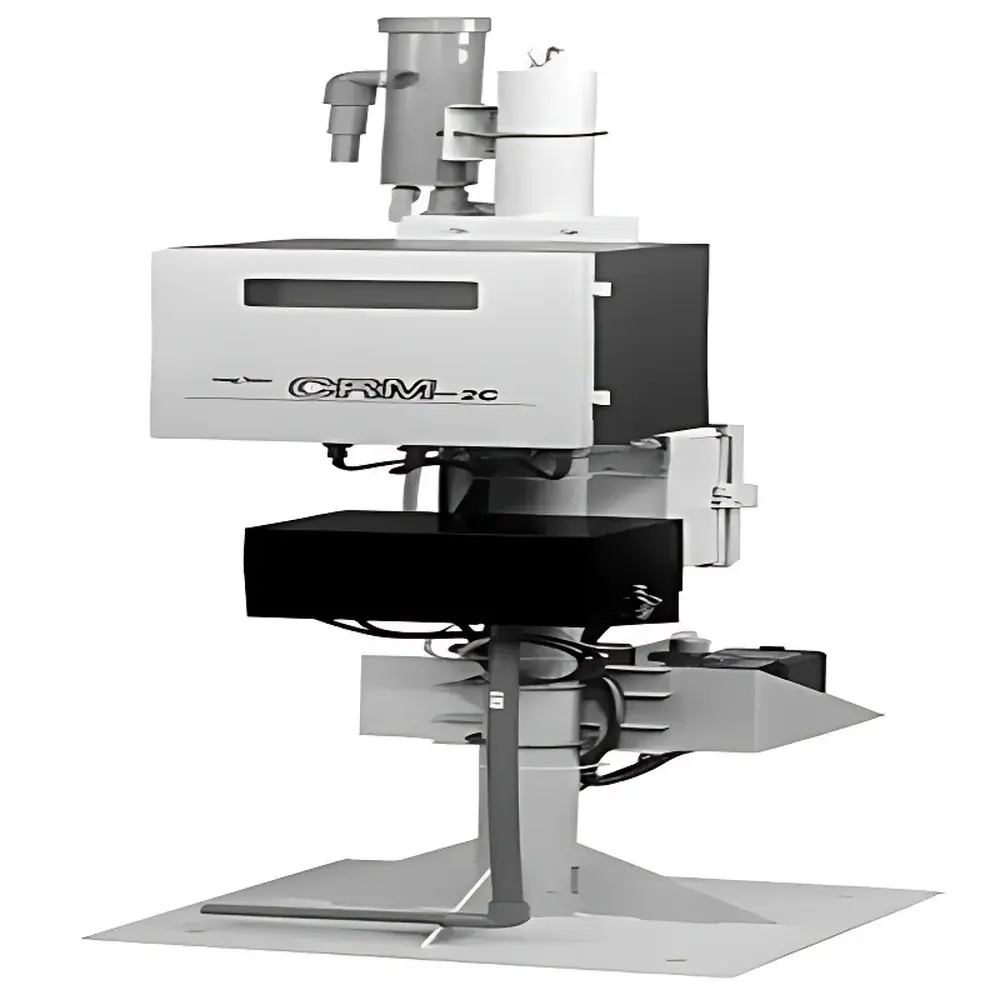
HACH CRM-2C Hexavalent Chromium Online Analyzer
| Brand | HACH |
|---|---|
| Origin | Imported |
| Manufacturer Type | Manufacturer |
| Model | CRM-2C |
| Measurement Range | 0–0.5 mg/L or 0–1.0 mg/L (manually selectable) |
| Repeatability | ±5% FS |
| Light Source | LED @ 565 nm |
| Measurement Interval | 5–120 min (1-min adjustable increments) |
| Analysis Time | 5–11 min (1-min adjustable increments) |
| Display | 30×8-digit LED |
| Analog Output | 4–20 mA or 0–1 V DC (max. load 700 Ω) |
| Relay Outputs | Configurable alarm signals |
| Alarm Threshold Range | 0.1–0.5 mg/L or 0.1–1.0 mg/L (0.1 mg/L step) |
| Digital Interface | RS232C (optional) |
| Sample Flow Rate | 1–3 L/min (with pretreatment tank) |
| Sample Volume per Cycle | 300 mL |
| Sample Temperature | 0–40 °C (non-freezing) |
| Sample Pressure | 0.2–0.8 kgf/cm² |
| Power Supply | 220 VAC, 50/60 Hz |
| Power Consumption | ~60 VA |
| Operating Environment | Indoor installation |
| Weight | 16 kg |
Overview
The HACH CRM-2C Hexavalent Chromium Online Analyzer is a fully automated, colorimetric analytical system engineered for continuous, unattended monitoring of Cr(VI) concentration in surface water and industrial wastewater streams. It operates on the principle of spectrophotometric detection following a standardized diphenylcarbazide (DPC) reaction — where hexavalent chromium reacts with DPC under acidic conditions (sulfuric acid medium) to form a stable violet-colored complex. This complex exhibits maximum absorbance at 565 nm, enabling quantitative determination via LED-based photometry. Designed for long-term deployment in municipal water quality stations, effluent monitoring points, and industrial pretreatment facilities, the CRM-2C delivers regulatory-grade data traceable to EPA Method 7196A and ISO 11083, supporting compliance with WHO, EU Drinking Water Directive (2020/2184), and national discharge limits for Cr(VI).
Key Features
- Rotating measurement cell design ensures homogeneous mixing of reagent and sample, minimizing sedimentation and preventing solenoid valve clogging — critical for high-solids or intermittently turbid influents.
- Stable, narrow-band LED light source at 565 nm provides consistent spectral output over extended operational life (>50,000 hours), eliminating lamp drift and reducing calibration frequency.
- Dual-range measurement capability (0–0.5 mg/L and 0–1.0 mg/L) allows flexible configuration for low-background environmental waters or higher-concentration industrial discharges.
- Microprocessor-controlled timing architecture enables precise adjustment of both measurement interval (5–120 min) and analysis duration (5–11 min), optimizing response time versus reagent consumption.
- Integrated analog (4–20 mA / 0–1 V) and optional digital (RS232C) outputs support seamless integration into SCADA, DCS, or PLC-based supervisory systems.
- Configurable relay outputs provide discrete alarm signaling for threshold exceedance, maintenance alerts, or system fault conditions — fully programmable within instrument firmware.
Sample Compatibility & Compliance
The CRM-2C is validated for use with raw surface water, treated effluent, cooling tower blowdown, and electroplating rinse waters — provided samples meet specified physical constraints: flow rate 1–3 L/min (when used with HACH-supplied pretreatment module), temperature 0–40 °C, non-freezing, and pressure 0.2–0.8 kgf/cm². The analyzer complies with IEC 61326-1 (EMC for industrial environments) and IEC 61010-1 (safety requirements for electrical equipment). Its measurement methodology aligns with ASTM D5281 (Standard Test Method for Hexavalent Chromium in Water by Colorimetric Determination), and supports audit-ready data integrity under GLP and ISO/IEC 17025 frameworks when paired with HACH’s compliant data logging solutions.
Software & Data Management
Embedded firmware includes real-time clock synchronization, automatic zero/span verification logging, and event-driven data tagging (e.g., “calibration start”, “reagent low”, “sample timeout”). All measurements are timestamped with millisecond resolution and stored internally for up to 30 days (circular buffer). Optional HACH DataSuite™ software enables remote configuration, historical trend visualization, export to CSV/Excel, and generation of regulatory-compliant reports (daily/monthly summary tables with QC flags). When configured with optional printer interface, the unit produces hard-copy logs meeting EPA 40 CFR Part 136 record retention requirements.
Applications
- Continuous compliance monitoring at NPDES-permitted industrial outfalls, particularly in metal finishing, chrome plating, and pigment manufacturing facilities.
- Early-warning detection in drinking water intake channels downstream of potential Cr(VI) contamination sources.
- Performance verification of ion exchange, reverse osmosis, or reduction-based Cr(VI) removal systems in wastewater treatment plants.
- Long-term trend analysis for watershed-scale chromium speciation studies coordinated with laboratory ICP-MS validation programs.
- Supporting ISO 14001 environmental management system documentation through automated, auditable Cr(VI) data streams.
FAQ
What sample pretreatment is required prior to CRM-2C analysis?
A HACH-approved pretreatment module (e.g., filtration + pH stabilization) is mandatory for samples containing suspended solids >10 mg/L or free chlorine >0.5 mg/L, as these interfere with DPC reaction kinetics and optical path clarity.
Can the CRM-2C be calibrated using NIST-traceable standards?
Yes — certified reference materials (CRMs) traceable to NIST SRM 3151a (Cr(VI) in aqueous matrix) are recommended for initial setup and periodic verification; calibration curves are stored with metadata including date, operator ID, and standard lot number.
Does the analyzer support 21 CFR Part 11 compliance?
Out-of-the-box, the CRM-2C meets electronic record requirements; full Part 11 compliance (audit trail, electronic signatures, role-based access) requires integration with HACH’s validated LIMS or DataSuite™ Enterprise edition with configured user authentication and change control protocols.
How often must reagents be replenished?
At typical 30-minute measurement intervals, the standard reagent pack (sulfuric acid + DPC solution) supports approximately 30 days of continuous operation; onboard level sensors trigger visual and relay alarms at <15% remaining volume.
Is remote diagnostics supported?
Yes — via optional Ethernet-to-RS232 gateway, technicians can perform firmware updates, view real-time sensor diagnostics, and download error logs without on-site access, reducing mean time to repair (MTTR) by up to 70%.
Related Products







