
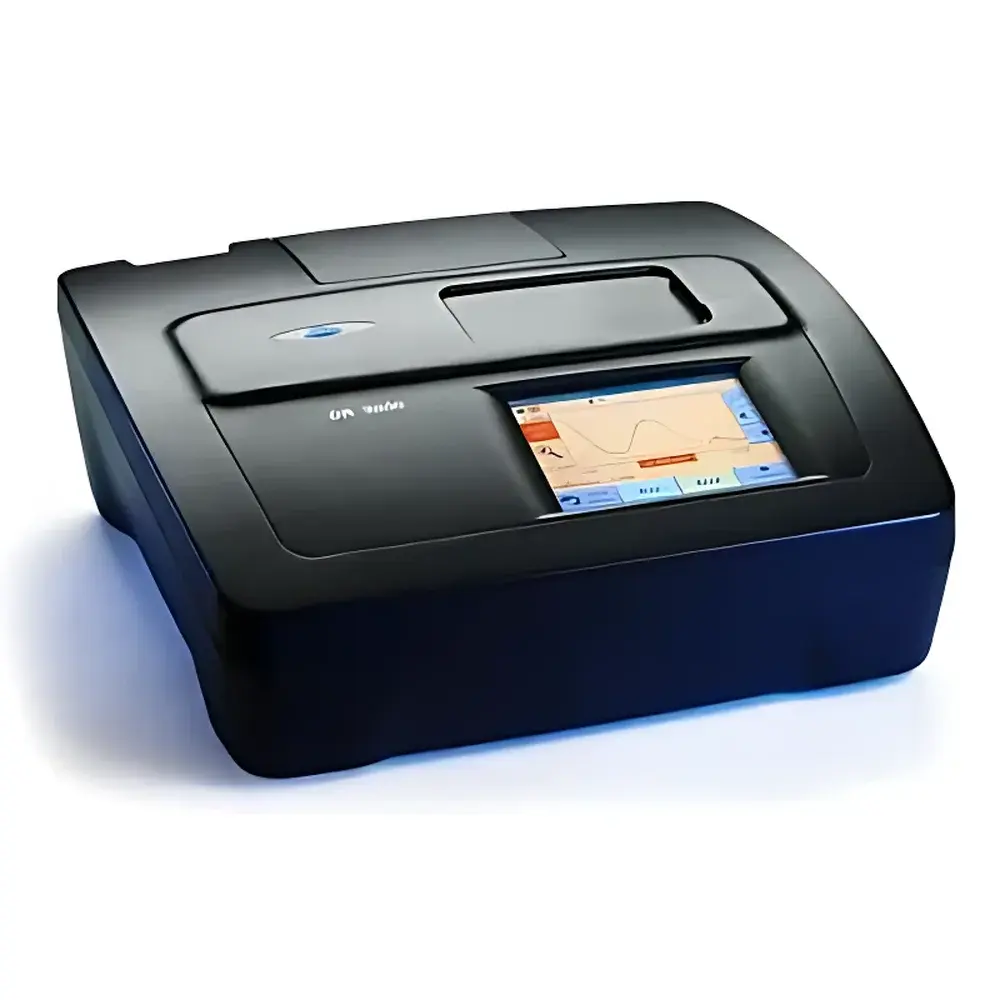
Hach DR3800 Benchtop Spectrophotometer
| Brand | Hach |
|---|---|
| Origin | Imported |
| Manufacturer Type | Manufacturer |
| Instrument Type | Laboratory Water Quality Analyzer |
| Detection Capability | Multi-Parameter |
| Wavelength Range | 320–1100 nm |
| Preloaded Methods | 240+ Standard & TNTplus Methods |
| Interface | Color Touchscreen Display |
| Connectivity | Dual USB Ports |
| Software Compatibility | Hach DataTrans™, LINK2SC™ |
| Compliance Support | ASTM D1253, ISO 7027, USP <85>, EPA Methods 4500-NO₂⁻, 4500-PO₄³⁻, 4500-NH₃, etc. |
Overview
The Hach DR3800 Benchtop Spectrophotometer is a precision UV-Vis spectrophotometric analyzer engineered for routine and method-developed water quality analysis in regulated laboratory environments. Operating on the principle of absorbance spectroscopy—measuring light attenuation at discrete or scanned wavelengths across the 320–1100 nm spectral range—the DR3800 delivers high reproducibility for quantifying analytes including nitrate, phosphate, ammonia, chlorine species, heavy metals (e.g., Cu, Fe, Mn), and organic contaminants via colorimetric or enzymatic reactions. Its optical architecture employs a tungsten-halogen lamp and a diffraction grating monochromator, ensuring stable photometric performance with low stray light (<0.05% at 340 nm) and wavelength accuracy ±1 nm. Designed for compliance-driven workflows, the instrument supports traceable calibration verification, method-specific validation protocols, and audit-ready data handling—making it suitable for laboratories operating under GLP, GMP, or drinking water regulatory frameworks such as U.S. EPA, WHO Guidelines, and EU Drinking Water Directive (98/83/EC).
Key Features
- Full-spectrum scanning capability (320–1100 nm) for method development, spectral peak identification, and interference assessment.
- 7-inch high-resolution color touchscreen interface with intuitive icon-driven navigation and context-sensitive on-screen guidance—reducing reliance on printed manuals and minimizing operator training time.
- Integrated barcode recognition for Hach TNTplus reagent vials: automatic method selection, parameter validation, and measurement execution upon vial insertion.
- Dual USB host ports enabling simultaneous connection to a PC (via Hach DataTrans™ software) and external peripherals—including USB flash drives for firmware updates, method imports, and secure data export (CSV, PDF, XML).
- Preloaded library of 240+ validated analytical methods, including 30+ TNTplus protocols compliant with ASTM, ISO, and EPA standard methods.
- No-reagent-blank operation enabled by rigorous reagent lot control, multi-point absorbance averaging (10 readings per measurement), and built-in optical drift compensation—reducing procedural steps without compromising accuracy.
Sample Compatibility & Compliance
The DR3800 accommodates standard 10 mm, 20 mm, and 50 mm rectangular cuvettes as well as Hach’s proprietary 16-mm round TNTplus vials. It supports liquid samples ranging from clarified surface water and wastewater effluents to digested sludge extracts and industrial process streams. All preprogrammed methods adhere to internationally recognized standards, including ASTM D3370 (sampling), ISO 7027 (turbidity), ISO 6060 (COD), and multiple U.S. EPA-approved procedures (e.g., Method 365.4 for phosphate, Method 352.1 for nitrate). The system supports user-defined method creation with wavelength selection, curve-fitting options (linear, quadratic, polynomial), and limit-of-detection calculation tools—all documented within the internal audit trail.
Software & Data Management
Hach DataTrans™ software provides bidirectional communication for method synchronization, report generation (including calibration logs, QC checks, and sample metadata), and LIMS integration via CSV or ODBC. When paired with LINK2SC™, the DR3800 enables side-by-side visualization of lab-generated results alongside real-time data from Hach sc1000-based online analyzers—facilitating cross-platform correlation studies and early anomaly detection. All measurements include timestamping, operator ID assignment (with optional password protection), and electronic signature support aligned with FDA 21 CFR Part 11 requirements for systems used in regulated environments. Data integrity is reinforced through immutable storage, automatic backup triggers, and encrypted USB export.
Applications
- Drinking water treatment: residual chlorine, fluoride, nitrate, and hardness monitoring per WHO and national regulatory thresholds.
- Wastewater compliance testing: BOD/COD estimation, total phosphorus, ammoniacal nitrogen, and orthophosphate in influent/effluent streams.
- Environmental field labs: rapid screening of contaminated groundwater for arsenic, chromium(VI), and cyanide using EPA-validated kits.
- Industrial hygiene: boiler feedwater iron, silica, and dissolved oxygen control in power generation and pharmaceutical manufacturing.
- Academic and research labs: spectral characterization of natural organic matter (NOM), method validation studies, and kinetic assay development.
FAQ
Does the DR3800 support custom method development?
Yes—users can define new methods via wavelength selection, calibration curve types, units, and pass/fail criteria; all stored locally with version control.
Is the instrument compatible with LIMS systems?
Yes—through Hach DataTrans™, which exports structured data files (CSV/XML) and supports configurable field mapping for seamless LIMS ingestion.
Can the DR3800 perform turbidity measurements?
Yes—using ISO 7027-compliant 860 nm nephelometric protocol with built-in calibration verification against formazin standards.
What level of cybersecurity does the DR3800 provide?
It supports role-based access control, encrypted data export, and audit log retention exceeding 10,000 entries—with no network connectivity by default unless explicitly enabled via USB-to-Ethernet adapter.
Are TNTplus reagents supplied with batch-specific certificates of analysis?
Yes—each TNTplus kit includes CoA documentation referencing raw material traceability, stability testing, and method-specific performance verification per ISO/IEC 17025 guidelines.







