
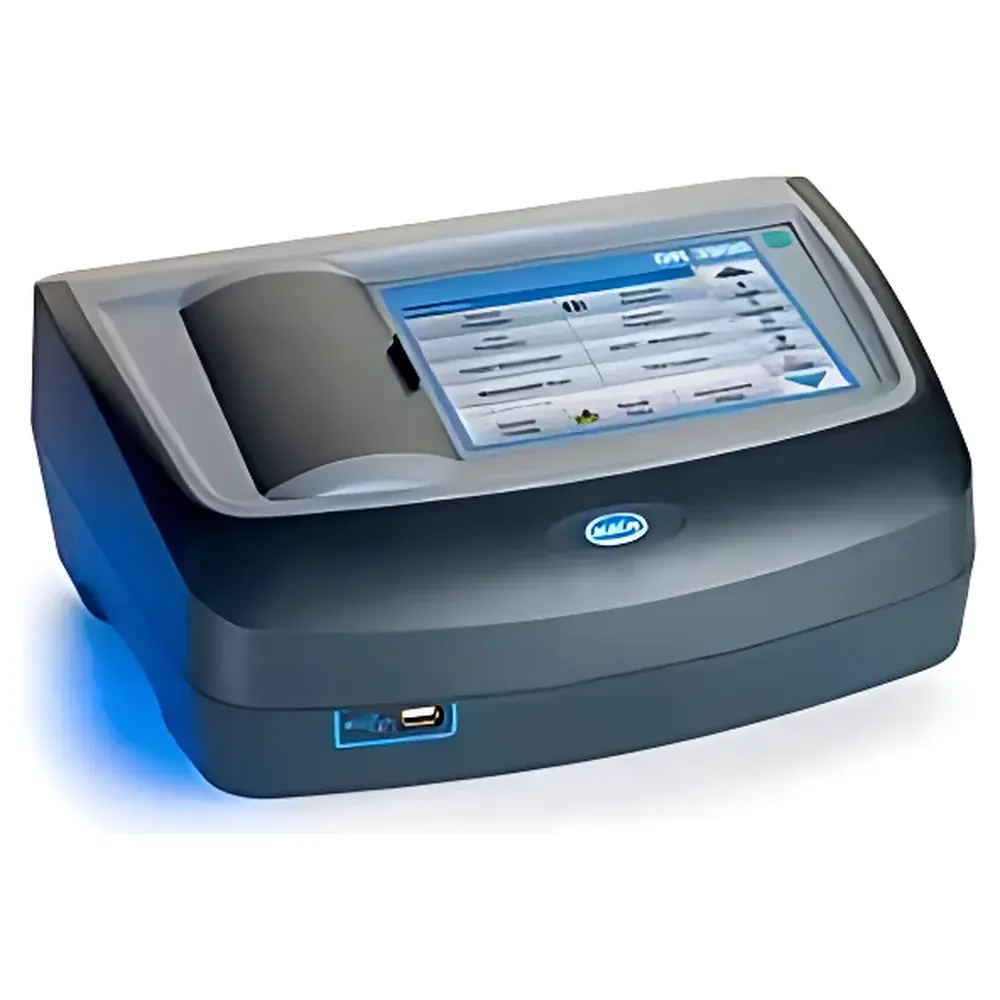
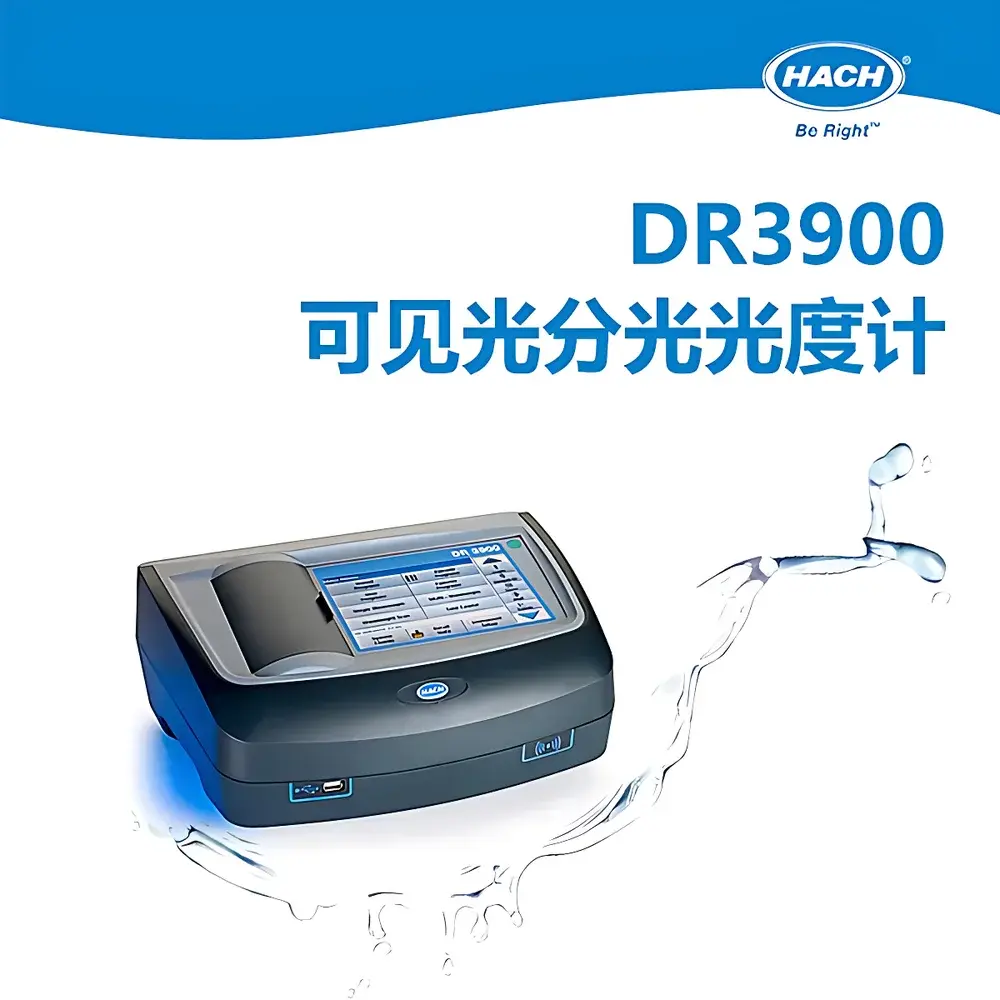
Hach DR3900 Benchtop Visible Spectrophotometer
| Brand | Hach |
|---|---|
| Origin | Imported |
| Manufacturer Type | Manufacturer |
| Model | DR3900 |
| Instrument Architecture | Dual-Beam |
| Detector Type | CCD Array |
| Wavelength Range | 320–1100 nm |
| Wavelength Accuracy | ±1.5 nm (340–900 nm) |
| Spectral Bandwidth | 5 nm |
| Stray Light | ≤0.001% T |
| Display | 7″ TFT WVGA Color Touchscreen (800 × 480 px) |
| Data Storage | 2000 Measurement Records |
| Preloaded Methods | >220 Standard Water Quality Methods |
| User-Defined Methods | Up to 100 |
| Barcode Recognition | Yes (Hach Predefined Reagents) |
| AQA Compliance Support | Yes |
| Connectivity | Ethernet, Dual USB Ports, Optional Printer Interface |
| Operating Environment | 10–40 °C, ≤80% RH (non-condensing) |
| Power Supply | 100–240 V AC, 50–60 Hz |
| Dimensions | 151 × 350 × 255 mm |
| Weight | 4.2 kg |
Overview
The Hach DR3900 Benchtop Visible Spectrophotometer is a dual-beam, microprocessor-controlled spectrophotometric analyzer engineered for precision, reproducibility, and regulatory alignment in water quality laboratories. Operating on the principle of absorbance-based photometry across the visible and near-UV spectrum (320–1100 nm), it employs a high-stability tungsten-halogen light source and a CCD array detector to deliver rapid, stable optical measurements with minimal drift. Its dual-beam architecture continuously compensates for lamp intensity fluctuations and environmental variability—critical for long-duration batch analysis or method validation under GLP-compliant workflows. Designed specifically for environmental, municipal, industrial, and academic water testing labs, the DR3900 bridges the gap between routine benchtop analysis and process-integrated online monitoring systems—enabling traceable, auditable, and interoperable data generation without manual transcription or secondary verification.
Key Features
- Dual-beam optical design with real-time reference beam compensation for enhanced baseline stability and measurement repeatability
- 7-inch WVGA color touchscreen interface (800 × 480 pixels) with intuitive, icon-driven navigation and on-screen procedural guidance—reducing operator-dependent error
- Automated wavelength selection synchronized to preloaded or user-defined methods; eliminates manual wavelength entry and associated misconfiguration risk
- Integrated barcode scanning for Hach’s line of certified, lot-specific reagent vials—ensuring method-to-reagent traceability and automatic method recall
- Advanced Quality Assurance (AQA) framework supporting configurable QA/QC routines—including standard verification, interference testing, and scheduled calibration checks—with full audit trail logging
- Multi-level user management with role-based access control (administrator, standard user) and password protection—supporting 21 CFR Part 11 readiness when paired with compliant software configurations
- On-instrument statistical processing: for critical parameters such as COD, the system automatically acquires 10 spatially distributed readings, identifies and excludes outliers using robust algorithmic filtering, and reports the mean value within 5 seconds
- Real-time firmware and method updates via Ethernet or USB—ensuring continuous alignment with evolving regulatory test protocols (e.g., EPA 4500-NO₂⁻, ISO 7027, ASTM D1253)
Sample Compatibility & Compliance
The DR3900 accommodates standard 10-mm rectangular cuvettes and Hach’s proprietary round vials (including TNTplus™ and LCK vials), supporting both liquid-phase absorbance measurement and turbidity quantification per ISO 7027. Its optical path design minimizes stray light (<0.001% T at 340 nm), enabling accurate low-absorbance measurements required for ultra-pure water or low-concentration nutrient assays. The instrument complies with IEC 61010-1 for electrical safety and meets electromagnetic compatibility requirements per EN 61326-1. When deployed with documented SOPs and version-controlled method files, the DR3900 supports compliance with ISO/IEC 17025 accreditation criteria, US EPA-approved laboratory practices, and GMP-aligned environmental monitoring programs.
Software & Data Management
Data integrity and interoperability are central to the DR3900’s architecture. Internal storage retains up to 2000 measurement records—including absorbance, transmittance, concentration, timestamp, operator ID, sample ID, and method metadata—with automatic time/date stamping and non-editable record locking. Dual USB ports facilitate secure export to encrypted USB drives, while the integrated Ethernet port enables direct integration into lab network infrastructures. Optional LINK2SC software extends functionality by synchronizing DR3900 laboratory results with SC1000 digital controller data streams—allowing side-by-side comparison of grab-sample and online sensor outputs. This bidirectional linkage permits remote, software-triggered recalibration of field probes based on validated lab reference values—eliminating site visits and reducing downtime. All exported data conform to CSV and XML formats compatible with LIMS platforms and comply with ALCOA+ principles (Attributable, Legible, Contemporaneous, Original, Accurate, Complete, Consistent, Enduring, Available).
Applications
- Regulatory compliance testing for drinking water, wastewater, and surface water per US EPA, ISO, and APHA standards
- Nutrient analysis (nitrate, nitrite, phosphate, ammonia) and organic load assessment (COD, TOC surrogates)
- Disinfectant residual monitoring (free chlorine, total chlorine, chlorine dioxide, ozone)
- Turbidity and suspended solids quantification in treatment optimization and filtration validation
- Educational laboratories requiring method transparency, student-accessible interfaces, and curriculum-aligned test protocols
- Industrial process water QC where rapid turnaround and method traceability are essential for ISO 9001 or ISO 14001 conformance
FAQ
Does the DR3900 support GLP or 21 CFR Part 11 compliance?
Yes—when operated with controlled access, electronic signatures enabled via external authentication systems, and audit-trail-enabled software (e.g., LINK2SC with configured archiving), the DR3900 can meet core technical requirements for regulated environments.
Can the DR3900 measure outside the visible range?
It operates from 320 nm to 1100 nm, covering near-UV through visible to near-infrared—sufficient for most water quality parameters but not deep-UV applications below 320 nm.
Is method validation documentation available?
Hach provides method performance summaries, detection limit data, and interlaboratory validation reports for all preloaded methods upon request—aligned with ISO/IEC 17025 clause 7.2.2.
How is wavelength accuracy verified during routine use?
The instrument performs automated wavelength calibration using internal holmium oxide and didymium filters; users may schedule or trigger this check manually as part of AQA protocols.
What happens if a barcode cannot be read?
The system defaults to manual method selection with visual confirmation prompts—and logs the event in the QA audit trail for review.
Related Products





