
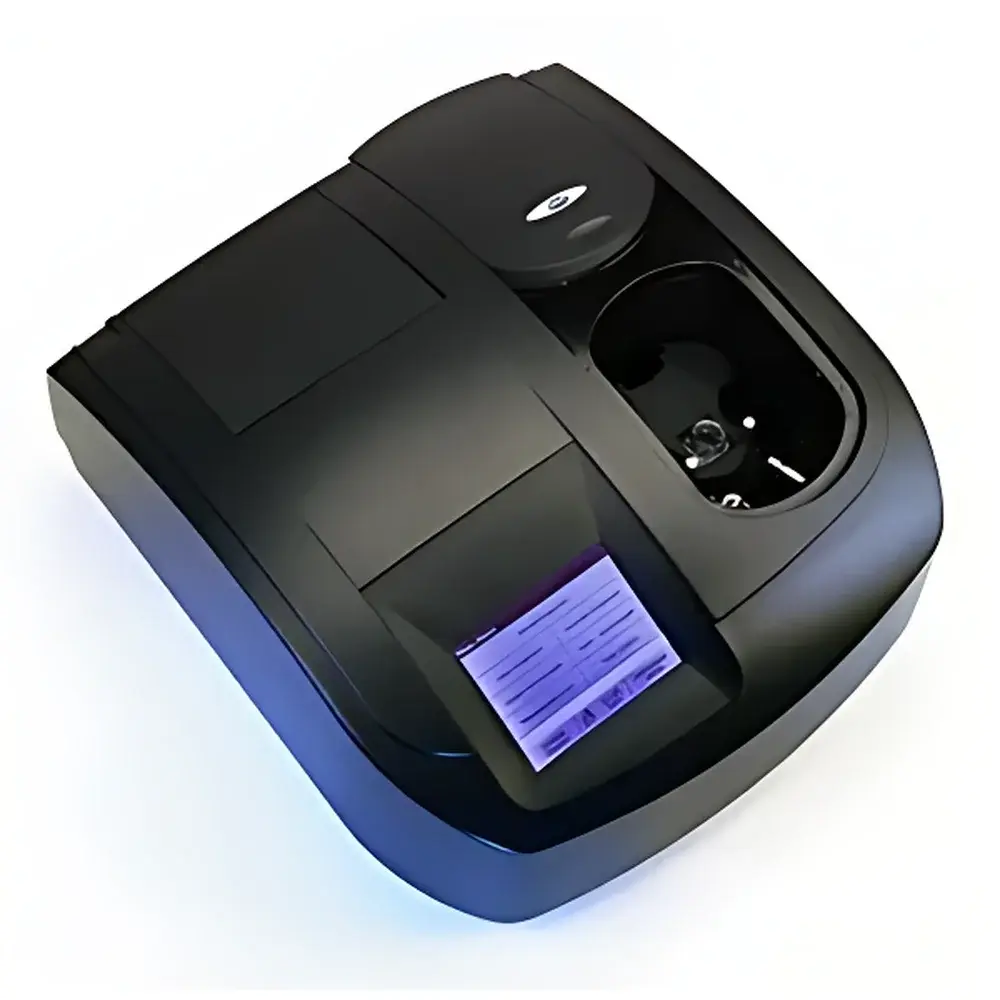
Hach DR5000 Benchtop UV-Vis Spectrophotometer
| Brand | Hach |
|---|---|
| Origin | Imported |
| Manufacturer Type | Manufacturer |
| Model | DR5000 |
| Instrument Architecture | Dual-Wavelength |
| Detector Type | CCD Array |
| Wavelength Range | 190–1100 nm |
| Wavelength Accuracy | ±1 nm (200–900 nm) |
| Spectral Bandwidth | 2 nm |
| Stray Light | < 0.05% T (KI solution at 220 nm) |
| Automation Level | Automatic Wavelength Selection & Calibration |
| Data Storage Capacity | 2000 measurement records with timestamp, sample ID, operator code, and method metadata |
| Interface | USB 1.1 (for PC connectivity, printer, keyboard, and firmware/data transfer) |
| Power Supply | 200–240 V, 50/60 Hz |
| Weight | 15.5 kg |
| Operating Environment | 10–40 °C, ≤90% RH (non-condensing) |
Overview
The Hach DR5000 Benchtop UV-Vis Spectrophotometer is a precision-engineered dual-wavelength spectrophotometric platform designed for routine and regulatory-compliant water quality analysis in laboratory and field-support settings. Operating on the principle of absorbance spectroscopy—based on the Beer-Lambert law—the instrument quantifies analyte concentration by measuring light attenuation across the ultraviolet and visible spectrum (190–1100 nm). Its optical architecture features a high-stability tungsten-halogen and deuterium lamp source combined with a holographic grating monochromator and a thermoelectrically stabilized CCD array detector. This configuration ensures robust photometric reproducibility (<0.002 ABS drift over 1 hour), low-noise signal acquisition, and long-term wavelength fidelity—critical for multi-parameter compliance testing under EPA, ISO 7027, ASTM D1253, and APHA Standard Methods.
Key Features
- Pre-calibrated, method-driven operation: Built-in library of over 250 validated water quality methods—including nitrate, phosphate, ammonia, COD, TOC surrogates, heavy metals (e.g., Cr, Cu, Fe), and disinfectant residuals (Cl₂, ClO₂, O₃)—enabling direct concentration readout without manual calibration curves.
- Barcode-enabled reagent recognition: Automatically identifies Hach’s pre-packaged, barcode-labeled reagents (e.g., TNTplus vials, LCK cuvettes), loads corresponding method parameters, and initiates blank correction and measurement sequence.
- Statistical measurement protocol: Acquires ten consecutive readings per sample, applies outlier rejection (Dixon’s Q-test), and reports the mean result within 10 seconds—enhancing measurement robustness in turbid or heterogeneous matrices.
- Touchscreen interface with multilingual support: 7-inch capacitive LCD display with intuitive, icon-driven navigation; supports English, Spanish, French, German, and Chinese language overlays for global lab deployment.
- Integrated flow cell option: Enables sub-mg/L detection of low-concentration analytes (e.g., nitrite, orthophosphate) via extended pathlength and minimized sample volume requirements (as low as 1.5 mL).
- Secure data governance: Password-protected user access levels (Operator, Supervisor, Administrator), audit-trail-capable event logging (method changes, calibration events, data exports), and timer-based session timeout—aligned with GLP and 21 CFR Part 11 readiness requirements.
Sample Compatibility & Compliance
The DR5000 accommodates standard 10 mm, 20 mm, 50 mm square cuvettes, and Hach-specific round vials (13 mm, 16 mm). It supports both transmission and reflectance measurements for suspended solids or colored samples. All factory-loaded methods are developed and verified per U.S. EPA guidance documents (e.g., Method 365.4 for phosphate, Method 353.2 for nitrate/nitrite) and harmonized with ISO 8466-1 (calibration function validation) and ISO 15839 (performance verification of water analyzers). Instrument qualification documentation—including Installation Qualification (IQ), Operational Qualification (OQ), and Performance Qualification (PQ) templates—is provided to support regulated environments (municipal labs, contract testing facilities, pharmaceutical water systems).
Software & Data Management
Data management is executed via Hach’s proprietary DR Utility software (Windows-compatible), which enables secure export of measurement records in CSV, PDF, or XML formats—with embedded metadata (date/time stamp, operator ID, method version, instrument serial number). The USB 1.1 interface supports encrypted firmware updates, batch method deployment, and synchronized backup of all 2000 stored results—including full spectral scans (absorbance vs. wavelength) where applicable. Audit trails record every critical action: method selection, calibration execution, data deletion, and user login/logout. Optional integration with LIMS via HL7 or ASCII flat-file protocols is supported through configurable export profiles.
Applications
The DR5000 serves as a primary analytical tool in municipal wastewater treatment plants (BOD/COD monitoring), drinking water utilities (disinfection byproduct precursors, iron/manganese control), industrial effluent compliance (textile dye discharge, electroplating rinse waters), environmental monitoring agencies (nutrient loading assessments in lakes/rivers), and academic teaching laboratories (kinetic studies, equilibrium constant determination). Its dual-wavelength capability enables simultaneous background correction (e.g., 700 nm reference for turbidity compensation in low-concentration phosphate assays), improving accuracy in real-world water matrices.
FAQ
Does the DR5000 comply with 21 CFR Part 11 requirements?
Yes—when used with DR Utility software v3.2 or later and configured with role-based authentication, electronic signatures, and immutable audit trails, it meets predicate rule requirements for electronic records and signatures in regulated laboratories.
Can custom methods be validated and locked for routine use?
Yes—up to 50 user-defined methods may be created, verified against reference standards, and digitally signed to prevent unauthorized modification.
Is spectral scanning functionality available?
Yes—the instrument supports full-spectrum acquisition (190–1100 nm, 1 nm increments) with peak identification, derivative analysis, and baseline correction tools for research-grade applications.
What maintenance is required to sustain wavelength accuracy?
Automatic self-calibration occurs at startup using internal holmium oxide and didymium filters; no manual alignment or lamp replacement calibration is needed during normal operation.
How is data integrity ensured during USB transfer?
All exported files include SHA-256 checksums and embedded digital signatures; DR Utility validates file integrity upon import to prevent tampering or corruption.
Related Products




