
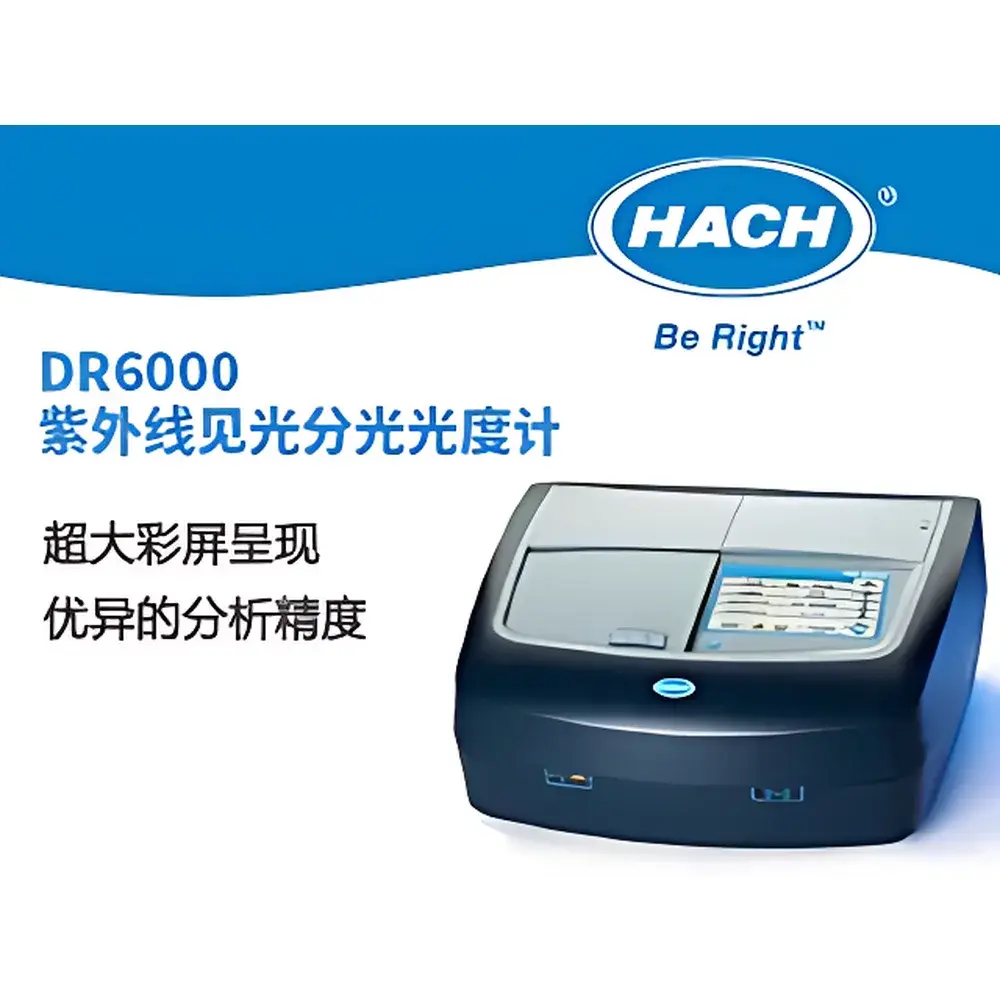
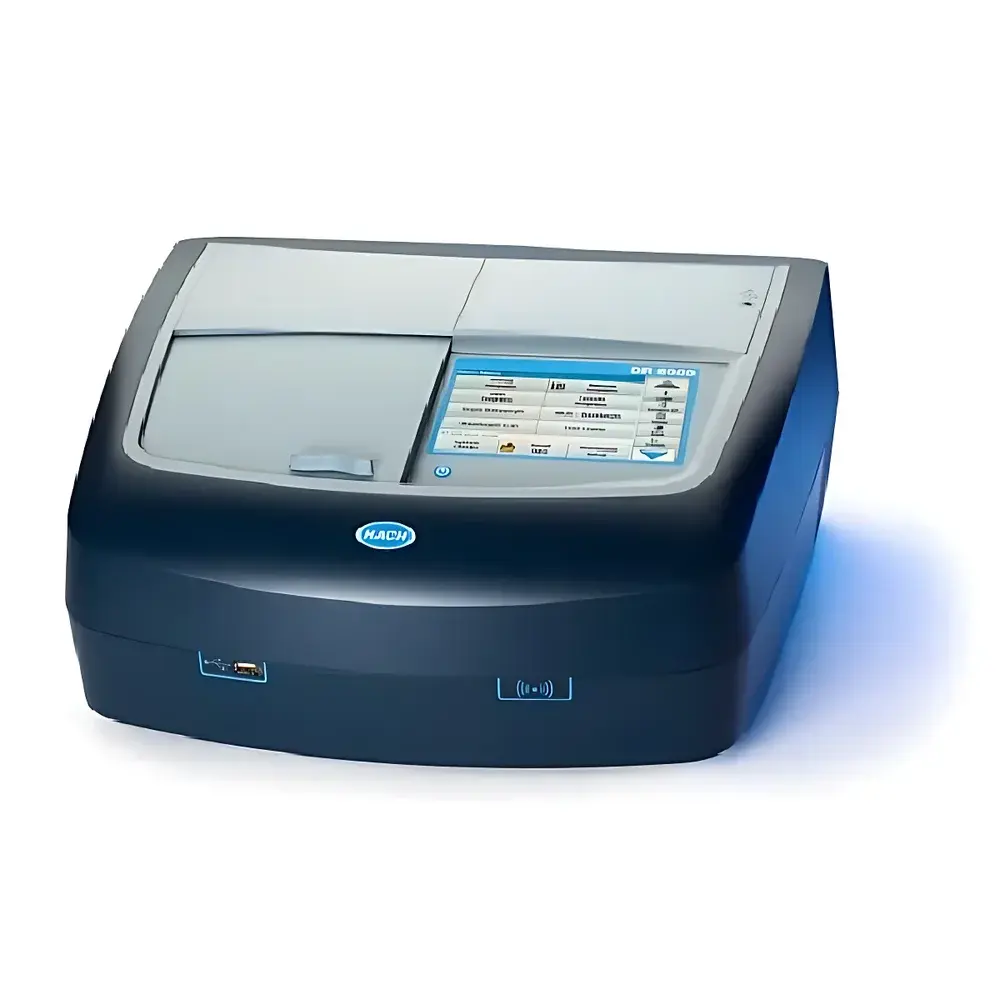
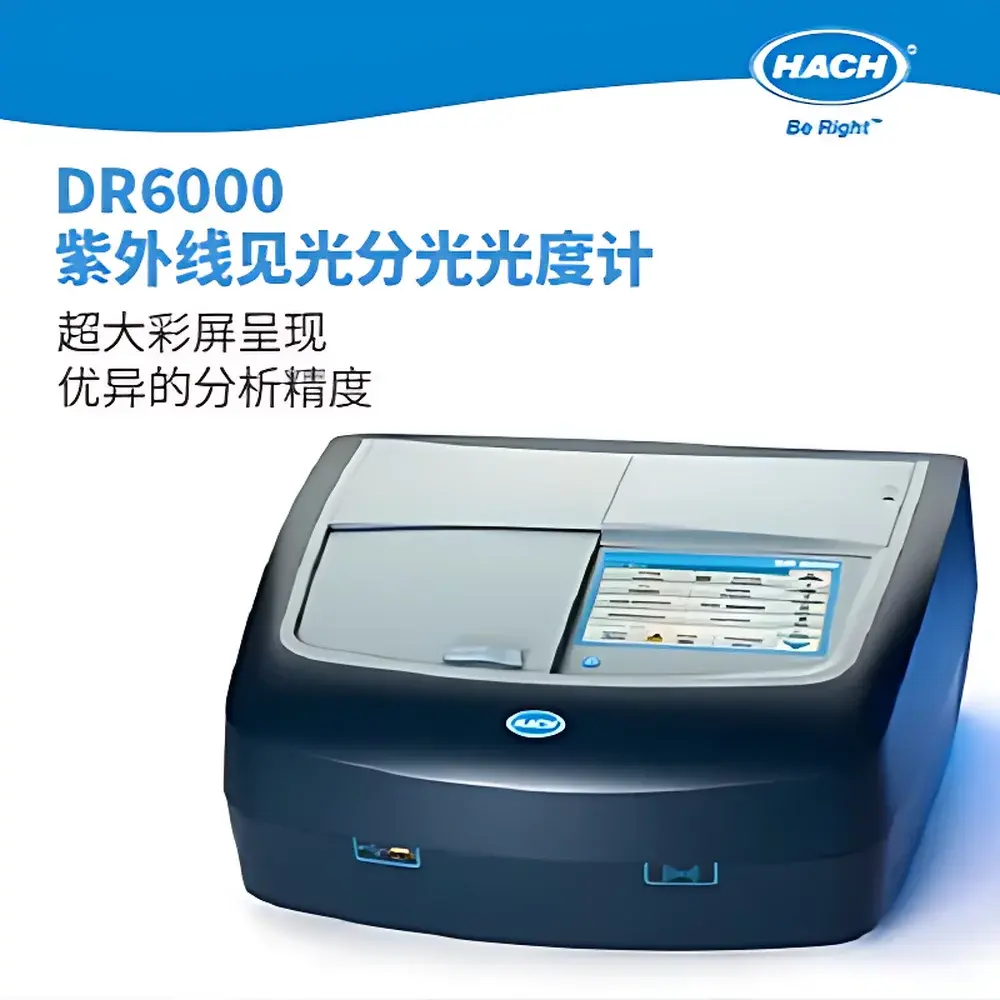
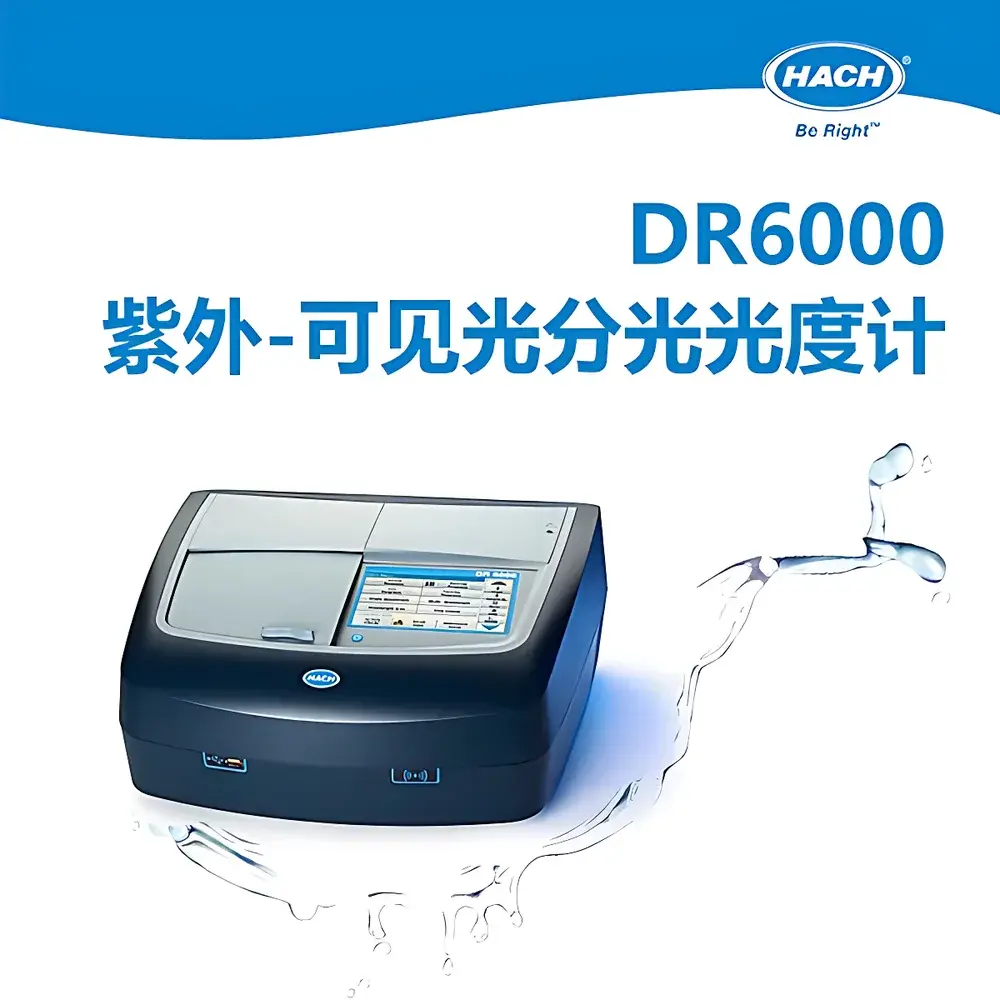
Hach DR6000 UV-Vis Spectrophotometer
| Brand | Hach |
|---|---|
| Origin | Imported |
| Manufacturer Type | Manufacturer |
| Model | DR6000 |
| Optical Design | Pseudo-Double-Beam |
| Detector | CCD Array |
| Wavelength Range | 190–1100 nm |
| Wavelength Automation | Automatic |
| Spectral Bandwidth | 2 nm |
| Wavelength Accuracy | ±1 nm (200–900 nm) |
| Stray Light | <3.3 Abs / <0.05% T (KI solution at 220 nm) |
Overview
The Hach DR6000 UV-Vis Spectrophotometer is a high-performance, laboratory-grade spectrophotometric analyzer engineered for precise quantitative and qualitative analysis of aqueous samples across the ultraviolet and visible spectrum (190–1100 nm). Utilizing a pseudo-double-beam optical architecture with a deuterium lamp (UV) and tungsten-halogen lamp (VIS), combined with a Czerny-Turner monochromator and CCD array detector, the DR6000 delivers exceptional photometric stability, high wavelength reproducibility (<0.1 nm), and robust baseline integrity. Its 2 nm spectral bandwidth ensures optimal resolution for routine water quality parameters—such as nitrate, phosphate, ammonia, heavy metals (e.g., Cr, Cu, Pb), TOC surrogates, and organic contaminants—without compromising measurement speed or signal-to-noise ratio. Designed in accordance with ISO 9001 manufacturing standards and validated against ASTM D511, D1253, and EPA Methods 4500-NO3−, 4500-PO43−, and 365.1, the instrument meets the technical and regulatory expectations of environmental testing laboratories operating under ISO/IEC 17025, US EPA Contract Lab Program (CLP), and GLP-compliant workflows.
Key Features
- 7-inch full-color capacitive touchscreen with intuitive icon-driven navigation—enabling method creation, calibration, and result review in ≤3 taps
- Built-in library of 250+ pre-programmed, method-validated analytical procedures—including EPA, APHA, and Standard Methods protocols—for immediate deployment
- Integrated AQA (Advanced Quality Assurance) module supporting scheduled verification, calibration tracking, audit trail generation, and electronic record retention per FDA 21 CFR Part 11 requirements
- IBR+ (Intelligent Barcode Recognition) system automatically identifies Hach’s 2D barcoded reagent vials—loading method parameters, lot-specific calibration curves, and expiry data without manual entry
- Automated multi-point measurement: acquires 10 sequential readings per sample, detects and excludes outliers using iterative Grubbs’ test, and reports mean absorbance within 10 seconds
- Modular expansion support: optional rotary sample changer (7-position), thermostatic cuvette holder, flow cell interface, and DRB200 digester integration for digestion-coupled assays (e.g., total phosphorus, COD)
- Triple USB connectivity (2× Type-A, 1× Type-B) + Gigabit Ethernet port—enabling direct LIMS synchronization, remote firmware updates, and secure data export via SFTP or HTTPS
Sample Compatibility & Compliance
The DR6000 accommodates standard rectangular cells (10, 20, 50 mm pathlengths), round 1-inch cells, and flow-through cells (10 mm). Its optical design minimizes scattering artifacts in turbid samples, and the 3.0 Abs photometric range supports high-concentration analyses without dilution. All preloaded methods are traceable to NIST-traceable reference standards and undergo annual interlaboratory validation by Hach’s Global Methods Validation Center. Instrument performance verification follows ASTM E275 and ISO 6060 protocols; stray light compliance (<0.05% T at 220 nm, KI) satisfies ISO 10810 Annex B requirements for UV-sensitive applications. Data integrity controls—including user-level access tiers (Operator, Supervisor, Administrator), electronic signatures, and immutable audit logs—support compliance with ISO/IEC 17025:2017 Clause 7.7 and EU Annex 11.
Software & Data Management
Hach’s DR6000 operates on embedded Linux-based firmware with real-time OS scheduling for deterministic response latency. Measurement data—including raw spectra, processed concentrations, metadata (operator ID, timestamp, cuvette ID, reagent lot), and QA/QC flags—are stored locally (5000 results + 200 custom methods) and synchronized to network drives or cloud repositories via configurable export schedules. The instrument natively exports CSV, XML, and PDF reports compliant with LIMS ingestion schemas (e.g., LabWare, STARLIMS, Thermo Fisher SampleManager). Optional Hach Link software provides advanced spectral overlay, kinetic trend analysis, and multivariate calibration (PLS) development—validated for use in method transfer between DR6000 units across distributed lab networks.
Applications
- Environmental monitoring: Routine analysis of surface water, wastewater effluent, drinking water, and groundwater per EPA Clean Water Act and Safe Drinking Water Act mandates
- Industrial process control: Real-time quantification of biocide residuals (e.g., chlorine dioxide), corrosion inhibitors, and nutrient dosing in cooling towers and boiler feedwater
- Public health laboratories: Detection of arsenic, fluoride, cyanide, and nitrite in community water systems under CDC ELITE and WHO guidelines
- Academic and research institutions: Teaching spectroscopic principles, method development for emerging contaminants (e.g., microplastics leachates, PFAS surrogates), and validation of novel colorimetric assays
- Food & beverage QA: Quantitative analysis of colorants, antioxidants (e.g., polyphenols), and fermentation metabolites (e.g., diacetyl in beer) using application-specific method packs
FAQ
Does the DR6000 support GLP-compliant electronic records and signatures?
Yes—the instrument enforces role-based authentication, time-stamped audit trails, and non-erasable electronic signatures aligned with FDA 21 CFR Part 11 Subpart B requirements.
Can the DR6000 be integrated into an existing LIMS without middleware?
Yes—its native Ethernet interface supports direct HL7 and ASTM E1384-compliant data streaming; no third-party drivers or gateways are required.
Is method validation documentation available for preprogrammed tests?
Hach provides full validation packages—including accuracy, precision, LOD/LOQ, linearity, and robustness data—for all 250+ built-in methods upon request under NDA.
What is the recommended calibration frequency for routine water testing?
Per Hach Technical Bulletin TB-001, wavelength calibration is verified daily using holmium oxide or didymium filters; photometric calibration is performed weekly with neutral density filters and annually with NIST-traceable standards.
Are consumables such as lamps and cuvettes covered under warranty?
Lamps are consumables excluded from standard warranty; however, the DR6000’s lamp life monitoring system alerts users 100 hours prior to end-of-life, minimizing unplanned downtime.
Related Products



