
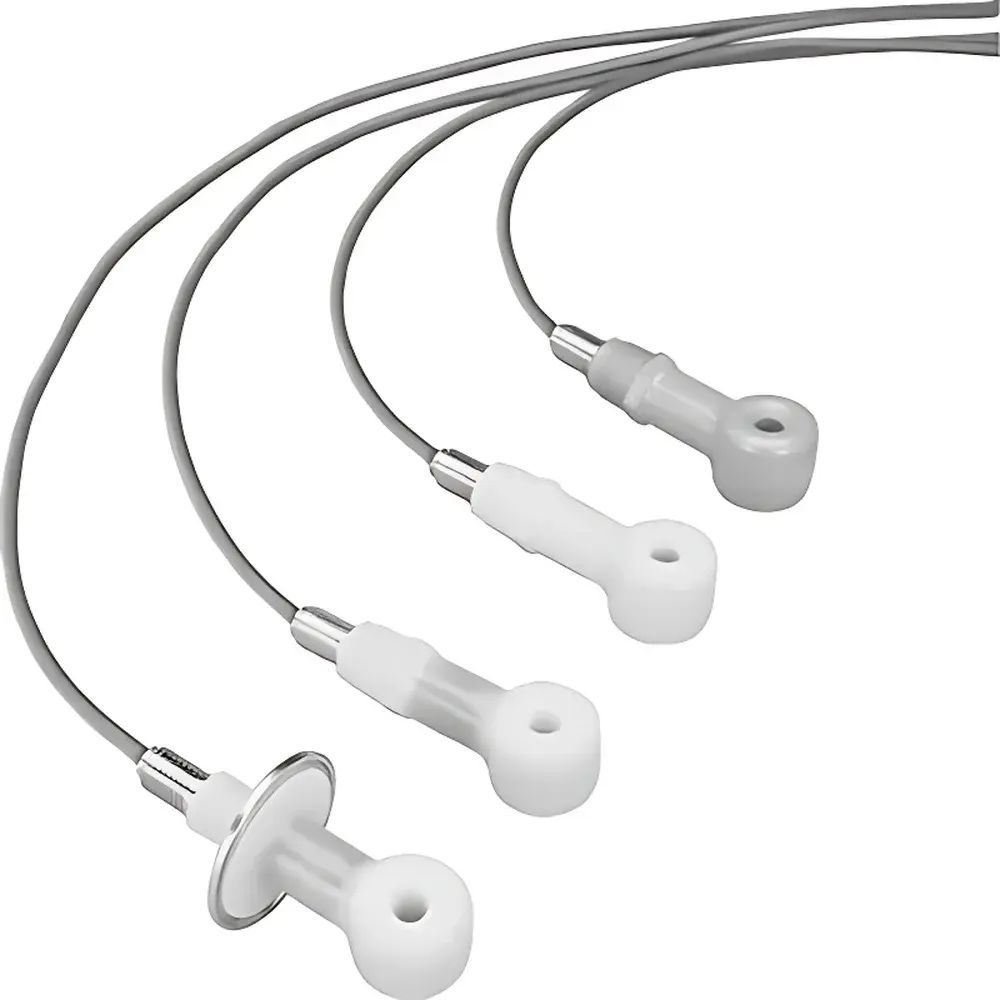
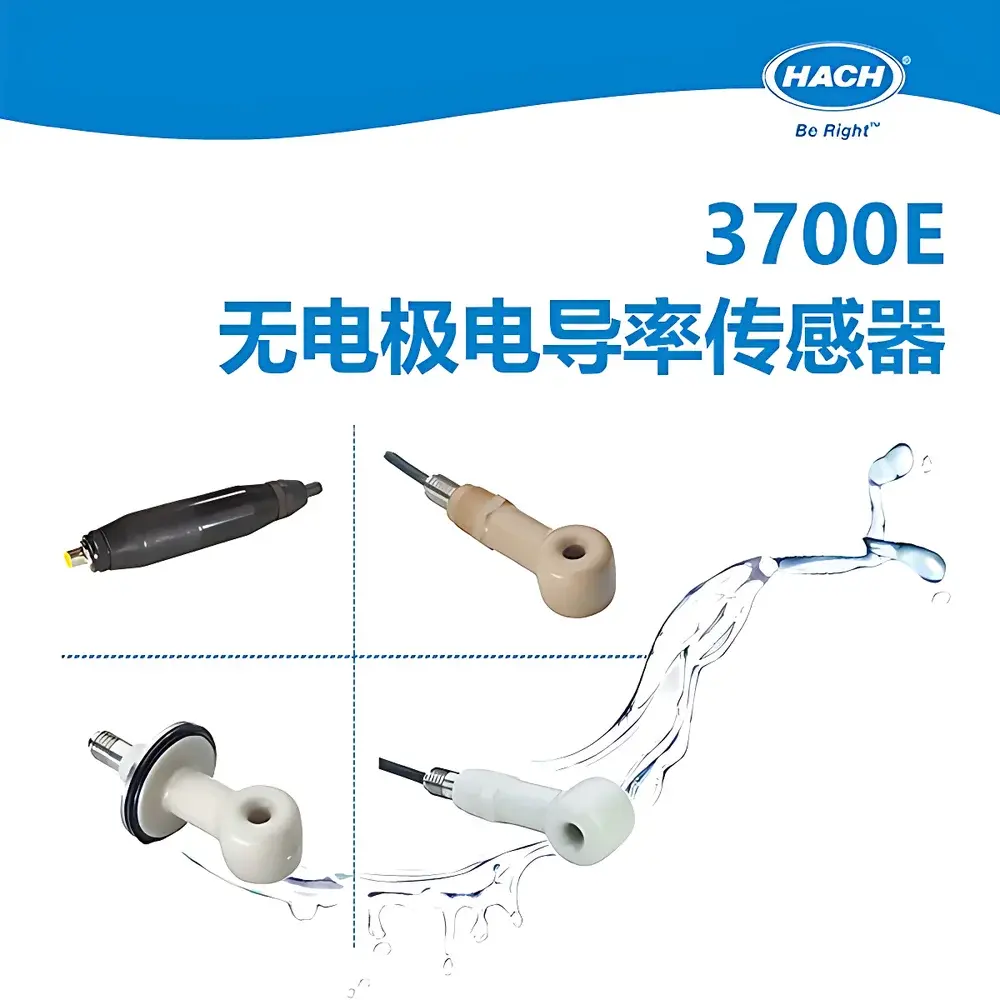
HACH GLI 3700E Series Electrodeless Conductivity Sensor
| Brand | HACH |
|---|---|
| Origin | Imported |
| Manufacturer Type | Manufacturer |
| Model | GLI 3700E |
| Price | Upon Request |
| Measurement Principle | Inductive (Toroidal) Conductivity Sensing |
| Range | 0–2,000,000 µS/cm |
| Wetted Materials | Polypropylene, PEEK, PFA Teflon®, or PVDF |
| Sample Temperature Range | −10 to 200 °C |
| Max Flow Rate | 3 m/s |
| Pressure Rating | Up to 200 psig at 150 °C |
| Accuracy | ±0.01% of reading across full range |
| Weight | 0.45 kg |
| Cable | Standard 20-ft integrated cable |
| Temperature Compensation | Automatic |
Overview
The HACH GLI 3700E Series Electrodeless Conductivity Sensor is an inductively coupled (toroidal) conductivity measurement device engineered for long-term reliability and precision in demanding online water quality monitoring applications. Unlike traditional two- or four-electrode sensors, the 3700E operates on the principle of electromagnetic induction: a drive coil (Coil A) generates an alternating magnetic field that induces a closed-loop current within the conductive solution flowing through the sensor body. A separate detection coil (Coil B) measures the magnitude of this induced current, which is directly proportional to the solution’s conductivity. This non-contact measurement architecture eliminates electrode polarization, fouling, corrosion, and coating-related drift—critical advantages in wastewater, boiler feedwater, chemical process streams, and high-purity water systems where conventional electrodes rapidly degrade or require frequent cleaning and recalibration.
Key Features
- Electrodeless toroidal design ensures immunity to surface contamination, scaling, oil film interference, and electrochemical polarization—enabling stable operation in aggressive, high-solids, or viscous media.
- Full-range accuracy of ±0.01% of reading across 0–2,000,000 µS/cm, supported by factory calibration traceable to NIST standards.
- Four wetted material options—polypropylene (PP), polyvinylidene fluoride (PVDF), polyether ether ketone (PEEK), and perfluoroalkoxy alkane (PFA Teflon®)—allow chemical compatibility optimization for acidic, alkaline, oxidizing, or high-temperature environments.
- Integrated automatic temperature compensation (ATC) using a built-in Pt1000 RTD sensor; valid across −10 to 200 °C, with compensation algorithm conforming to ASTM D1125 and ISO 7888.
- Robust mechanical construction rated for continuous operation at up to 200 psig (13.8 bar) at 150 °C, with flow tolerance up to 3 m/s—suitable for pressurized pipelines, steam condensate return lines, and industrial effluent channels.
- Standard 6.1-meter (20-ft) shielded, jacketed, and moisture-resistant integrated cable simplifies installation and minimizes signal noise in electrically noisy plant environments.
Sample Compatibility & Compliance
The GLI 3700E series is validated for use in aqueous solutions across municipal, industrial, and pharmaceutical water treatment processes—including raw intake water, activated sludge effluent, reverse osmosis permeate, ultra-pure water (UPW), and chemical dosing streams. Its compliance profile supports integration into regulated environments: the sensor’s analog 4–20 mA output and optional digital HART® interface are compatible with SCADA, DCS, and PLC-based control architectures meeting IEC 61511 (functional safety) and ISA-84 requirements. When paired with HACH’s SC1000 or CL17 controllers, the system supports audit-trail-enabled data logging aligned with FDA 21 CFR Part 11 and EU Annex 11 expectations for electronic records in GMP water systems.
Software & Data Management
While the 3700E sensor itself is analog-output–based, it is fully interoperable with HACH’s suite of intelligent transmitters and data acquisition platforms. The SC1000 Universal Controller provides real-time linearization, configurable alarm thresholds, trend logging (up to 30 days of 1-minute intervals), and Modbus TCP/RTU export for enterprise-level historian integration (e.g., OSIsoft PI, Ignition, or DeltaV). All calibration events, diagnostic logs (e.g., coil integrity checks, temperature deviation alerts), and configuration changes are timestamped and stored with user ID attribution—supporting GLP/GMP documentation requirements. Firmware updates and configuration backups are performed via USB or Ethernet without sensor removal.
Applications
- Continuous monitoring of conductivity in municipal wastewater influent and effluent streams for regulatory reporting under EPA NPDES permits.
- In-boiler and feedwater conductivity surveillance in power generation facilities to detect condenser tube leaks and minimize corrosion risk.
- Monitoring of cleaning-in-place (CIP) rinse cycles in food & beverage and biopharmaceutical manufacturing, where rapid, drift-free response to low-conductivity water breakthrough is essential.
- Chemical concentration control in plating baths, etchant solutions, and acid regeneration systems—leveraging the sensor’s resistance to aggressive chemistries and thermal cycling.
- High-purity water loop monitoring in semiconductor fab UPW distribution networks, where sub-µS/cm resolution and zero electrode leaching are mandatory.
FAQ
How does the electrodeless design improve long-term measurement stability compared to contact-type sensors?
The absence of exposed electrodes eliminates electrochemical degradation mechanisms—including passivation, chloride pitting, and silver/silver chloride reference drift—resulting in calibration intervals extended to 6–12 months under typical operating conditions.
Can the GLI 3700E be installed in sanitary (3-A or EHEDG-compliant) process lines?
Yes—when configured with PEEK or PFA Teflon® wetted parts and mounted using tri-clamp or hygienic threaded adapters, the sensor meets 3-A SSI Standard 68-03 and EHEDG Doc. 8 requirements for clean-in-place compatibility.
Is temperature compensation fully automatic and configurable?
Yes—the integrated Pt1000 RTD enables real-time, linearized compensation per the Callendar-Van Dusen equation; users may select between NaCl-based or KCl-based reference curves via transmitter configuration.
What is the minimum conductivity detectable with full accuracy?
The sensor maintains ±0.01% of reading accuracy down to 1 µS/cm when used with a properly shielded signal path and low-noise transmitter; effective lower limit is governed by cable length and grounding practices.
Does HACH provide validation documentation for pharmaceutical applications?
Yes—IQ/OQ protocols, material compliance certificates (USP Class VI, FDA 21 CFR 177), and traceable calibration reports are available upon request for GMP water system qualification.
Related Products







