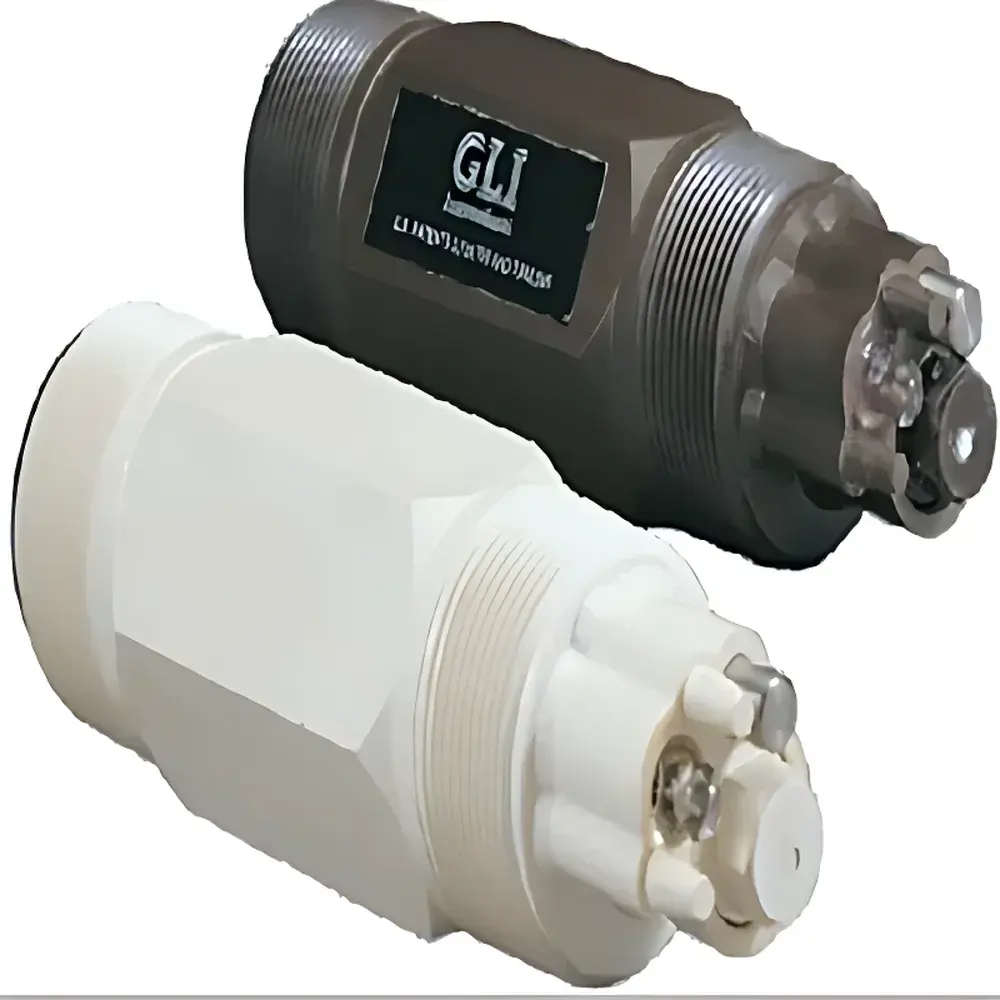
HACH GLI PHD Differential pH/ORP Electrode
| Brand | HACH |
|---|---|
| Origin | Imported |
| Manufacturer | HACH (GLI Division) |
| Model | GLI PHD |
| pH Range | -2 to 14 |
| ORP Range | -1500 to +1500 mV |
| pH Accuracy | ±0.01 pH |
| ORP Accuracy | ±0.5 mV |
| Temperature Range | -5 to 105 °C |
| Max Pressure | 6.9 bar at 105 °C |
| Electrode Body Material | PEEK or Ryton |
| Reference System | Replaceable Salt Bridge |
| Output | Integrated Pre-amplifier |
| Mounting Options | Sanitary, Threaded, Flanged, and Submersible Configurations |
| Patent | US Patent No. 6,398,181 B1 |
Overview
The HACH GLI PHD Differential pH/ORP Electrode is an engineered solution for continuous, high-integrity pH and oxidation-reduction potential (ORP) measurement in demanding industrial process environments. Unlike conventional two-electrode pH sensors—comprising a glass measuring electrode and a single reference electrode—the GLI PHD implements a patented three-electrode differential architecture. This configuration includes two identical measuring electrodes and one stable background reference electrode immersed in the process medium. The instrument computes the voltage difference between the two measuring electrodes relative to the background reference, effectively canceling out common-mode drifts induced by liquid junction potential instability, reference electrode contamination, or ground-loop interference. This differential principle eliminates the need for a traditional Ag/AgCl reference element in direct contact with the process stream, thereby mitigating clogging, poisoning, and electrolyte depletion—key failure modes in harsh chemical, wastewater, pharmaceutical, and food & beverage applications. The sensor is designed for long-term stability under variable temperature, pressure, and conductivity conditions, supporting uninterrupted operation in both closed-loop control systems and open-channel monitoring.
Key Features
- Patented differential measurement technology (US Patent No. 6,398,181 B1) enabling true drift compensation without reliance on conventional reference junctions.
- Integrated solid-state preamplifier housed within the electrode body, minimizing signal attenuation and noise susceptibility over extended cable runs.
- Selectively configurable electrode body material: PEEK (polyether ether ketone) for dimensional stability across thermal cycles; Ryton (PPS) for superior resistance to caustic solutions above pH 12.
- Replaceable salt bridge module—field-serviceable without sensor replacement—extending operational lifetime and reducing total cost of ownership.
- Multiple certified mounting options: tri-clamp sanitary fittings (3A compliant), NPT threaded, DIN flange, and submersible housings—compatible with ASME BPE, EHEDG, and FDA-compliant piping systems.
- Rated for continuous operation up to 105 °C and 6.9 bar (100 psi), with full performance validation across the entire pH range (–2 to 14) and ORP range (–1500 to +1500 mV).
Sample Compatibility & Compliance
The GLI PHD electrode demonstrates robust compatibility with aggressive process streams including chlorinated brines, sodium hydroxide scrubbers, sulfuric acid dosing lines, anaerobic digesters, and sterile bioreactor effluents. Its differential architecture inherently resists fouling from sulfides, heavy metals, proteins, and suspended solids—common interferents that degrade conventional reference electrodes. The sensor meets requirements for use in GMP-regulated environments: its design supports audit-ready calibration logging, and when paired with HACH SC1000 or HQ40d transmitters, enables full 21 CFR Part 11 compliance—including electronic signatures, user access control, and immutable audit trails. It conforms to ISO 7027 for turbidity-robust measurement integrity and aligns with ASTM D1293 (Standard Test Method for pH of Water) and EN ISO 10523 (Water Quality — Determination of pH) for laboratory-grade traceability in online deployment.
Software & Data Management
When interfaced with HACH’s IntelliCAL™ platform or the GLI Series 3000 transmitter, the PHD electrode supports automated calibration verification (ACV), multi-point slope/offset diagnostics, and real-time drift trending. Data export adheres to Modbus RTU/TCP and HART 7 protocols, enabling seamless integration into DCS, SCADA, and MES platforms (e.g., Siemens PCS7, Emerson DeltaV, Rockwell FactoryTalk). Firmware updates preserve metrological traceability via NIST-traceable calibration constants embedded in the sensor’s EEPROM. All calibration events—including buffer recognition, temperature compensation coefficients, and electrode impedance checks—are timestamped and stored with user ID attribution, satisfying GLP/GMP data integrity requirements.
Applications
- Chemical manufacturing: pH control in neutralization reactors, caustic scrubber loops, and chlorine dioxide generation.
- Pharmaceutical water systems: continuous monitoring of purified water (PW) and water-for-injection (WFI) per USP and EU Annex 1.
- Food & beverage processing: inline acidity control during fermentation, CIP rinse verification, and dairy product standardization.
- Municipal and industrial wastewater: ORP-guided denitrification, disinfection residual management, and anaerobic digester optimization.
- Power plant chemistry: condensate polishing, boiler feedwater pH monitoring, and hydrazine residual tracking.
FAQ
How does differential measurement improve long-term stability compared to conventional pH sensors?
It eliminates dependence on a single liquid junction potential by referencing two identical measuring electrodes against a stable background reference—thereby rejecting common-mode drift sources such as reference contamination, temperature gradients, and ground noise.
Can the GLI PHD be calibrated using standard NIST-traceable buffers?
Yes—calibration follows standard two- or three-point procedures using pH 4.01, 7.00, and 10.01 buffers; the differential architecture ensures slope consistency remains within ±0.5% over 90 days without recalibration in stable processes.
Is the replaceable salt bridge compatible with all GLI PHD configurations?
Yes—the modular salt bridge assembly is standardized across PEEK and Ryton variants and requires no special tools for field replacement.
Does the integrated preamplifier support connection to third-party transmitters?
Yes—output is a low-impedance, buffered mV signal compatible with any pH/ORP transmitter accepting high-impedance differential inputs (e.g., Yokogawa, Endress+Hauser, ABB).
What documentation is provided for regulatory validation?
Each unit ships with a Certificate of Conformance, material traceability records (including RoHS/REACH declarations), and optional IQ/OQ protocols aligned with ASTM E2500 and GAMP5 guidelines.
Related Products