
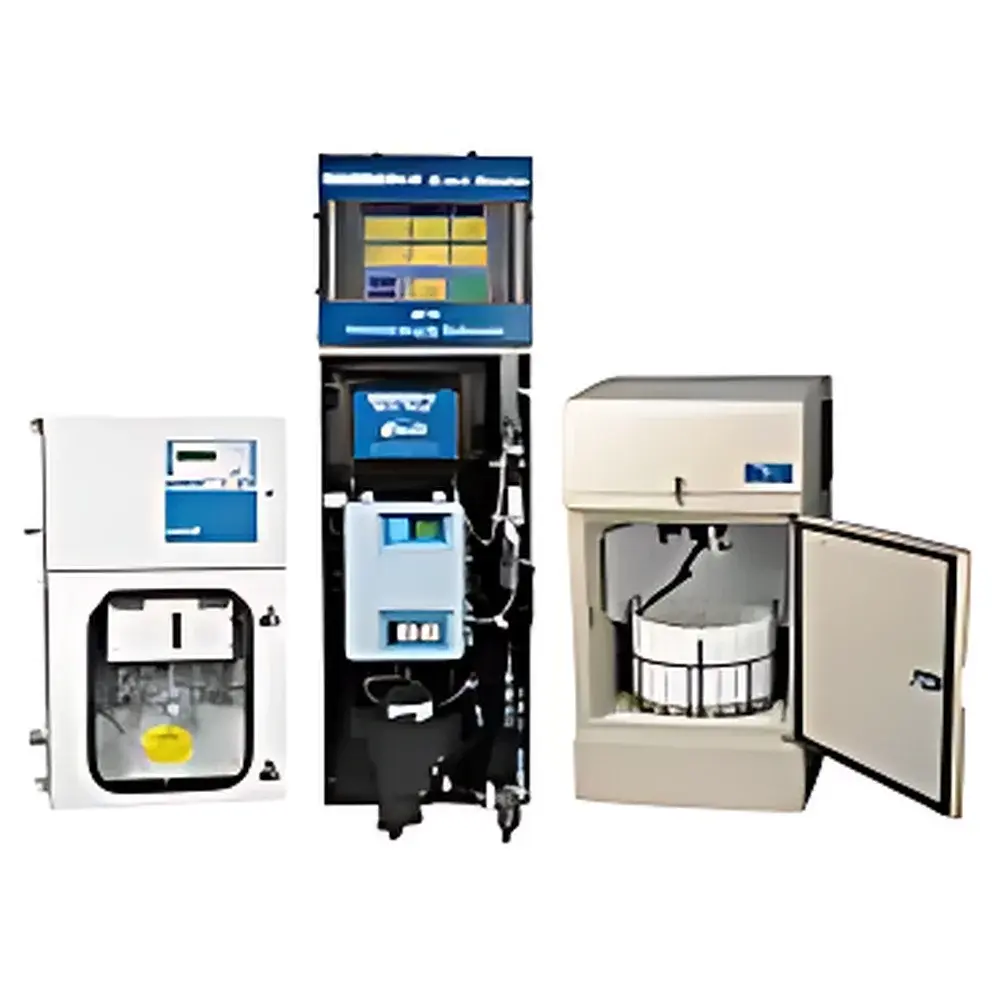
Hach GUARDIAN BLUE Early Warning System for Drinking Water Security
| Brand | Hach |
|---|---|
| Origin | Imported |
| Manufacturer Type | Manufacturer |
| Model | GUARDIAN BLUE |
| Alarm Triggers | Signal threshold, High/Low parameter, Parameter freeze, Sensor offline |
| Power Supply | 115 VAC, 100 W |
| Operating Temperature | 5–40 °C |
| Storage Temperature | −20–65 °C |
| Humidity | ≤90% RH at 40 °C |
| Enclosure Rating | IP62 (industrial-grade, splash-resistant) |
| Communication | RS-485 MODBUS |
| Dimensions | 46 × 51 × 39 cm |
| Weight | 29 kg |
| Enclosure Material | 316 stainless steel |
| Mounting | Wall-mounted or pedestal-mounted |
| Display | 15-inch touchscreen |
| Certifications | EPA Environmental Technology Verification (ETV), UL 1010, U.S. Department of Homeland Security Safety Act Certified (Patent No. US 6,999,898), ASTM D5176-compliant data handling, FDA 21 CFR Part 11-ready audit trail support |
Overview
The Hach GUARDIAN BLUE Early Warning System is the world’s first and only EPA-verified, DHS-certified real-time drinking water security platform engineered specifically for municipal water treatment and distribution facilities. Unlike conventional online analyzers that monitor fixed parameters against static thresholds, GUARDIAN BLUE employs a dynamic, multivariate anomaly detection architecture grounded in continuous baseline modeling and pattern recognition. It operates on the principle of deviation-based event intelligence: every 60 seconds, the system recalculates a real-time, site-specific water quality baseline using synchronized inputs from integrated sensors—including residual/total chlorine, pH, conductivity, turbidity, pressure, temperature, and total organic carbon (TOC). When sensor-derived signatures deviate beyond statistically defined tolerance envelopes—whether due to known contaminants (e.g., cyanide, arsenic, organophosphate pesticides) or unknown perturbations (e.g., cross-connections, pipe corrosion breakthroughs, or uncharacterized chemical intrusions)—the system triggers an actionable alert with contextual classification. Its foundational algorithm, protected under U.S. Patent 6,999,898, enables detection of both targeted threats and emergent anomalies without prior knowledge of contaminant identity—a capability validated across 36 months of DHS-conducted testing with live threat agents.
Key Features
- Real-time multivariate baseline modeling: Adaptive recalibration every 60 seconds using concurrent sensor streams to establish dynamic operational norms.
- Dual-library event correlation engine: Compares detected anomalies against two parallel reference databases—the Threat Agent Library (containing spectral and kinetic fingerprints of >120 regulated and emerging contaminants) and the Facility-Specific Event Library (populated with historical local events for contextual learning).
- EPA ETV-verified performance: Achieved 100% detection and alarm activation for all challenge compounds introduced during the Environmental Technology Verification program, including EPA Method 415.1–compliant TOC quantification.
- Integrated hardware ecosystem: Native interoperability with Hach Astro TOC UV analyzer (EPA 415.1), Hach Distribution System Water Quality Panels, and Sigma refrigerated autosamplers for coordinated response—triggered sampling initiates within <5 seconds of alarm confirmation.
- Homeland Security Safety Act certification: Recognized by the U.S. Department of Homeland Security as an anti-terrorism technology; provides statutory liability protection for utilities under 6 U.S.C. § 444.
- Industrial-grade ruggedization: IP62-rated 316 stainless steel enclosure, 15-inch capacitive touchscreen HMI, and UL 1010–certified power architecture for 24/7 operation in pump stations, clearwells, and gate valve vaults.
Sample Compatibility & Compliance
GUARDIAN BLUE is designed exclusively for potable water matrices compliant with EPA National Primary Drinking Water Regulations (NPDWR) and WHO Guidelines for Drinking-water Quality. It requires no reagents, consumables, or sample pretreatment—operating directly on raw or chlorinated distribution system water. All integrated sensors adhere to ASTM D5176 (Standard Practice for On-Line Monitoring of Turbidity, pH, Conductivity, and Residual Chlorine), while TOC measurements conform strictly to EPA Method 415.1 (UV-persulfate oxidation coupled with NDIR detection). The system supports GLP/GMP-aligned data integrity through time-stamped, immutable event logs with operator authentication, electronic signatures, and full audit trail generation compliant with FDA 21 CFR Part 11 requirements when deployed with validated software configuration.
Software & Data Management
The embedded Event Monitor firmware provides role-based access control (admin, operator, technician), configurable alarm severity tiers (Level 1–3), and automated report generation in PDF/CSV formats. All sensor data, baseline models, alarm events, and library-matching outcomes are stored locally on encrypted industrial SSD storage (≥3 years retention at 1-min resolution) and exportable via MODBUS RTU over RS-485 to SCADA, PI System, or cloud-based utility asset management platforms. Firmware updates are delivered via secure HTTPS with SHA-256 signature verification. Cybersecurity posture meets IEC 62443-3-3 SL2 requirements, including TLS 1.2 encryption for remote diagnostics and disabled default credentials upon first boot.
Applications
- Early intrusion detection in finished water distribution networks—identifying clandestine contamination events before public exposure.
- Infrastructure health monitoring—detecting incipient failures such as main breaks, biofilm sloughing, or galvanic corrosion via correlated multi-parameter drift patterns.
- Regulatory compliance support—automated documentation for EPA Unregulated Contaminant Monitoring Rule (UCMR) reporting and state-level source water protection plans.
- Emergency response triage—guiding field crews with real-time event classification (e.g., “chlorine demand surge consistent with nitrification” vs. “TOC spike indicative of organic solvent ingress”).
- Resilience planning—building facility-specific anomaly libraries to improve future detection specificity and reduce false positives through supervised machine learning.
FAQ
Does GUARDIAN BLUE require laboratory confirmation after an alarm?
Yes—while GUARDIAN BLUE provides rapid, high-confidence event classification, all Level 2 and Level 3 alarms must be verified via grab sampling and certified lab analysis per EPA-approved methods (e.g., EPA 508 for pesticides, EPA 200.8 for metals).
Can it detect non-toxic but operationally disruptive events (e.g., air entrainment or pump cavitation)?
Yes—its multivariate pattern recognition identifies transient hydraulic anomalies through correlated pressure, flow (via optional integration), and turbidity signatures, even in absence of chemical change.
Is the Threat Agent Library updatable?
Yes—Hach releases quarterly library updates via secure firmware patch, incorporating newly characterized contaminants and regional threat profiles validated through DHS-coordinated interlaboratory studies.
What cybersecurity standards does the system meet?
It complies with IEC 62443-3-3 SL2, NIST SP 800-82 Rev. 2, and AWWA G430-22 for water sector OT environments—including network segmentation guidance, secure boot, and disabled Telnet/FTP services by default.
How is calibration managed across distributed sensor nodes?
All connected Hach sensors perform self-diagnostics and auto-zero validation daily; manual calibration intervals follow manufacturer-recommended schedules (e.g., pH every 7 days, TOC every 30 days), with calibration logs automatically synced to the Event Monitor.
Related Products







