
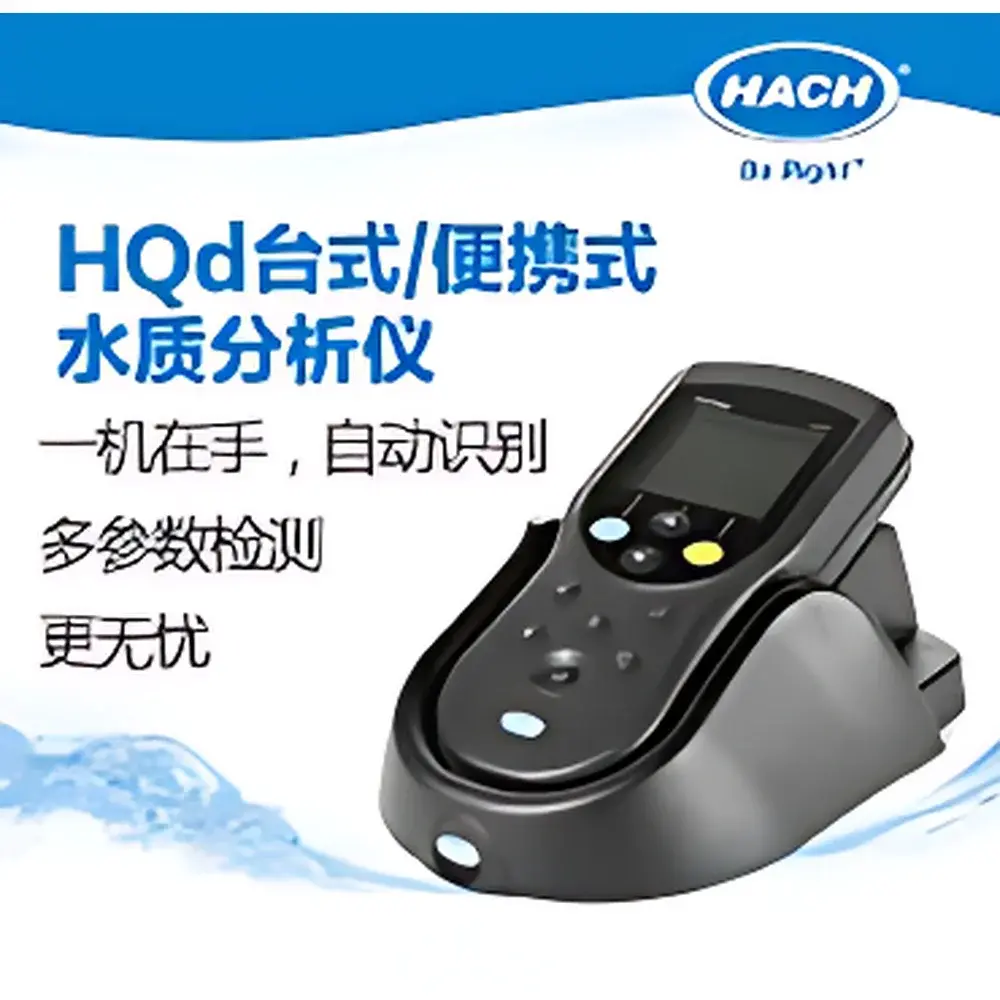
Hach HQd Portable/Desk-Top Digital Conductivity Analyzer
| Brand | Hach |
|---|---|
| Origin | USA |
| Manufacturer Type | Manufacturer |
| Origin Category | Imported |
| Model | HQd |
| Price | Upon Request |
| Measured Parameters | Multi-parameter |
| Portability | Portable |
| Conductivity Range | 0–200 mS/cm |
| TDS Range | 0–200 g/L |
| Resistivity Range | 0–100 MΩ·cm |
| Salinity Range | 0–100 ppt |
| Temperature Range | −20 to 150 °C |
| Accuracy | ±0.5% of Full Scale |
| Minimum Resolution | 0.001 µS/cm |
Overview
The Hach HQd Portable/Desk-Top Digital Conductivity Analyzer is a field-deployable and laboratory-grade electrochemical platform engineered for high-reproducibility measurement of conductivity, TDS, resistivity, salinity, and temperature across diverse aqueous matrices. Built upon Hach’s IntellCAL™ digital electrode architecture, the HQd system operates on a microprocessor-controlled potentiostatic principle with four-wire conductivity measurement capability—ensuring stable excitation frequency, low-noise signal acquisition, and immunity to cable capacitance effects. Its dual-role design supports both benchtop QA/QC workflows and rugged environmental monitoring in wastewater treatment plants, drinking water distribution networks, industrial process streams, and surface water field surveys. The instrument complies with fundamental metrological requirements outlined in ASTM D1125 (Standard Test Methods for Electrical Conductivity and Resistivity of Water) and ISO 7888 (Water Quality — Determination of Electrical Conductivity), and its data integrity framework aligns with GLP and GMP documentation expectations.
Key Features
- Digital electrode recognition: Automatic detection and configuration of IntellCAL™ electrode type, calibration history, serial number, and sensor-specific parameters upon connection.
- Three operational modes: Instant-read (single-point trigger), continuous monitoring (real-time trend logging), and timed-interval sampling (programmable data capture at user-defined intervals).
- Intuitive graphical interface with backlit LCD, adjustable font size, and context-sensitive calibration guidance—including step-by-step prompts, real-time slope validation, and pass/fail status indicators for each calibration step.
- Integrated temperature compensation: User-selectable reference temperature (e.g., 25 °C, 20 °C) for conductivity calculations; automatic salinity-based DO correction when paired with a compatible conductivity sensor.
- Full IP67-rated housing (instrument body) and submersible electrode options: Standard IntellCAL electrodes rated for 3 m depth (24 h), ruggedized variants certified for 30 m immersion, and Ultra-series sensors optimized for rapid response in low-conductivity or high-viscosity samples.
- Onboard data logging: Stores up to 500 sample records per electrode profile, each tagged with timestamp, operator ID, sample ID, calibration metadata, and environmental conditions.
Sample Compatibility & Compliance
The HQd platform accommodates a broad spectrum of sample types—from ultrapure water (e.g., pharmaceutical rinse water, semiconductor process baths) to hypersaline brines and aggressive industrial effluents. Its electrode portfolio includes refillable gel-filled, solid-state, and polymer-junction configurations to mitigate junction clogging, ion leaching, or thermal drift in challenging matrices. All IntellCAL electrodes undergo factory calibration traceable to NIST-certified standards, with documented uncertainty budgets available upon request. The system supports audit-ready data export compliant with FDA 21 CFR Part 11 requirements when used with Hach’s optional LogBook software and secure user authentication protocols. Regulatory alignment extends to USP (Water Conductivity), EPA Method 120.1, and EN 27888 for routine water quality assessment.
Software & Data Management
Data transfer occurs via standard USB 2.0 interface—enabling direct export to USB flash drives or PC-connected workstations without proprietary drivers. Hach’s HQd Data Manager software (Windows-compatible) provides secure import, filtering, statistical analysis (mean, SD, RSD), and customizable report generation (PDF/CSV/XLSX). Each dataset retains full metadata provenance: electrode serial number, calibration coefficients, ambient temperature, operator credentials, and GPS-tagged location (when used with optional Bluetooth-enabled field modules). Audit trails record all user actions—including method edits, calibration overrides, and data deletions—with immutable timestamps. Firmware updates are delivered through Hach’s validated release cycle, maintaining regulatory compliance throughout the instrument lifecycle.
Applications
- Drinking water utilities: Routine verification of conductivity against WHO and EPA secondary maximum contaminant levels (SMCLs); source water profiling and distribution system integrity checks.
- Pharmaceutical manufacturing: USP compliance testing of Purified Water and Water for Injection (WFI); cleaning validation rinse water monitoring.
- Environmental field studies: Estuarine salinity mapping, groundwater intrusion detection, and stormwater runoff characterization under variable temperature and turbidity conditions.
- Industrial process control: Electroplating bath concentration tracking, boiler feedwater purity assurance, and cooling tower conductivity-based blowdown optimization.
- Educational laboratories: Undergraduate analytical chemistry instruction on ionic strength relationships, temperature compensation models, and electrode maintenance best practices.
FAQ
Does the HQd analyzer support automatic temperature compensation for conductivity measurements?
Yes—it applies linear or non-linear (NaCl-based) temperature compensation algorithms, with user-definable reference temperatures ranging from 0 °C to 35 °C.
Can I use the same HQd base unit with both laboratory and field electrodes?
Absolutely—the modular design accepts all IntellCAL™ electrode families (Standard, Rugged, Ultra) without hardware modification or firmware reconfiguration.
Is calibration data retained if the electrode is disconnected or replaced?
Yes—each IntellCAL™ electrode stores its own calibration history, slope, offset, and date-stamped verification records internally, independent of the base unit.
What level of data security does the HQd provide for regulated environments?
When configured with password-protected user roles and LogBook software, it meets ALCOA+ principles (Attributable, Legible, Contemporaneous, Original, Accurate) and supports electronic signature workflows per 21 CFR Part 11.
How is electrode performance verified during routine operation?
The system displays real-time conductivity stability metrics, alerts on out-of-tolerance slope deviations (>±15%), and logs daily verification checks using certified reference standards.





