
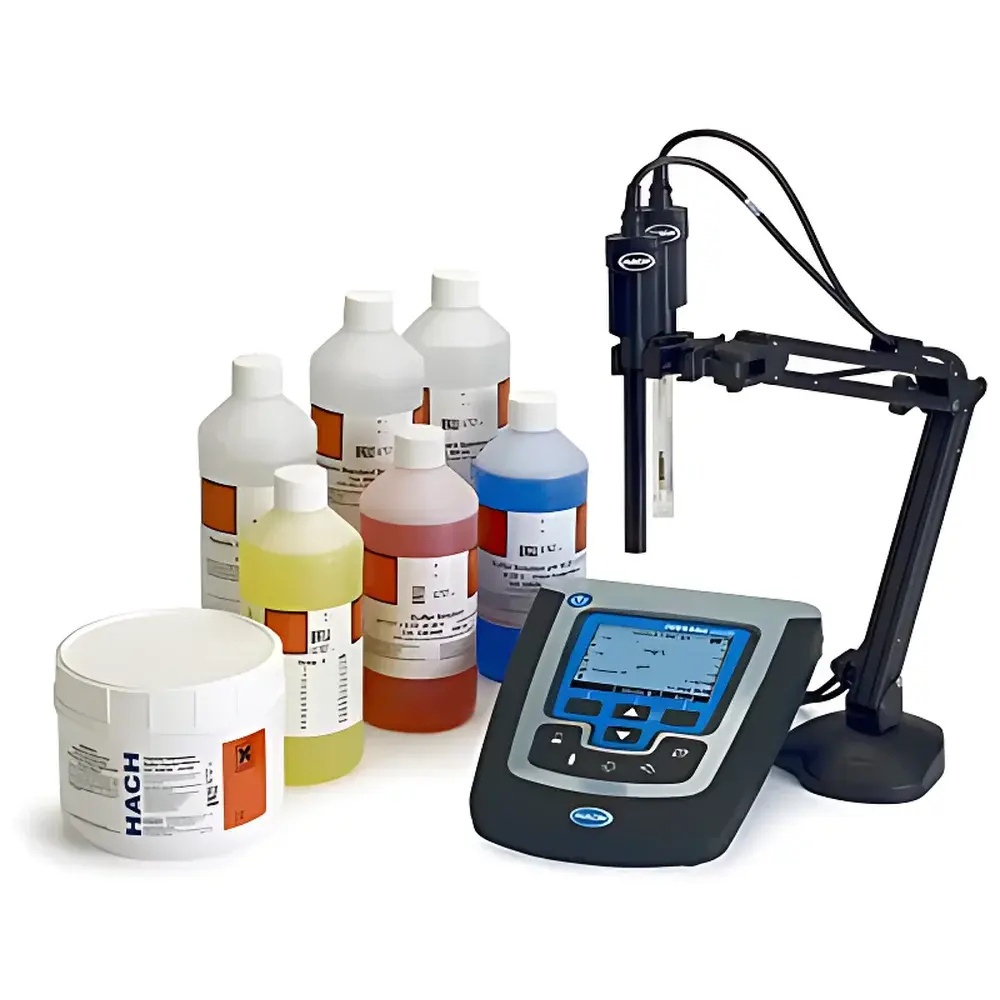
Hach HQd Series Benchtop/Portable Multi-Parameter Digital Water Quality Analyzer
| Brand | Hach |
|---|---|
| Origin | USA |
| Manufacturer Type | Original Equipment Manufacturer (OEM) |
| Product Origin | Imported |
| Model | HQd Series |
| Instrument Type | Laboratory & Field-Deployable Water Quality Analyzer |
| Measurable Parameters | pH, ORP, Conductivity, Dissolved Oxygen (LDO), BOD/CBOD (via LBOD electrode), Sodium, Ammonium, Ammonia, Fluoride, Nitrate, Chloride |
| Electrode Types | IntelliCAL™ Standard, Rugged, and Ultra Configurations |
| Compliance | ASTM D888, EPA Method 4500-O, EPA Method 415.3, ISO 5814, USP <643>, GLP/GMP Data Integrity Support (21 CFR Part 11–ready audit trail, user ID, sample ID, electrode serial logging) |
Overview
The Hach HQd Series Benchtop/Portable Multi-Parameter Digital Water Quality Analyzer is an engineered platform for precise, traceable, and flexible measurement of critical water quality parameters in both laboratory and field environments. Built upon Hach’s proprietary IntelliCAL™ smart electrode architecture, the HQd system employs digital sensor communication protocols to eliminate analog signal drift and ensure metrological integrity across measurement sessions. Its core measurement technologies include potentiometric ion-selective detection (for pH, ORP, Na⁺, NH₄⁺, F⁻, NO₃⁻, Cl⁻), four-electrode conductometric analysis (for conductivity, resistivity, TDS, salinity, and temperature compensation), and luminescence-based dissolved oxygen sensing (LDO® technology per ISO 5814), which eliminates membrane fouling and oxygen consumption artifacts inherent in Clark-type electrodes. Designed for regulatory compliance workflows, the HQd supports method-defined test protocols—including USEPA-approved BOD₅ and CBOD determination via the integrated LBOD electrode—and delivers full traceability required under GLP, GMP, and drinking water utility reporting frameworks.
Key Features
- Digital electrode recognition and auto-configuration: Each IntelliCAL™ electrode contains embedded memory storing calibration history, sensor type, serial number, and user-defined settings—enabling plug-and-play operation without manual setup.
- Three measurement modes: Instant-read (single-point), continuous monitoring (real-time trend logging), and interval-sampling (time-stamped batch acquisition) for adaptive experimental design.
- Intuitive graphical interface with contextual calibration guidance: On-screen prompts verify standard solution validity, detect endpoint stability, and flag out-of-tolerance conditions—reducing operator error and training time.
- Comprehensive data provenance: Every recorded value is automatically tagged with electrode serial number, calibration timestamp, user ID, sample ID, ambient temperature, pressure (for DO), and instrument firmware version—ensuring full ALCOA+ compliance (Attributable, Legible, Contemporaneous, Original, Accurate).
- Ruggedized hardware options: Standard (3 m submersion rating), Rugged (30 m IP68-rated stainless-steel housing with armored cable), and Ultra (fast-response, low-ionic-strength optimized sensors)—all featuring waterproof, twist-lock connectors meeting IEC 60529 standards.
- USB 2.0 host interface: Enables direct export of CSV-formatted datasets to USB drives or PCs; compatible with Hach’s LabStation™ software for advanced report generation, statistical process control (SPC), and LIMS integration.
Sample Compatibility & Compliance
The HQd Series accommodates aqueous matrices ranging from ultrapure boiler feedwater (conductivity down to 0.055 µS/cm) to high-salinity estuarine samples (up to 70 ppt salinity). Its IntelliCAL™ pH Ultra electrode maintains stable response in low-ionic-strength solutions (e.g., rainwater, deionized water), while the Rugged conductivity electrode applies automatic temperature compensation referenced to user-selectable baseline temperatures (e.g., 20 °C, 25 °C, or custom values), satisfying ASTM D1125 and ISO 7888 requirements. For BOD testing, the LBOD electrode integrates a micro-stirrer and conforms to USEPA Method 405.1 for carbonaceous BOD (CBOD) and Method 405.2 for total BOD. All LDO measurements comply with ISO 5814:2012 for optical DO determination and support pressure-compensated mg/L and % saturation outputs. The system meets FDA 21 CFR Part 11 readiness criteria through secure user authentication, electronic signatures, and immutable audit trails.
Software & Data Management
The HQd runs embedded firmware supporting customizable calibration routines—including user-defined pH buffer tables (beyond NIST-traceable 4.01/7.00/10.01 standards) and dynamic conductivity temperature compensation curves. Data logs are stored internally (≥10,000 readings) with timestamped metadata and can be exported via USB mass storage mode. When paired with Hach LabStation™ (Windows-based), users access automated QA/QC flagging (e.g., calibration expiration alerts, electrode drift thresholds), statistical summaries (mean, SD, RSD), and regulatory report templates aligned with EPA Form 3320-1 and ISO/IEC 17025 documentation requirements. All data transfers retain cryptographic hash verification to prevent tampering—essential for accredited environmental laboratories undergoing ILAC-MRA audits.
Applications
- Drinking water treatment: Real-time monitoring of disinfectant residual (via ORP), corrosion potential (pH/conductivity), and source water quality (NH₄⁺, NO₃⁻, Cl⁻).
- Wastewater compliance: CBOD/BOD₅ tracking per NPDES permits; simultaneous DO, conductivity, and temperature profiling in aeration basins.
- Pharmaceutical water systems: USP TOC surrogate validation using conductivity/resistivity ratio analysis and low-level chloride detection.
- Academic and research labs: Multi-parameter kinetic studies (e.g., nitrification rate via NH₄⁺ depletion + DO consumption), sensor cross-sensitivity evaluation, and method validation against reference titrimetric or spectrophotometric techniques.
- Field-deployed environmental monitoring: Stormwater runoff characterization (Na⁺, Cl⁻, conductivity), wetland health assessment (DO saturation, pH buffering capacity), and aquifer vulnerability screening (F⁻, NO₃⁻).
FAQ
Does the HQd analyzer support GLP-compliant data archiving?
Yes—the system logs electrode serial numbers, calibration coefficients, user credentials, timestamps, and environmental metadata for every measurement, generating audit-ready records compatible with 21 CFR Part 11 and ISO/IEC 17025 requirements.
Can I use non-Hach electrodes with the HQd platform?
No—only IntelliCAL™ digital electrodes are recognized and fully functional; analog or third-party probes lack embedded memory and protocol compatibility.
What is the maximum submersion depth for the Rugged electrode?
The Rugged IntelliCAL™ electrode is rated IP68 for continuous operation at 30 meters depth for up to 24 hours, verified per IEC 60529.
How does LDO® technology differ from traditional electrochemical DO sensors?
LDO® uses phase-shift fluorescence quenching by molecular oxygen—eliminating cathode poisoning, electrolyte depletion, and flow-dependency issues associated with amperometric sensors.
Is firmware upgrade supported in the field?
Yes—updates are delivered via USB drive and installed through the instrument’s maintenance menu, preserving all stored calibration and user configurations.







