
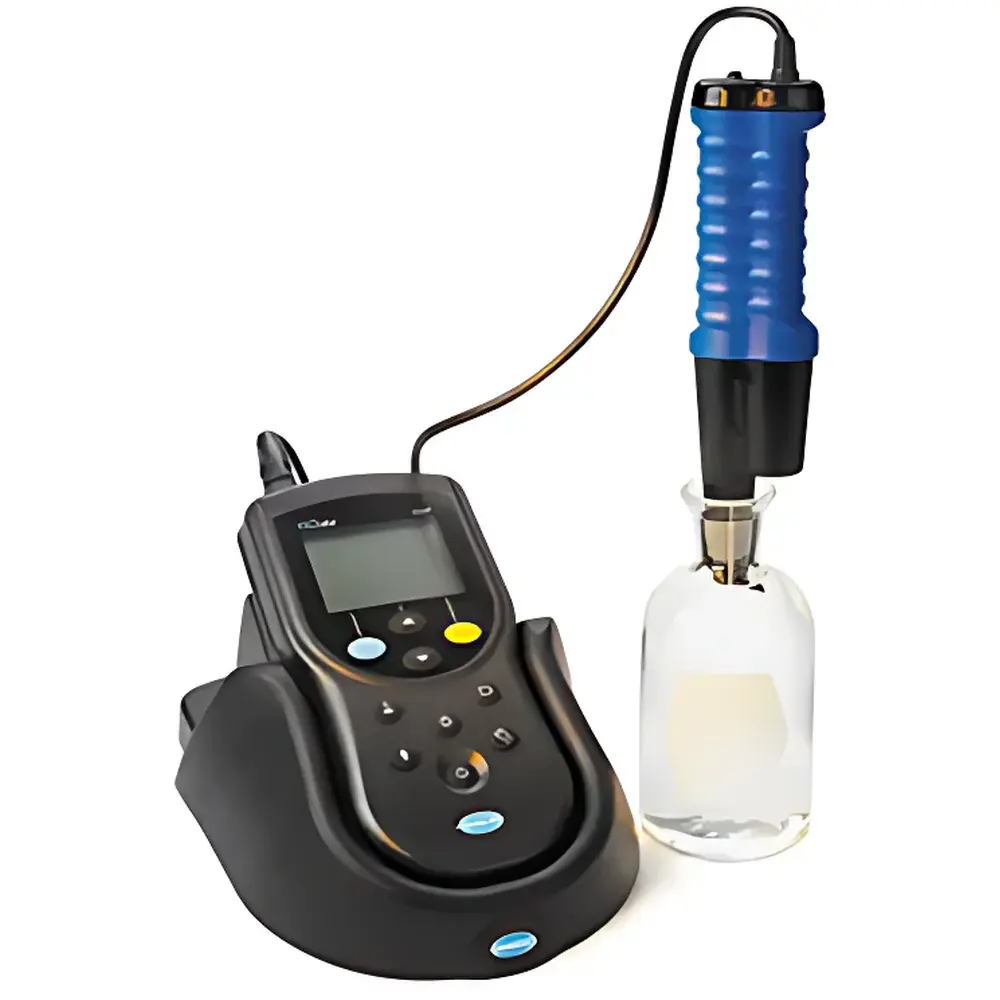
Hach LBOD BOD Measurement System
| Brand | Hach |
|---|---|
| Origin | Imported |
| Manufacturer Status | Manufacturer |
| Instrument Type | Portable BOD Analyzer |
| Principle | Pressure Differential Method |
| Measurement Range | 0.05–10 mg/L |
| Detection Limit | 0.05 mg/L |
| Accuracy | ±0.05 mg/L |
| Response Time (T95) | ≤30 s |
| Repeatability | ±0.03 mg/L |
| Weight (System + Accessories) | 225 g |
| Dimensions (L × D) | 191 mm × 41 mm |
| DO Resolution | 0.01 mg/L |
| Temperature Accuracy (at 20 °C, ±5 °C range) | ±0.2 °C |
| Temperature Repeatability | ±0.2 °C |
| Pressure Accuracy | ±3 mbar |
| Pressure Repeatability | ±5 mbar |
| BOD Precision vs. GGA (198 mg/L) | 10% RSD (198 ± 30 mg/L) |
Overview
The Hach LBOD BOD Measurement System is a portable, membrane-free biochemical oxygen demand (BOD) analyzer engineered for rapid, field-deployable water quality assessment in compliance with standard methods for wastewater and surface water monitoring. Unlike conventional polarographic or galvanic DO sensors, the LBOD system employs a patented pressure differential measurement principle—detecting oxygen consumption in a sealed, temperature-controlled BOD bottle by quantifying minute pressure changes induced by microbial respiration. This approach eliminates electrochemical drift, membrane fouling, and electrolyte depletion, enabling direct, real-time BOD estimation without sample dilution or incubation beyond standard 5-day protocols. The system integrates seamlessly with Hach’s HQ30d and HQ40d multi-parameter meters, leveraging their calibrated temperature, pressure, and dissolved oxygen modules to compute BOD values per ASTM D5210 and ISO 5815-1, while maintaining traceability to GLP/GMP data integrity requirements.
Key Features
- Membrane-free optical-pressure transduction architecture—no consumable membranes, electrolytes, or electrode polishing required.
- Patented pressure differential sensing ensures stable baseline performance across varying organic loadings and turbid matrices.
- Two-point calibration protocol (zero and span) completed in under 60 seconds; no polarization time needed prior to measurement.
- Ultra-low maintenance footprint: zero recurring costs for membrane replacement, electrolyte refills, or sensor refurbishment.
- Compact handheld form factor (191 mm × 41 mm, 225 g) optimized for field technicians conducting sequential site sampling.
- T95 response time ≤30 seconds for both dissolved oxygen and derived BOD estimation—enabling rapid decision-making during emergency spill assessments or regulatory compliance checks.
Sample Compatibility & Compliance
The LBOD system is validated for use with standard 300-mL BOD bottles conforming to EPA Method 405.1 and APHA Standard Methods 5210B. It accommodates raw wastewater, treated effluent, river water, and lake samples—with demonstrated robustness against suspended solids up to 150 mg/L and chloride concentrations ≤10,000 mg/L. All measurements comply with ISO/IEC 17025:2017 general requirements for testing laboratories and support audit-ready documentation when paired with HQ-series meters configured for 21 CFR Part 11-compliant electronic records (including user authentication, audit trails, and immutable data export). Calibration verification meets ASTM D888-22 specifications for dissolved oxygen sensor accuracy and repeatability.
Software & Data Management
Data acquisition and reporting are managed via Hach’s LogR software suite and the embedded firmware of HQ30d/HQ40d platforms. Raw pressure, temperature, and DO signals are timestamped and logged at user-selectable intervals (1–600 s), with automatic BOD calculation using the standardized stoichiometric conversion factor (1 mg O2/L ≈ 1 mg BOD5/L). Export formats include CSV, PDF reports with metadata (operator ID, location GPS tag, calibration history), and direct integration into LIMS environments via Hach’s Enterprise Data Manager (EDM). All data entries retain full traceability—including operator login credentials, calibration event logs, and instrument configuration snapshots—to satisfy GLP and environmental agency chain-of-custody requirements.
Applications
- Regulatory wastewater discharge monitoring per NPDES permits and EU Urban Wastewater Treatment Directive (91/271/EEC).
- Performance evaluation of biological treatment units (e.g., activated sludge, MBR, trickling filters) through daily BOD loading analysis.
- Field-based source tracking during combined sewer overflow (CSO) events or stormwater runoff investigations.
- Educational laboratory instruction on aerobic biodegradation kinetics, avoiding the logistical constraints of traditional 5-day incubation setups.
- Pre-treatment screening for industrial effluents prior to municipal sewer entry—ensuring compliance with local pretreatment ordinances.
FAQ
Does the LBOD system require daily calibration?
No—calibration is performed only before initial deployment and after extended storage (>72 h); field verification using certified zero and span standards is recommended every 24 h for critical compliance applications.
Can it measure BOD in seawater or high-salinity samples?
Yes, provided salinity compensation is enabled in the HQ meter firmware; pressure differential detection inherently minimizes ionic interference compared to amperometric DO sensors.
Is the system compatible with existing BOD incubators?
Yes—the LBOD sensor head inserts directly into standard 300-mL BOD bottles sealed with rubber stoppers and can be used inside any incubator meeting ASTM D5210 temperature uniformity requirements (20 ± 1 °C).
How is data integrity ensured during remote field operations?
All measurements are digitally signed and time-stamped using NIST-traceable internal clocks; offline logging persists through power loss, and encrypted USB export prevents unauthorized modification.
What validation documentation is supplied with the system?
Each unit ships with a Certificate of Conformance, factory calibration report (traceable to NIST SRM 2195), and method validation summary per ISO 5815-1 Annex A.
Related Products







