
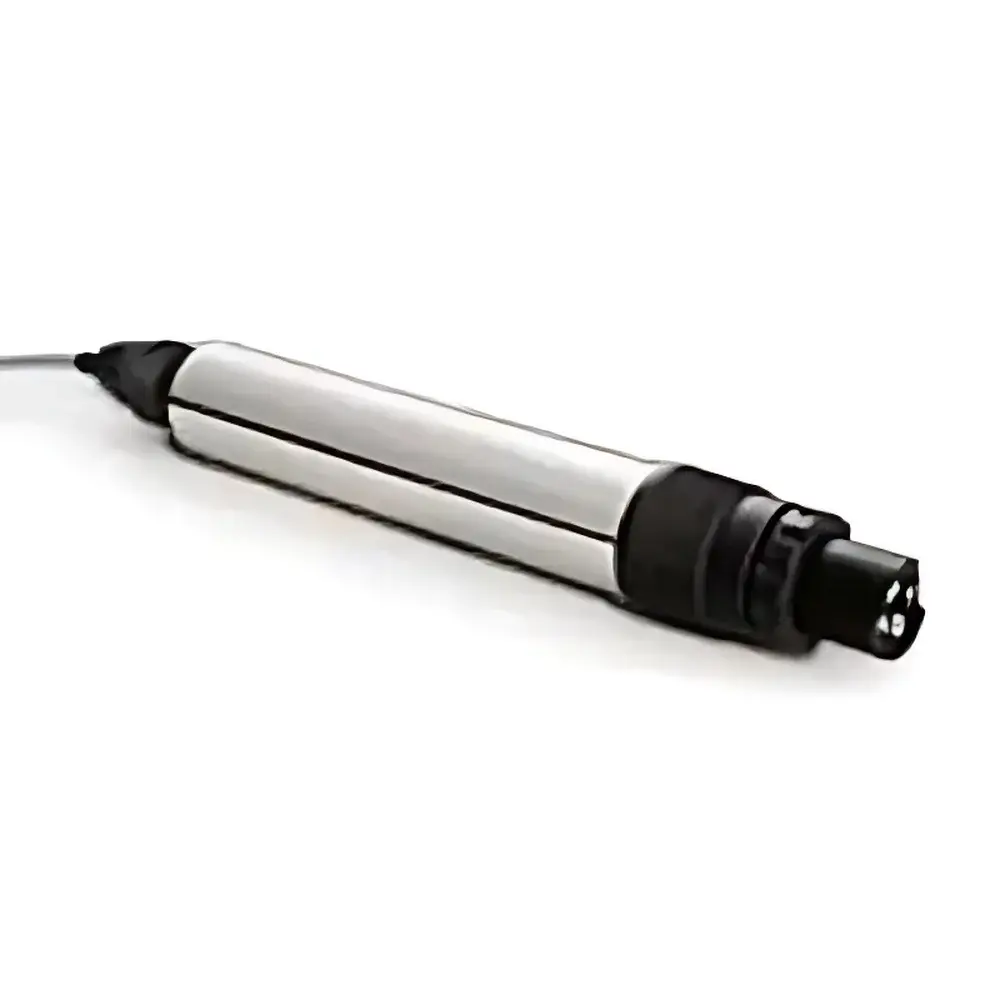
HACH NH4D sc Ammonium Ion Analyzer
| Brand | HACH |
|---|---|
| Origin | Imported |
| Manufacturer Type | Manufacturer |
| Instrument Type | Laboratory |
| Measurement Principle | Ion-Selective Electrode (ISE) Method |
| Measurement Range | 0.2–1000 mg/L NH₄–N |
| Accuracy | ±5% of reading or ±0.2 mg/L (with certified standard solutions) |
| Detection Limit | 0.2 mg/L NH₄–N |
| Response Time (T90) | <2 minutes |
| Sample Temperature Range | 0–40°C |
| Sample pH Range | 5–9 |
| Immersion Depth | 0.3–3.0 m |
| Max Sample Pressure | 0.3 bar |
| Sensor Housing Material | 316 Stainless Steel with Ryton® end caps |
| Dimensions | 48 × 361 mm |
| Cable Length | 10 m (standard) |
| Weight | 1.3 kg |
| Operating Certifications | CE compliant |
| Warranty | 2 years |
Overview
The HACH NH4D sc Ammonium Ion Analyzer is a laboratory-grade, ion-selective electrode (ISE)-based instrument engineered for continuous, real-time quantification of ammonium nitrogen (NH₄–N) in aqueous environmental and industrial process streams. It operates on the potentiometric principle: the NH₄⁺-selective membrane generates a Nernstian voltage response proportional to the logarithm of free ammonium ion activity in solution. Unlike colorimetric or enzymatic methods, ISE-based detection requires no reagents, avoids sample digestion or derivatization, and delivers direct, in-situ measurement—making it ideal for monitoring dynamic biological treatment stages such as nitrification in activated sludge systems. The analyzer integrates a dedicated potassium-selective electrode (K⁺-ISE) and a differential pH (pHD) reference electrode to actively compensate for the two most prevalent electrochemical interferences: K⁺ competition at the ammonium sensing membrane and pH-induced ammonia/ammonium speciation shifts. This multi-electrode architecture ensures robustness across variable water matrices without manual recalibration during routine operation.
Key Features
- Integrated triple-sensor design: NH₄⁺-selective electrode, K⁺-selective electrode, and pHD reference electrode—all housed in a single, field-deployable probe assembly.
- Dynamic interference compensation: Real-time correction for potassium ion interference and pH-dependent NH₃/NH₄⁺ equilibrium using embedded thermodynamic algorithms.
- CARTRICAL™ calibration technology: Enables independent, traceable calibration of each electrode element; supports cross-sensor validation and drift diagnostics without external hardware.
- Temperature-compensated measurement: Built-in Pt1000 RTD sensor provides automatic temperature correction across 0–40°C, ensuring accuracy under varying ambient and process conditions.
- Robust mechanical construction: 316 stainless steel body with Ryton® end caps delivers chemical resistance to chlorinated effluents, sulfide-rich anaerobic zones, and abrasive suspended solids.
- Direct immersion capability: Rated for continuous submersion up to 3.0 m depth and 0.3 bar hydrostatic pressure—compatible with aerated basins, clarifiers, and inline process lines.
- sc Platform compatibility: Seamless integration with HACH sc1000, sc200, or sc300 controllers for data logging, alarm configuration, remote diagnostics, and MODBUS TCP/RTU communication.
Sample Compatibility & Compliance
The NH4D sc is validated for use in municipal wastewater, tertiary effluent, industrial cooling water, and bioreactor influent/effluent streams with pH 5–9 and total suspended solids ≤150 mg/L. It meets CE marking requirements per Directive 2014/30/EU (EMC) and 2014/35/EU (LVD). While not inherently compliant with ISO 5667-3 or ASTM D1426 for grab-sample lab analysis, its continuous monitoring output aligns with EPA Method 350.1 (potentiometric ISE) and supports GLP-aligned data integrity when paired with sc controllers featuring 21 CFR Part 11-compliant audit trails and electronic signature workflows. Sensor performance remains stable in presence of common interferents including Na⁺, Ca²⁺, Mg²⁺, and Cl⁻—provided K⁺ concentration remains below 100 mg/L (compensation range).
Software & Data Management
When connected to HACH’s sc-series controllers, the NH4D sc enables configurable data acquisition intervals (1 sec to 24 h), user-defined alarm thresholds (high/low, rate-of-change), and automated calibration scheduling. All raw mV outputs, temperature values, and compensated NH₄–N concentrations are timestamped and stored locally (up to 100,000 records) with optional SD card backup. Export formats include CSV and Modbus registers for integration into SCADA, LIMS, or cloud-based asset management platforms. Firmware updates are performed via USB or Ethernet, and sensor health metrics—including electrode slope, asymmetry potential, and K⁺-ISE deviation—are accessible through the controller’s diagnostic menu for predictive maintenance planning.
Applications
- Real-time optimization of nitrification/denitrification cycles in activated sludge and MBR systems.
- Early detection of ammonium breakthrough in tertiary filtration or ion exchange units.
- Process control feedback for ammonium dosing in denitrification anoxic zones.
- Compliance monitoring of NH₄–N discharge limits per local regulatory frameworks (e.g., EU Urban Wastewater Treatment Directive, US NPDES permits).
- Industrial process water surveillance in food & beverage, pharmaceutical, and semiconductor manufacturing where low-level NH₄–N impacts product purity or membrane integrity.
FAQ
Does the NH4D sc require daily calibration?
No—CARTRICAL™ enables extended calibration intervals (typically 7–30 days depending on matrix stability); however, a two-point calibration with traceable NH₄–N standards is recommended before commissioning and after sensor cleaning.
Can it measure in seawater or high-salinity brines?
Not recommended: Ionic strength >5000 µS/cm significantly degrades ISE selectivity and response time; use only in freshwater or low-conductivity secondary effluents.
Is the sensor compatible with automatic cleaning systems?
Yes—optional air-pulse or ultrasonic wiper kits (e.g., HACH CLS10) can be mounted directly to the probe body to minimize biofouling in high-TSS applications.
What is the expected service life of the sensor under continuous operation?
Typical functional lifespan is 12–18 months in well-maintained aerobic environments; replacement intervals decrease in anaerobic, sulfide-rich, or highly abrasive conditions.
Does the analyzer support MODBUS RTU over RS-485?
Yes—when interfaced with an sc200 or sc300 controller, full register mapping for NH₄–N concentration, temperature, K⁺-ISE mV, and diagnostic flags is available per HACH Modbus Protocol Specification Rev. 4.2.
Related Products







