
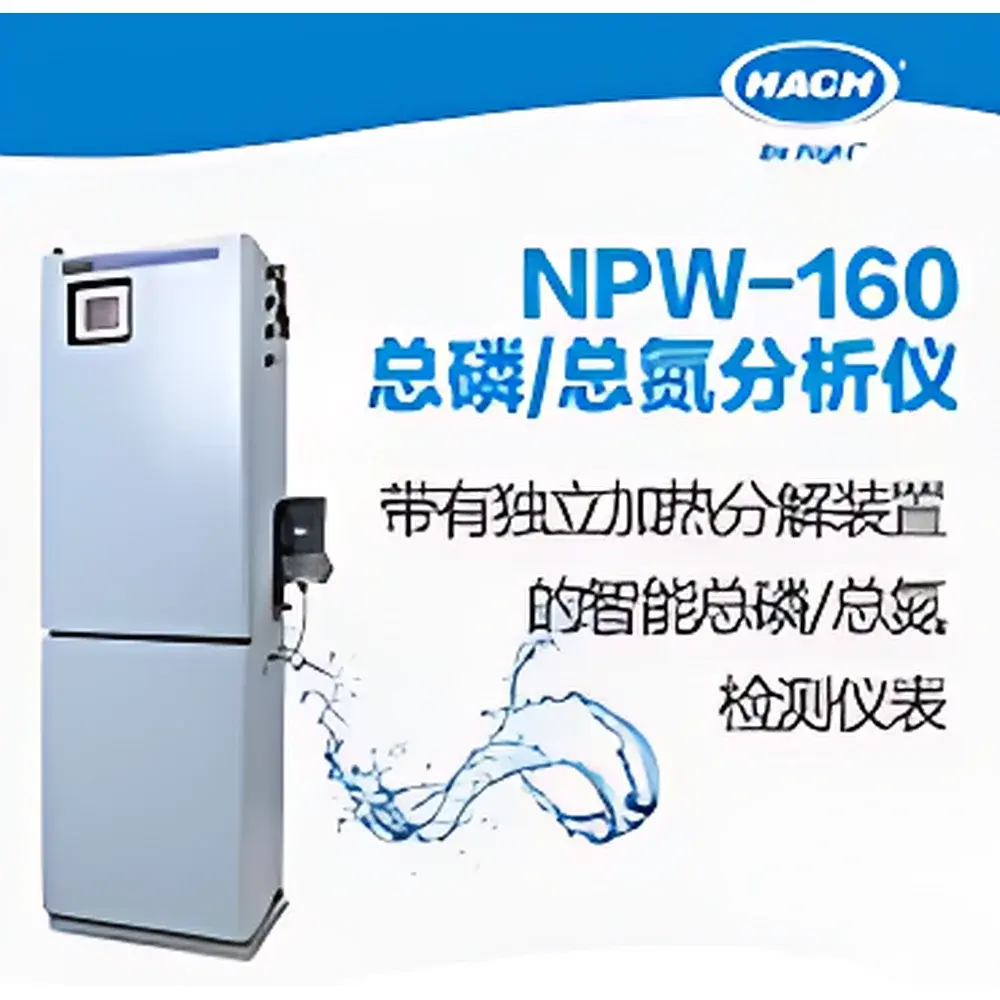
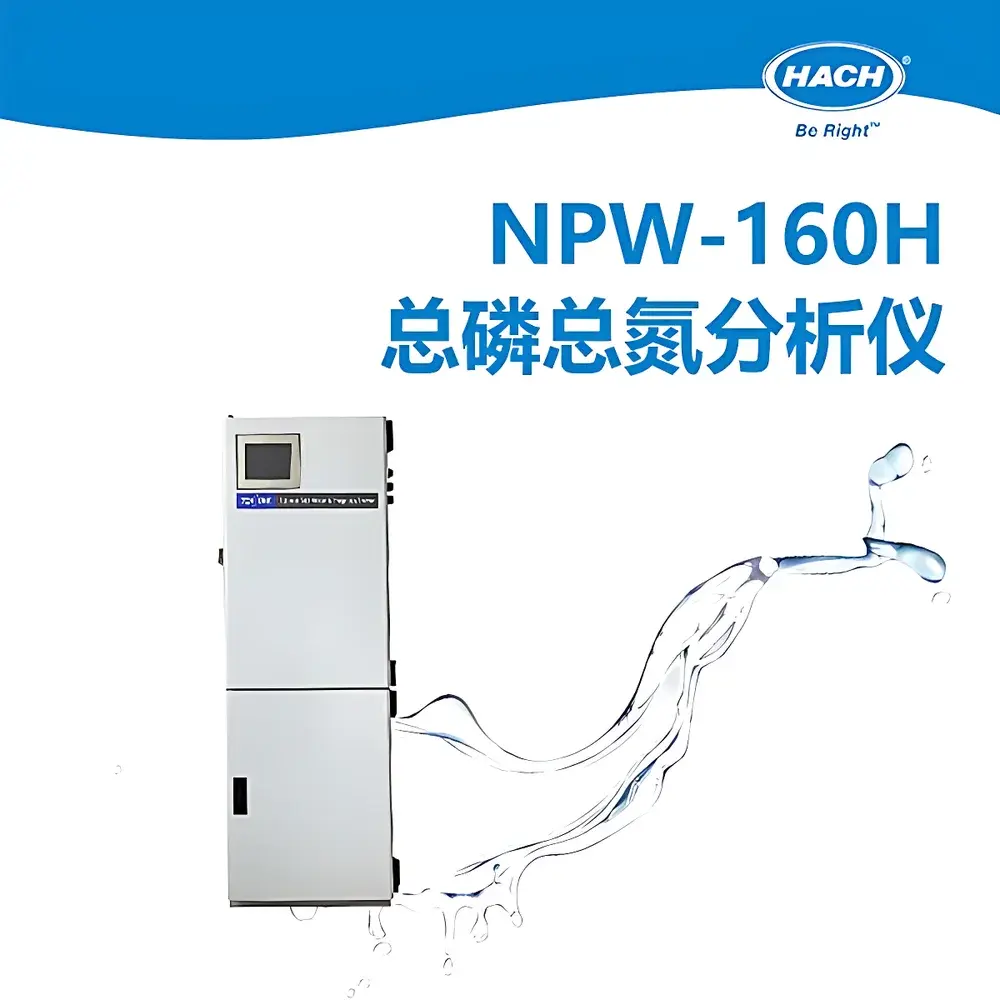
Hach NPW-160 Online Total Phosphorus, Total Nitrogen, and UV-COD Analyzer
| Brand | Hach |
|---|---|
| Origin | Imported |
| Manufacturer Type | Manufacturer |
| Model | NPW-160 |
| Measurement Parameters | Total Phosphorus (TP), Total Nitrogen (TN), UV-based Chemical Oxygen Demand (UV-COD) |
| Instrument Type | Online Analyzer |
| Measurement Principle | Alkaline Persulfate Oxidation + Spectrophotometry (TP: Molybdenum Blue at 700 nm |
| TN | UV Absorbance at 220/275 nm with Turbidity Correction |
| UV-COD | Dual-wavelength UV-Vis at 254/546 nm) |
| Measurement Ranges | TN: 0–2 mg/L to 0–100 mg/L |
| TP | 0–0.5 mg/L to 0–20 mg/L |
| UV-COD | 0–20 mg/L to 0–500 mg/L |
| Accuracy | ≤ ±5% of reading |
| Detection Limits | TN: 0.2 mg N/L |
| TP | 0.06 mg P/L |
| Resolution | 0.001 mg/L |
Overview
The Hach NPW-160 is a fully automated, online multiparameter water quality analyzer engineered for continuous, unattended monitoring of total phosphorus (TP), total nitrogen (TN), and UV-based chemical oxygen demand (UV-COD) in surface water, municipal wastewater, and drinking water treatment applications. It implements standardized wet-chemistry oxidation followed by spectrophotometric detection—fully compliant with internationally recognized methods including ISO 11908 (for TN), ISO 6878 (for TP), and US EPA Method 410.4 (UV-COD estimation). The system performs sequential digestion and analysis using alkaline persulfate oxidation at 120 °C for 30 minutes, converting refractory phosphorus and nitrogen compounds into orthophosphate and nitrate, respectively. Quantification relies on high-stability optical modules with thermally regulated cuvettes and dual-beam photometry to minimize drift and ensure long-term baseline stability.
Key Features
- Triple-parameter simultaneous or staggered analysis (TP, TN, UV-COD) within a single compact analyzer footprint, reducing footprint and operational complexity in central monitoring stations.
- Modular optical path design with temperature-controlled flow cells (5 mm, 10 mm, or 20 mm path lengths) selectable per application—optimized for low-concentration surface water or high-load wastewater matrices.
- Integrated digestion module with precise thermal control (±0.5 °C) and pressure-relief safety valves, ensuring reproducible oxidation efficiency across variable sample loads and ambient conditions.
- Automatic turbidity correction for TN measurement via dual-wavelength UV absorbance (220 nm and 275 nm), applying the standard correction factor A = A220 − 2 × A275 to eliminate interference from suspended solids.
- Self-diagnostic routines including blank calibration verification, reagent depletion alerts, optical window fouling detection, and flow integrity monitoring—all logged with timestamps for audit readiness.
- Ruggedized industrial enclosure (IP65 rated) with corrosion-resistant fluidic manifolds, supporting deployment in outdoor kiosks, pump stations, or inline process streams without climate-controlled housing.
Sample Compatibility & Compliance
The NPW-160 accepts raw, filtered, or clarified aqueous samples with turbidity ≤ 100 NTU and total suspended solids (TSS) < 150 mg/L. It accommodates pH ranges from 4.0 to 9.0 without pre-adjustment for TP/TN modules; TN analysis includes automatic acidification to pH 2–3 post-digestion. The analyzer meets requirements for routine environmental compliance reporting under EU Water Framework Directive (WFD) Annex V monitoring programs, U.S. Clean Water Act NPDES permit tracking, and China’s GB 3838-2002 surface water quality standards. All measurement protocols align with GLP principles and support 21 CFR Part 11-compliant data handling when integrated with Hach SC200 or PI System controllers featuring electronic signature and audit trail capabilities.
Software & Data Management
Operation is managed through Hach’s unified LIMS-ready firmware (v3.2+), accessible via embedded web interface or remote SCADA integration (Modbus TCP, OPC UA). Real-time data streams include raw absorbance values, corrected concentrations, QC flag status (e.g., “Low Signal”, “Digestion Timeout”, “Reagent Low”), and maintenance counters (e.g., digestion cycle count, valve actuation logs). Historical datasets are exportable in CSV or XML format with ISO 8601 timestamps and metadata tags (sample ID, instrument ID, method version). Firmware updates are delivered via secure HTTPS push and validated with SHA-256 checksums to maintain configuration integrity during regulatory audits.
Applications
- Real-time nutrient load assessment at wastewater treatment plant influent/effluent points for optimization of biological nutrient removal (BNR) processes.
- Early-warning monitoring of eutrophication risk in reservoirs and rivers using sub-hourly TP/TN trend analysis.
- Correlative UV-COD estimation in chlorinated or ozonated streams where traditional dichromate-based COD is impractical due to oxidant interference.
- Compliance verification for discharge permits requiring weekly or monthly TP/TN reporting—reducing manual lab sampling frequency by up to 80%.
- Process control feedback in advanced oxidation or membrane filtration units where organic carbon and nutrient co-removal must be quantified simultaneously.
FAQ
Does the NPW-160 require daily manual calibration?
No. It performs automatic zero and span verification every 24 hours using certified liquid standards; optional multi-point calibration can be scheduled weekly.
Can it operate without external reagent pumps or air compressors?
Yes. All reagents—including alkaline persulfate, molybdate antimony tartrate, and ascorbic acid—are housed in pressurized, sealed cartridges with integrated level sensors and auto-shutoff valves.
Is UV-COD measurement traceable to gravimetric COD reference methods?
UV-COD provides a robust correlation (r² ≥ 0.92) with dichromate COD in municipal wastewater matrices but is not a direct replacement for regulatory COD compliance testing; it serves best as a rapid surrogate for process trending and anomaly detection.
What cybersecurity protocols does the embedded controller support?
TLS 1.2 encryption for web interface access, role-based user authentication (admin/operator/viewer), and disabled default credentials upon first boot—aligned with IEC 62443-3-3 SL2 requirements for industrial control systems.
How is maintenance downtime minimized during routine service?
Hot-swappable reagent cartridges and field-replaceable optical modules allow full functional restoration in under 15 minutes without firmware reset or recalibration.
Related Products







