
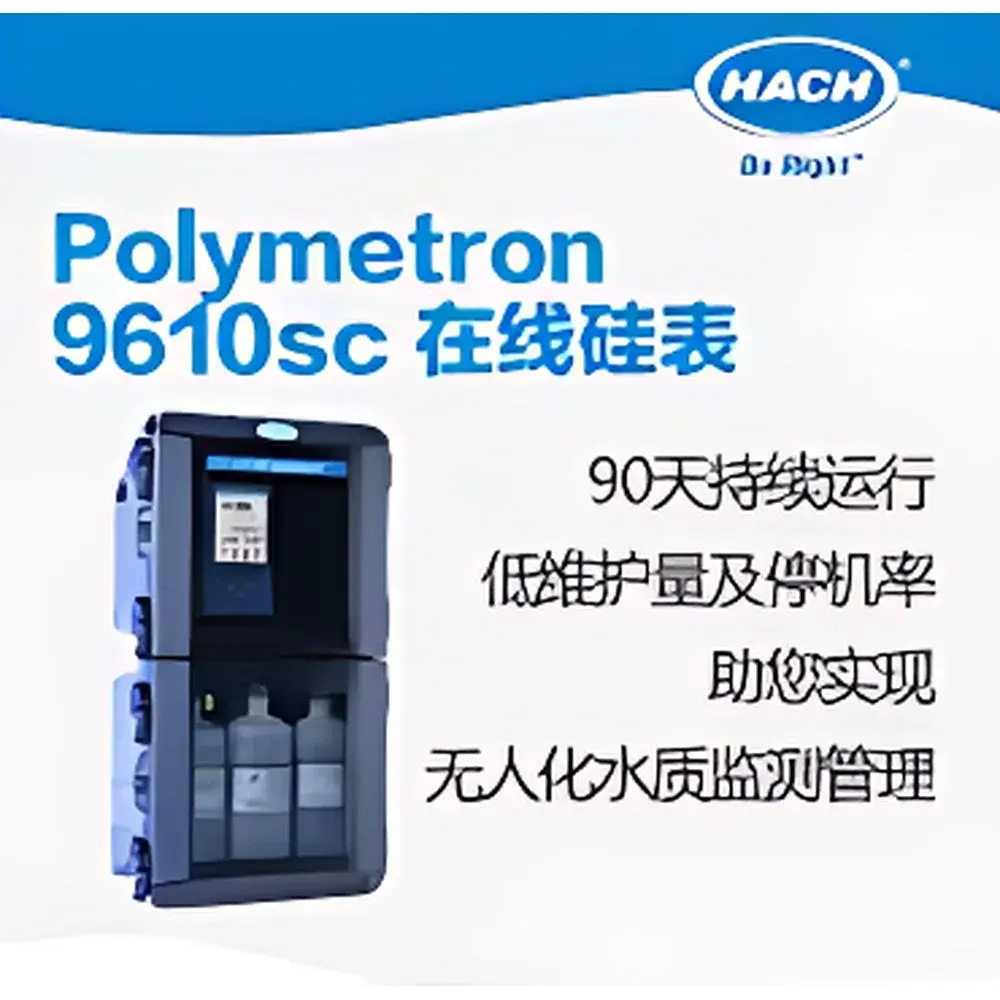
Hach Polymetron 9610sc Online Silica Analyzer
| Brand | Hach |
|---|---|
| Origin | USA |
| Manufacturer | Hach Company |
| Product Type | Imported |
| Model | Polymetron 9610sc |
| Instrument Category | Online Analyzer |
| Channel Options | 1, 2, 4, or 6 channels |
| Measurement Principle | Colorimetric Analysis (Silicomolybdate Method) |
| Range | 0.5–5000 µg/L as SiO₂ |
| Accuracy | ±1% or ±1 µg/L (whichever is greater) for 0–500 µg/L |
| Repeatability | ±0.5 µg/L or ±1% (whichever is greater) |
| LOD | 0.5 µg/L |
| Response Time | 9 min at 25°C |
| Reagent Consumption | 2 L per reagent per 90 days |
| Cycle Time | 15 min |
| Operating Temperature | 5–45°C |
| Sample Temp | 5–50°C |
| Sample Pressure | 2–87 psi |
| Flow Rate | 55–300 mL/min |
| Enclosure Rating | NEMA 4X / IP66 |
| Power | 100–240 V AC, 50/60 Hz |
| Output | 4–20 mA |
| Dimensions | 804 × 452 × 360 mm (H×W×D) |
| Weight | 20 kg (empty), 36.3 kg (with reagents) |
| Certifications | CE, KC, C-tick, cETLus (UL 61010-1, NEMA 250, CSA C22.2 No. 61010-1) |
| Compatible Controllers | SC200, SC1000 |
Overview
The Hach Polymetron 9610sc Online Silica Analyzer is a high-stability, low-maintenance photometric instrument engineered for continuous, unattended measurement of dissolved silica (as SiO₂) in ultra-pure water streams across power generation, semiconductor manufacturing, pharmaceutical production, and advanced wastewater treatment facilities. It employs the standardized silicomolybdate colorimetric method—where soluble silica reacts with molybdate ions under acidic conditions to form a yellow silicomolybdic acid complex; citric acid selectively disrupts phosphate interference, while an amino acid reducing agent converts the complex to a stable, deep-blue chromophore quantified at 815 nm. This chemically selective, spectrophotometric detection scheme ensures robust performance in matrices containing trace phosphates, organic contaminants, and variable ionic strength—critical for steam-cycle chemistry monitoring and boiler feedwater compliance.
Key Features
- Extended 90-day reagent autonomy: Consumes only 2 liters per reagent over three months—double the runtime of legacy 5000-series analyzers—reducing site visits and operational overhead.
- Pump-free reagent delivery: Patented pressure-driven fluidics eliminate peristaltic pumps, removing a primary failure point and eliminating calibration drift associated with tubing fatigue or occlusion.
- Prognosys predictive diagnostics: Embedded firmware continuously monitors valve actuation cycles, optical path integrity, reagent depletion trends, and temperature stability—triggering early-warning LEDs and actionable alerts via SC200/SC1000 controllers before fault conditions escalate.
- Tool-free reagent replacement: Color-coded, snap-seal reagent bottles enable one-handed installation—no spills, no priming, no air bubbles—minimizing technician exposure and contamination risk.
- Dual grab sampling interface: Integrated “Grab-in” and “Grab-out” ports allow rapid manual introduction of field-collected samples for verification or offline validation without interrupting continuous operation.
- NEMA 4X/IP66-rated enclosure: Fully sealed against dust, water jets, and corrosive atmospheres—suitable for installation in turbine halls, chemical dosing rooms, or outdoor shelters without additional weatherproofing.
Sample Compatibility & Compliance
The 9610sc maintains analytical integrity across a broad range of sample conditions: inlet water temperatures from 5–50°C, pressures up to 87 psi, and flow rates between 55–300 mL/min. Its chemically resistant wetted path—constructed from PFA, ETFE, and sapphire optics—resists scaling, biofilm adhesion, and oxidation by chlorine or ozone residuals. The analyzer complies with ASTM D859 (Standard Test Method for Silica in Water), ISO 10530 (Water quality — Determination of silica — Spectrometric method), and supports GLP/GMP data integrity requirements through SC200/SC1000 controller audit trails, user access logs, and electronic signature capability. When integrated with SC1000 platforms, it meets FDA 21 CFR Part 11 requirements for electronic records and signatures in regulated environments.
Software & Data Management
Data acquisition and configuration are managed exclusively through Hach’s SC200 or SC1000 universal controllers, which provide intuitive touchscreen navigation, real-time trend visualization, configurable alarm thresholds (high/low, rate-of-change), and automated calibration scheduling. All measurements—including raw absorbance values, temperature-compensated concentration outputs, diagnostic flags, and reagent usage counters—are timestamped and exportable via Modbus RTU/TCP, Profibus DP, or HART 7 protocols. Controller firmware supports secure remote access via encrypted VPN tunnels, enabling off-site troubleshooting and preventive maintenance planning without physical presence. Raw spectral data is retained for ≥30 days, supporting root-cause analysis during regulatory audits or process excursions.
Applications
- Power plant demineralized water and condensate monitoring—ensuring silica remains below 20 µg/L to prevent turbine blade deposition and heat-transfer inefficiency.
- Semiconductor fab UPW loops—verifying sub-1 µg/L silica compliance prior to wafer cleaning and etching stages.
- Pharmaceutical purified water (PW) and water-for-injection (WFI) distribution systems—supporting USP and EU GMP Annex 1 water quality specifications.
- Industrial boiler feedwater circuits—detecting silica breakthrough from ion exchange or reverse osmosis pretreatment units.
- Municipal and industrial effluent monitoring—tracking silica discharge limits where regulated under local environmental permits.
FAQ
What is the minimum detectable silica concentration?
The limit of detection (LOD) is 0.5 µg/L as SiO₂, validated per ICH Q2(R2) principles using signal-to-noise ratio (S/N ≥ 3) methodology.
Can the 9610sc measure silica in seawater or high-salinity brines?
No—the analyzer is optimized for low-conductivity, low-TDS matrices (< 10 µS/cm). High chloride or sulfate concentrations interfere with molybdate complex formation and require dilution or alternate methods (e.g., ICP-MS).
Is manual calibration required?
Field calibration is optional and performed using certified NIST-traceable silica standards (e.g., Hach 2035902); factory calibration remains stable for ≥6 months under normal operating conditions.
How does the system handle phosphate interference?
Citric acid is introduced stoichiometrically to selectively dissociate phosphomolybdate complexes while preserving silicomolybdate formation—enabling accurate silica quantification in phosphate-dosed boiler waters.
What communication protocols are supported?
Modbus RTU/TCP, Profibus DP, and HART 7 are available via plug-in modules (6792500, 6792600, 6792700), all configured and monitored through the SC200/SC1000 controller interface.
Related Products







