
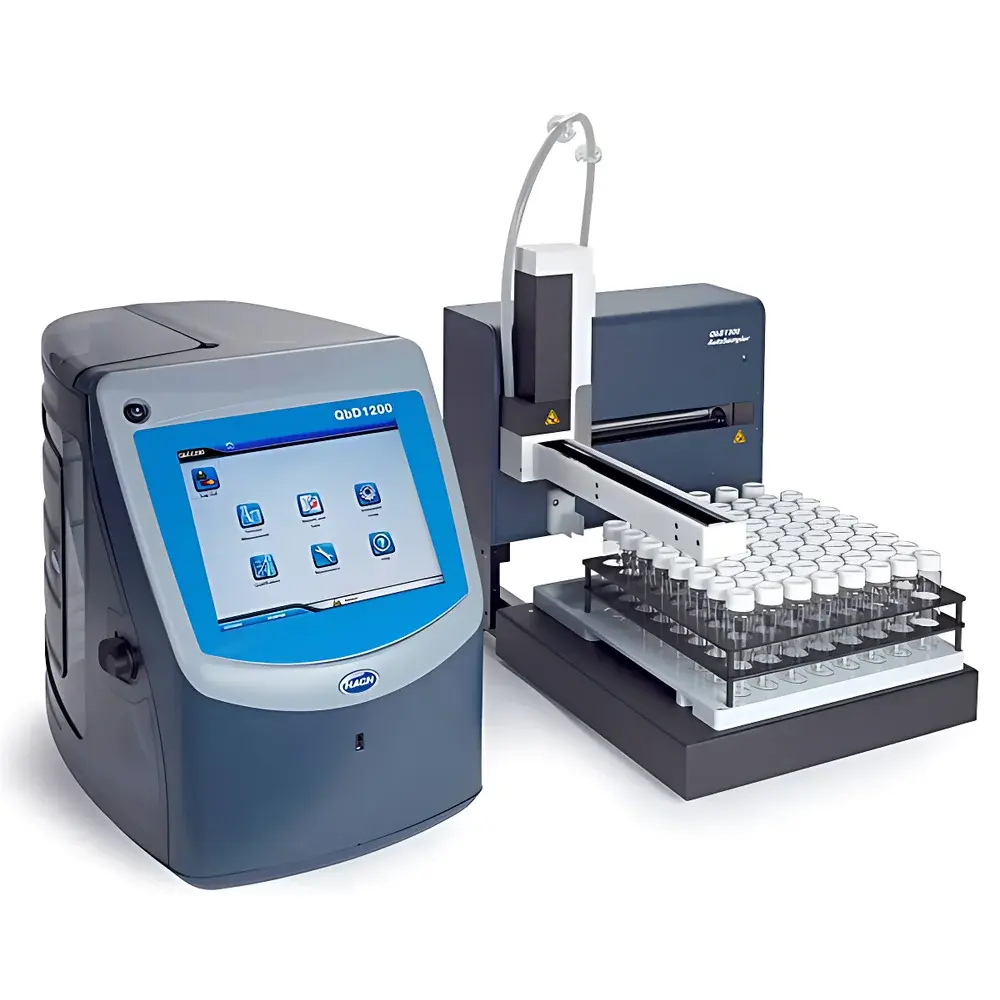
Hach QbD1200 Total Organic Carbon Analyzer
| Brand | Hach |
|---|---|
| Origin | USA |
| Manufacturer Type | Original Equipment Manufacturer (OEM) |
| Product Origin | Imported |
| Model | QbD1200 |
| Instrument Type | Online TOC Analyzer |
| Detection Principle | UV-Persulfate Oxidation with NDIR Detection |
| Oxidation Method | UV (254 nm) + Sodium Persulfate |
| Measurement Range | 0.4 ppb – 100,000 ppb (as C) |
| Accuracy | ±2% of reading or ±3 ppb (whichever is greater) |
| Resolution | 1 ppb |
| Detection Limit | 0.4 ppb |
| Repeatability | ±2% of reading or ±3 ppb (whichever is greater) |
| Analysis Time | ~5 minutes per sample |
| Calibration Cycle | Automated 90-minute calibration |
| Sample Carryover | <0.2% (from 500 ppb to baseline) |
| Overload Recovery | Full recovery to 1 ppb after single measurement at 1,000 ppm |
| Auto-ranging & Auto-dilution | Yes |
| Reagent Requirement | Single reagent system (acid + oxidant pre-mixed or separately supplied) |
| Power Supply | 100–240 VAC, 47–63 Hz |
| Dimensions (Analyzer) | 320 × 507 × 410 mm |
| Weight | 10 kg |
| Operating Environment | 10–35 °C, ≤90% RH (non-condensing) |
Overview
The Hach QbD1200 Total Organic Carbon Analyzer is an online, laboratory-grade TOC instrument engineered for regulatory-compliant water quality monitoring in pharmaceutical, biotechnology, and high-purity industrial applications. It employs a validated dual-oxidation strategy—ultraviolet (254 nm) photolysis combined with sodium persulfate oxidation—to quantitatively convert all non-volatile and semi-volatile organic carbon species into carbon dioxide. The resulting CO2 is then measured via a digital Non-Dispersive Infrared (NDIR) detector with continuous background compensation and drift correction. Unlike conventional TOC analyzers requiring separate inorganic carbon (IC) removal steps, the QbD1200 integrates dynamic endpoint detection to ensure complete IC elimination and total organic carbon (TOC) oxidation within a single reaction chamber—eliminating carryover, reducing maintenance, and enabling true unattended operation across ultra-trace to high-concentration ranges (0.4 ppb–100,000 ppb as C).
Key Features
- Single-reagent workflow: Eliminates need for acid spiking, IC purge modules, or multi-step reagent handling—reducing consumable complexity and operational risk.
- Digital NDIR detection with real-time reference channel: Enables automatic background subtraction and long-term signal stability without manual recalibration.
- Dynamic endpoint detection algorithm: Monitors CO2 evolution kinetics to terminate oxidation precisely when oxidation is complete—ensuring stoichiometric conversion and minimizing over-oxidation artifacts.
- Integrated self-health diagnostics: 10 dedicated sensor points continuously monitor UV lamp intensity, Peltier cooling performance, liquid/gas flow rates, pressure, temperature, and NDIR baseline—logging all parameters for audit-ready traceability.
- 10.4-inch high-resolution color touchscreen interface: Fully guided workflow with context-sensitive prompts; no external PC required for operation, data review, or report generation.
- Automated system suitability testing (SST) and calibration: Pre-programmed routines compliant with USP , EP 2.2.44, JP 16 , and ICH Q2(R2); includes KHP-based 18-point calibration (6 concentrations × 3 replicates).
- Robust overload recovery: Recovers from samples up to 10× upper range limit (1,000 ppm C) within one analysis cycle—no manual cleaning or service intervention required.
Sample Compatibility & Compliance
The QbD1200 is validated for use with purified water (PW), water for injection (WFI), clean-in-place (CIP) rinse waters, and environmental monitoring samples per global pharmacopeial requirements. It meets all criteria specified in USP , EP 2.2.44, JP 16 , IP, KP, and CP. Its architecture supports full compliance with FDA 21 CFR Part 11—including electronic signatures, audit trails, role-based access control, and encrypted on-board data storage. All measurements are timestamped, digitally signed, and stored in an AES-256 encrypted internal SSD with retention capacity exceeding 10 years of continuous operation. IQ/OQ/PQ documentation packages align with ICH Q5A, Q5C, and Annex 11 expectations for computerized system validation.
Software & Data Management
No external computing infrastructure is required: all instrument control, data acquisition, reporting, and security functions reside onboard. Reports—including calibration logs, SST results, and raw chromatograms—are generated in PDF and CSV formats and exported via secure FTP over Ethernet. The embedded database enforces immutable records: once written, data cannot be edited or deleted without full audit trail logging. User roles (Operator, Supervisor, Administrator) govern access to method editing, calibration execution, and audit trail review. All actions—including parameter changes, calibration initiations, and report exports—are captured with user ID, timestamp, and reason-for-change fields—fully satisfying ALCOA+ (Attributable, Legible, Contemporaneous, Original, Accurate, Complete, Consistent, Enduring, Available) data integrity principles.
Applications
- Pharmaceutical water systems: Continuous TOC monitoring of PW and WFI distribution loops per USP/EP/JP requirements.
- Cleanliness verification: Quantitative assessment of organic residue following equipment sanitization (e.g., API manufacturing lines, bioreactors).
- Process water qualification: Support for PQ of water purification systems under Annex 1 and ISPE Baseline Guide Vol. 4.
- Environmental release monitoring: Effluent compliance testing where low-level TOC detection (<1 ppb) and regulatory traceability are mandatory.
- Method transfer & validation labs: Reference-grade performance enables direct adoption in GMP/GLP environments without method revalidation.
FAQ
Does the QbD1200 require an external PC for operation or data export?
No. All functionality—including method setup, calibration, reporting, and secure data export via FTP—is fully self-contained on the instrument.
Is the system compliant with 21 CFR Part 11 and Annex 11?
Yes. It includes electronic signatures, role-based access control, encrypted audit trails, and immutable data storage—validated for use in regulated GMP environments.
How does the QbD1200 handle high-inorganic-carbon (IC) samples?
It uses dynamic endpoint detection—not acid spiking or purge-and-trap—to fully remove IC during oxidation, eliminating the need for auxiliary IC removal hardware.
What is the recommended maintenance interval?
Annual preventive maintenance is sufficient under normal operating conditions; no monthly servicing is required.
Can the instrument auto-dilute out-of-range samples?
Yes. Integrated auto-ranging and programmable dilution enable accurate measurement across the full 0.4 ppb–100,000 ppb span without manual intervention.
Is reagent preparation flexible?
Yes. Users may either purchase pre-formulated reagents or prepare acid and oxidant solutions in-house using certified-grade materials—supporting both cost control and supply chain resilience.
Related Products







