
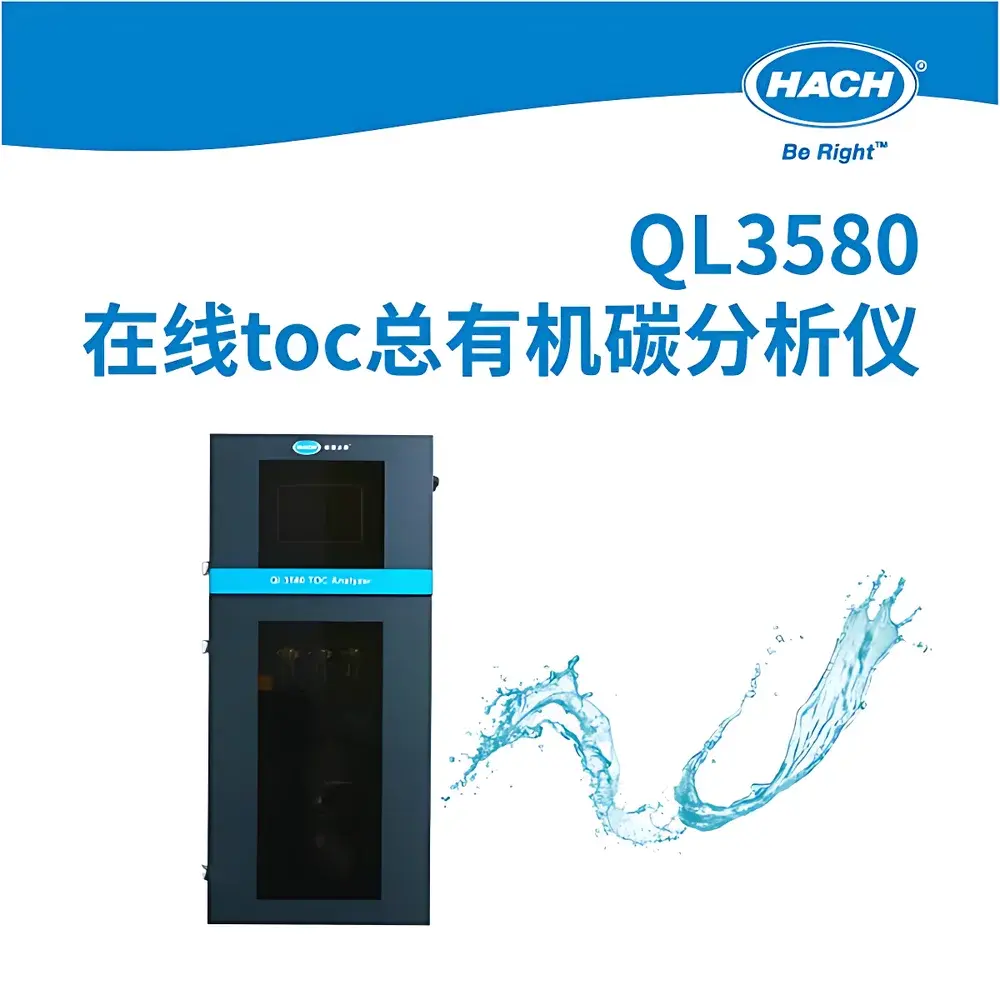
Hach QL3580 Online Total Organic Carbon (TOC) Analyzer
| Brand | Hach |
|---|---|
| Origin | USA |
| Manufacturer Type | Original Equipment Manufacturer (OEM) |
| Product Origin | Imported |
| Model | 8653800 |
| Instrument Type | Online TOC Analyzer |
| Detection Principle | Non-Dispersive Infrared (NDIR) Absorption |
| Oxidation Method | UV/Persulfate with Hydroxyl Radical Enhancement (O₂ carrier gas mode) or UV/Persulfate alone (instrument air carrier gas mode) |
| Operating Temperature Range | 5–45 °C |
| Accuracy | ±0.5 mg C/L or ±3% of reading (whichever is greater) |
| Resolution | 0.5 mg C/L |
| Detection Limit | >0.5 mg C/L |
| Repeatability | TOC: ±0.5 mg C/L or ±2% of reading (whichever is greater) |
| TIC | ±4% of reading |
| Sample Pathway | 4 mm ID integrated flow cell, no pretreatment required |
Overview
The Hach QL3580 Online Total Organic Carbon (TOC) Analyzer is an industrial-grade, continuous-monitoring instrument engineered for reliable quantification of organic carbon content in aqueous streams across environmental compliance and process water applications. It operates on the fundamental principle of catalytic oxidation followed by non-dispersive infrared (NDIR) detection of liberated CO₂. The system employs dual oxidation configurations: under high-purity oxygen carrier gas, it activates a synergistic UV/persulfate–hydroxyl radical oxidation pathway—capable of mineralizing refractory and particulate-bound organics; under standard instrument air, it utilizes robust UV/persulfate oxidation optimized for routine effluent monitoring. This design ensures consistent carbon recovery across diverse matrixes—including municipal wastewater influent/effluent, industrial discharge points, surface water intakes, and regulated outfalls—without alkaline reagents that introduce CO₂ dissolution artifacts or operator handling variability.
Key Features
- Dual-carrier-gas operation (O₂ or instrument air) enables method flexibility and field-deployable calibration traceability.
- Integrated 4 mm internal-diameter fluidic path with built-in flow-through cell eliminates need for external filtration, acidification, or sparging—reducing maintenance intervals and consumables cost.
- Reagent-free oxidation chemistry avoids sodium hydroxide or phosphoric acid use, mitigating CO₂ absorption bias and supporting GLP-aligned documentation of reagent preparation steps.
- High-resolution NDIR detector with temperature-compensated optical bench delivers stable baseline performance across ambient temperature fluctuations (5–45 °C).
- 10.1-inch HD capacitive touchscreen interface supports multi-level user access control (operator, supervisor, administrator), audit-trail-enabled configuration logging, and over-the-air firmware updates via Ethernet or USB.
- TOC/COD correlation module allows empirical conversion using site-specific regression models—facilitating cross-compliance reporting where both parameters are mandated by regulatory permits (e.g., EPA NPDES, EU Urban Wastewater Treatment Directive).
Sample Compatibility & Compliance
The QL3580 is validated for direct analysis of raw, unfiltered water samples with turbidity ≤ 100 NTU and total suspended solids (TSS) ≤ 50 mg/L. It meets ASTM D5905–22 (Standard Test Method for Total Organic Carbon in Water) and ISO 8245:1999 (Water Quality — Determination of Organic Carbon — Total and Dissolved) requirements when operated per manufacturer-specified protocols. Its architecture supports 21 CFR Part 11-compliant data integrity through electronic signature workflows, immutable audit trails, and role-based permissioning—making it suitable for facilities operating under FDA-regulated pharmaceutical water systems or ISO 17025-accredited environmental labs. Calibration verification checks align with USP guidance for purified water and water for injection (WFI) monitoring.
Software & Data Management
Hach Insight™ Web Server software provides secure remote access to real-time TOC trends, historical datasets (up to 2 years at 1-minute resolution), and diagnostic logs. Data export complies with CSV, PDF, and XML formats compatible with LIMS integration (via OPC UA or Modbus TCP). Automated QC flagging identifies drift beyond ±2% over 24 h or deviation exceeding accuracy specification during daily standard verification—triggering configurable email/SNMP alerts. All measurement events, calibration actions, and user logins are timestamped and cryptographically hashed to satisfy GMP/GLP data retention mandates.
Applications
- Continuous monitoring of municipal wastewater treatment plant discharge points for regulatory reporting (e.g., EPA Clean Water Act Section 402).
- Industrial effluent compliance at chemical, pharmaceutical, food & beverage, and semiconductor manufacturing sites.
- Surface water quality surveillance for watershed management agencies and environmental protection authorities.
- Process water TOC tracking in biopharmaceutical clean steam condensate loops and purified water distribution systems.
- Supporting ISO 14001 environmental management system (EMS) objectives through automated carbon load trending and anomaly detection.
FAQ
Does the QL3580 require daily reagent preparation?
No—oxidation relies solely on UV lamp energy and persulfate solution (pre-filled, shelf-stable cartridges with 90-day stability), eliminating manual reagent mixing.
Can it measure TOC in seawater or high-salinity brines?
Not recommended—chloride interference above 500 mg/L may suppress hydroxyl radical yield; application engineering review required for saline matrices.
Is the instrument certified for explosion-proof environments?
The standard QL3580 is rated for Class I, Division 2 hazardous locations; ATEX/IECEx-certified variants (model suffix -EX) are available upon request.
How often must the NDIR sensor be calibrated?
Factory-calibrated for life; zero/span verification is recommended every 7 days using certified CO₂ standards traceable to NIST SRM 1620.
What cybersecurity protocols does the embedded web server support?
TLS 1.2 encryption, IEEE 802.1X port-based network authentication, and configurable firewall rules via Hach Device Manager v4.2+.
Related Products







