
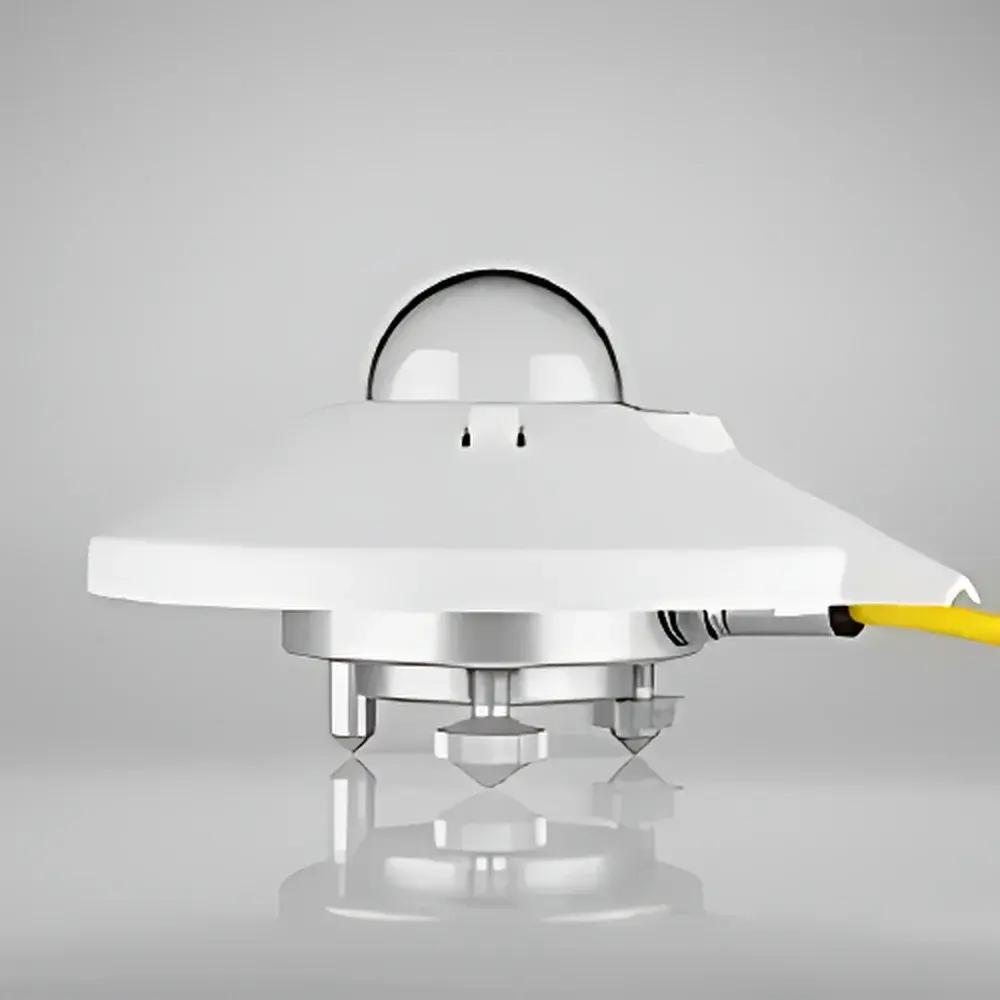
HACH SUV5 UV Radiometer
| Brand | Kipp & Zonen |
|---|---|
| Origin | Imported (Netherlands) |
| Model | SUV5 |
| Measurement Range | Total UV Irradiance (280–400 nm) |
| Output Options | RS-485 Modbus® RTU digital interface |
| Analog Outputs | 4–20 mA or 0–1 V |
| Temperature Compensation | Internal linearized correction over full operating range (-40 to +70 °C) |
| Desiccant Lifetime | ≥10 years (maintenance-free operation) |
| Housing | Anodized aluminum, IP67 rated |
| Spectral Response | Cosine-corrected, ±5% angular response up to 75° zenith angle |
| Stability | <±1 %/year (typical drift) |
Overview
The HACH SUV5 UV Radiometer is a precision-calibrated, thermally stabilized instrument engineered for continuous, long-term measurement of total ultraviolet (UV) irradiance across the biologically and photochemically relevant spectral band (280–400 nm). Developed by Kipp & Zonen — a globally recognized leader in solar and atmospheric radiation instrumentation — the SUV5 employs a silicon carbide (SiC) photodiode with spectrally optimized optical filtering and a precision cosine diffuser to ensure high-fidelity hemispherical response. Its measurement principle relies on photovoltaic conversion of incident UV photons into a proportional electrical signal, rigorously corrected for temperature-induced responsivity drift via an embedded, linearized thermal compensation algorithm. Designed for unattended deployment in demanding outdoor environments, the SUV5 meets IEC 61724-1:2021 requirements for PV system monitoring and complies with ISO 9060:2018 classification as a “Secondary Standard” radiometer for broadband UV.
Key Features
- Thermally linearized internal temperature compensation ensures stable output across -40 °C to +70 °C ambient conditions, eliminating external calibration dependency under field thermal cycling.
- Maintenance-free desiccant system with guaranteed ≥10-year service life minimizes operational downtime and reduces lifecycle cost of ownership.
- Dual-output architecture supports both industrial-standard analog signals (4–20 mA current loop or 0–1 V voltage output) and robust digital communication via RS-485 using Modbus® RTU protocol — enabling seamless integration into SCADA, PLC, and data logger networks.
- IP67-rated anodized aluminum housing provides resistance to corrosion, dust ingress, and transient water immersion — validated for permanent outdoor installation in coastal, desert, and alpine climates.
- Cosine-corrected optical head achieves <±5% angular response error up to 75° zenith angle, meeting ISO 9060:2018 directional response specifications for broadband radiometry.
- Factory calibration traceable to the World Radiometric Reference (WRR) at PMOD/WRC (Davos, Switzerland), with documented uncertainty <±3 % (k=2) for total UV irradiance.
Sample Compatibility & Compliance
The SUV5 is not a sample-based analytical instrument; it measures incident broadband UV irradiance on a planar surface without physical contact or consumables. It requires no reagents, filters, or optical alignment during operation. The sensor is compatible with standard mounting hardware (e.g., solar tracker arms, meteorological masts, flat-roof brackets) and integrates directly with HACH’s SC1000 or other third-party controllers supporting Modbus RTU or 4–20 mA inputs. Regulatory compliance includes adherence to IEC 61724-1:2021 (Photovoltaic system performance monitoring), ISO 9060:2018 (Solar energy — Specification and classification of instruments for measuring hemispherical solar and direct solar radiation), and EN 50530 (Electrical safety of PV inverters, where irradiance input is used for MPPT validation). Data integrity meets GLP-aligned logging practices when paired with compliant dataloggers supporting audit-trail timestamping.
Software & Data Management
The SUV5 operates as a stand-alone transducer and does not include embedded firmware-based configuration software. Configuration of Modbus registers (e.g., slave ID, baud rate, parity) is performed via serial terminal utility or integrated within host SCADA platforms (e.g., Ignition, Siemens Desigo, Campbell Scientific LoggerNet). Analog outputs require no software setup. For centralized UV data management, the sensor feeds into HACH’s INTELLIGENT SENSOR PLATFORM (ISP) ecosystem or third-party environmental monitoring suites such as PVsyst, Meteodyn WT, or WeatherLink Live. When deployed in regulated environments (e.g., solar farm commissioning under IEC 62446-1), raw irradiance values support 21 CFR Part 11-compliant electronic records when acquired through validated data acquisition systems with user access control and change audit trails.
Applications
- Ground-truth validation of satellite-derived UV index forecasts in national meteorological networks.
- Long-term UV dose monitoring for material degradation studies (e.g., polymer aging, paint fading, roofing membrane testing) per ASTM G154 and ISO 4892-3.
- Real-time irradiance input for maximum power point tracking (MPPT) algorithms and soiling loss quantification in utility-scale photovoltaic plants.
- Ecological UV exposure assessment in alpine, polar, and tropical research stations studying DNA damage thresholds in phytoplankton or amphibian populations.
- Compliance monitoring for occupational UV exposure limits (ACGIH TLV®) near industrial UV curing lines or germicidal lamp installations.
FAQ
Is the SUV5 calibrated upon shipment, and is recalibration required?
Yes — each unit ships with a NIST-traceable calibration certificate referencing WRR. Recalibration is recommended every two years for critical applications or after physical shock; however, the 10-year desiccant lifetime and thermal stability design support extended calibration intervals in stable deployments.
Can the SUV5 be mounted on a solar tracker?
Yes — its low-profile, lightweight design (≤1.2 kg) and standard 1/4″-20 UNC mounting thread are fully compatible with single- and dual-axis solar trackers meeting IEC 61727 mechanical load specifications.
Does the SUV5 measure UVA, UVB, and UVC separately?
No — it reports total broadband UV irradiance (280–400 nm) only. Spectral separation requires a UV spectroradiometer (e.g., Bentham DMc300) or filter-based multi-channel systems.
What is the maximum cable length for RS-485 communication?
Up to 1,200 meters at 9.6 kbps (with proper twisted-pair shielded cable and termination resistors), per EIA/TIA-485-A standards.
Is the analog output isolated?
Yes — the 4–20 mA output is galvanically isolated to 1,500 VDC, preventing ground-loop interference in distributed monitoring systems.







