
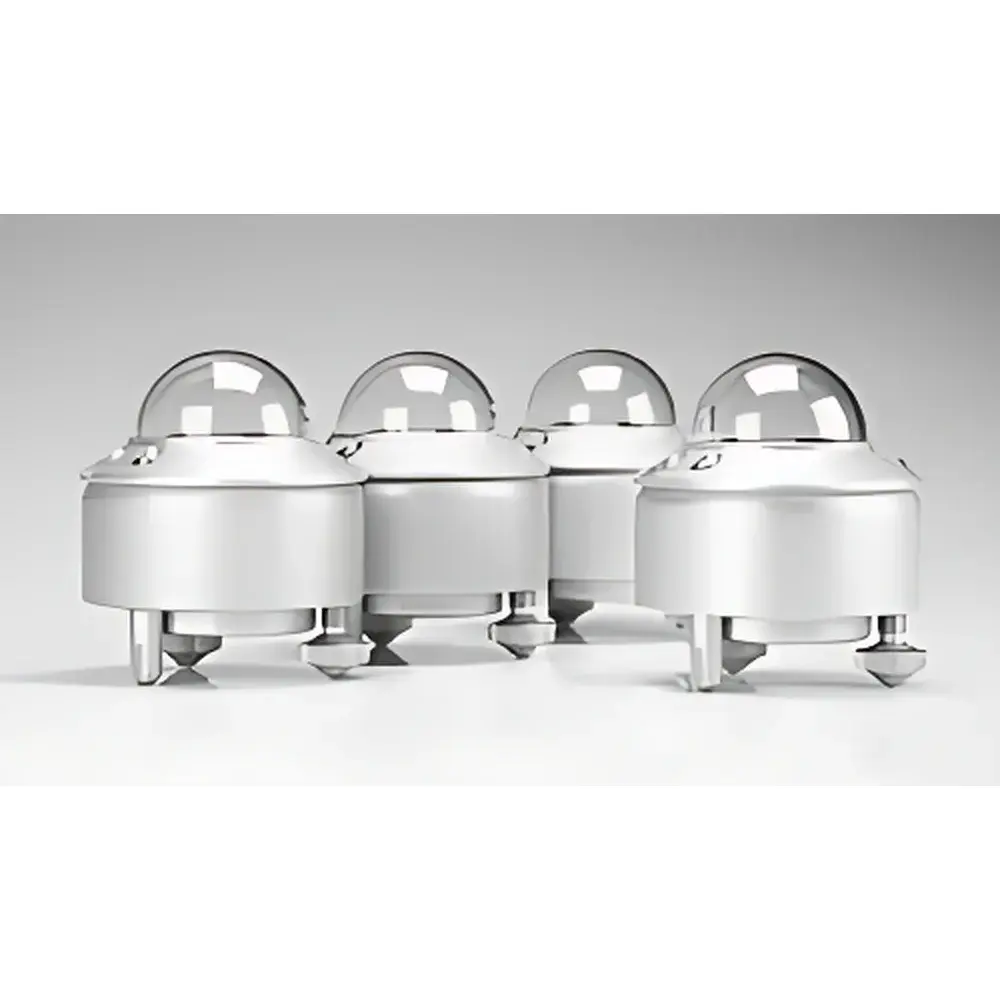
HACH SUVA/SUVB/SUV-E UV Radiometer Series (Kipp & Zonen)
| Brand | Kipp & Zonen |
|---|---|
| Model | SUVA / SUVB / SUV-E |
| Spectral Range (SUVA) | 315–400 nm |
| Spectral Range (SUVB) | 280–315 nm |
| Spectral Range (SUV-E) | Erythemal Action Spectrum (CIE 1987) weighted |
| Output Options | 0–1 V analog + RS-485 Modbus® RTU digital |
| Directional Response Error | < ±2 % (10° to 80° zenith angle) |
| Temperature Dependence | < ±0.1 %/°C (with integrated thermistor compensation) |
| Power Consumption | < 1.5 mA @ 12 VDC |
| Operating Temperature | –40 °C to +80 °C |
| IP Rating | IP68 |
Overview
The HACH SUVA/SUVB/SUV-E UV radiometer series—manufactured by Kipp & Zonen and distributed globally under the HACH brand—comprises a family of precision-calibrated, field-deployable broadband ultraviolet (UV) solar radiation sensors. Each model is engineered for long-term outdoor exposure and traceable metrological performance in uncontrolled environmental conditions. The SUVA sensor measures spectral irradiance across the UVA band (315–400 nm), critical for assessing photochemical aging, polymer degradation, and atmospheric ozone monitoring. The SUVB sensor targets the biologically active UVB range (280–315 nm), where solar flux exhibits strong diurnal and seasonal variability and is directly linked to stratospheric ozone column thickness. The SUV-E variant implements the CIE (Commission Internationale de l’Éclairage) 1987 erythemal action spectrum—a standardized physiological weighting function that models human skin’s spectral sensitivity to sunburn-inducing UV exposure. All three instruments operate on the principle of thermopile-based detection with quartz-dome-corrected optical filtering and built-in temperature stabilization, ensuring high reproducibility and minimal zero drift over extended deployment cycles.
Key Features
- Optically calibrated quartz dome with spectral-selective interference filters, optimized for angular response uniformity and cosine correction across 0–80° solar zenith angles
- Integrated Pt1000 thermistor and real-time temperature compensation algorithm, limiting thermal drift to < ±0.1 %/°C across the full operating range (–40 °C to +80 °C)
- Low-power architecture consuming less than 1.5 mA at 12 VDC—enabling multi-year operation on standard solar-powered data logger systems
- Dual-output interface: isolated 0–1 V analog signal (1 mV per µW/cm² for SUVA/SUVB; 1 mV per mED/m²/s for SUV-E) and RS-485 Modbus® RTU protocol for direct integration into SCADA, IoT gateways, or automated weather stations
- IP68-rated stainless-steel housing with marine-grade anodized aluminum base, compatible with standard ISO 9060:2018 mounting hardware and passive ventilation design to minimize thermal offset
Sample Compatibility & Compliance
These radiometers are designed for continuous outdoor measurement of global horizontal irradiance (GHI) in the ultraviolet spectrum and require no sample preparation or consumables. They comply with the fundamental requirements of ISO 9060:2018 for secondary standard classification and meet the spectral responsivity criteria defined in ASTM G173-03 (Standard Tables for Reference Solar Spectral Irradiances). For erythemal applications, the SUV-E adheres strictly to the CIE S 007/E-1998 and ICNIRP 2004 guidelines for UV exposure assessment. All units ship with NIST-traceable calibration certificates valid for 12 months, and recalibration services follow ISO/IEC 17025-accredited procedures. Data generated by these sensors support regulatory reporting under EPA UV-B Monitoring Program protocols and are routinely accepted in GLP-compliant environmental health studies.
Software & Data Management
The radiometers interface natively with Campbell Scientific CR-series, Delta-T Devices GP2, and HOBO RX3000 data loggers via analog input or Modbus register mapping. HACH’s AquaSuite™ platform supports automated ingestion, unit-conversion (e.g., µW/cm² → UV Index), and time-synchronized aggregation with co-located pyranometers and PAR sensors. Raw output includes timestamped irradiance values, internal temperature readings, and diagnostic flags (e.g., dome contamination warning, voltage drop alert). When deployed in FDA-regulated clinical photobiology studies or EU REACH-compliant material testing labs, the system supports audit-trail generation and electronic signature compliance per 21 CFR Part 11 when paired with validated logging firmware.
Applications
- Long-term UV climatology networks operated by national meteorological services (e.g., NOAA SURFRAD, WMO GAW)
- Photovoltaic module degradation analysis—correlating UVA exposure dose with encapsulant yellowing and backsheet delamination rates
- Erythemal UV Index forecasting and public health advisories for dermatological risk management
- Validation of radiative transfer models (e.g., libRadtran, TUV) used in atmospheric chemistry simulations
- Calibration reference for hyperspectral UV spectroradiometers in field intercomparison campaigns
FAQ
What is the recommended recalibration interval for field-deployed SUVA/SUVB/SUV-E sensors?
Annual recalibration is advised for research-grade applications; biennial intervals may be acceptable for operational monitoring where traceability is maintained via side-by-side comparison with a reference instrument.
Can these radiometers be mounted vertically for measuring UV albedo?
Yes—when installed with appropriate tilt-angle brackets and shadow-band compensation, they support reflected UV measurements; however, directional response uncertainty increases beyond 80° incidence and must be corrected using empirical cosine error tables.
Is Modbus register mapping documentation publicly available?
Yes—HACH provides a complete Modbus RTU register map (including holding registers for irradiance, temperature, status bits, and calibration coefficients) in the product technical manual, revision-controlled under document ID HACH-SUVA-TECH-MAN-EN-2.4.
Do these sensors require desiccant or dome heating in high-humidity environments?
No—the IP68 housing and hermetically sealed quartz dome eliminate condensation risk; no active heating or desiccant maintenance is required under normal deployment conditions.
Related Products







