
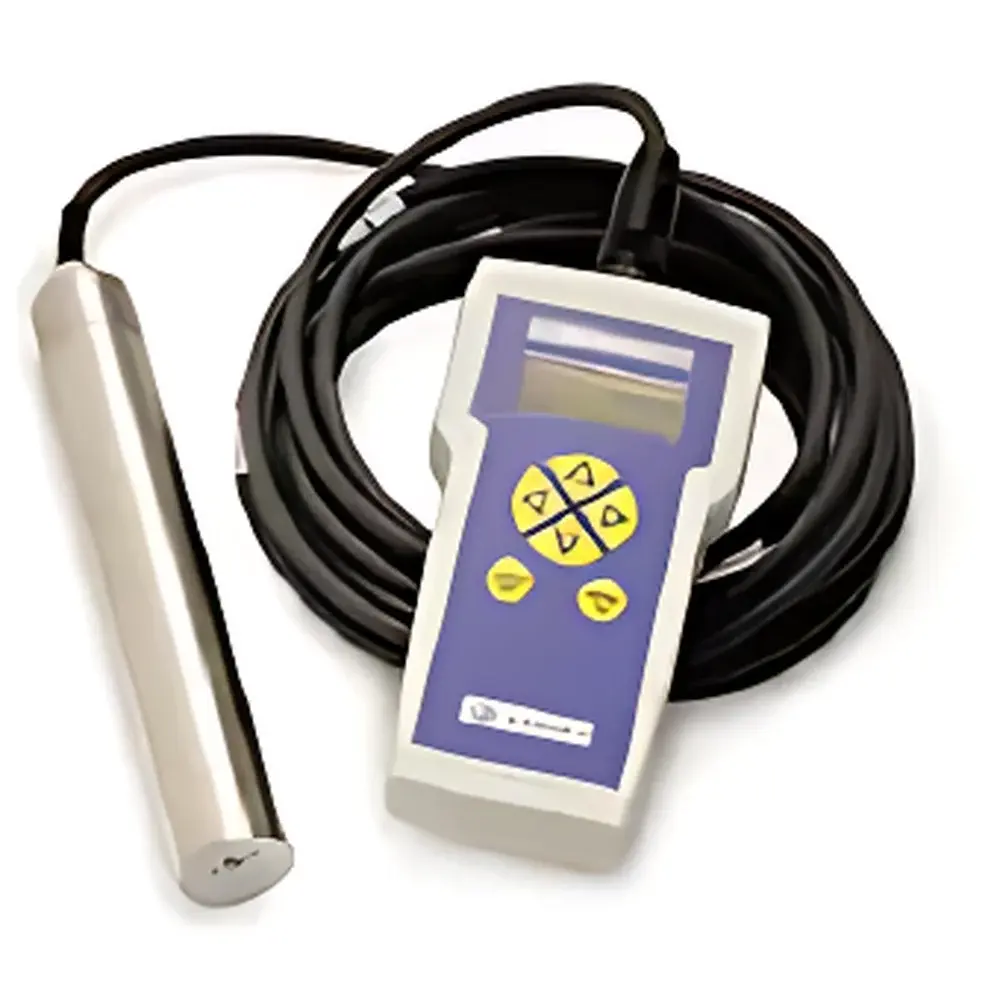
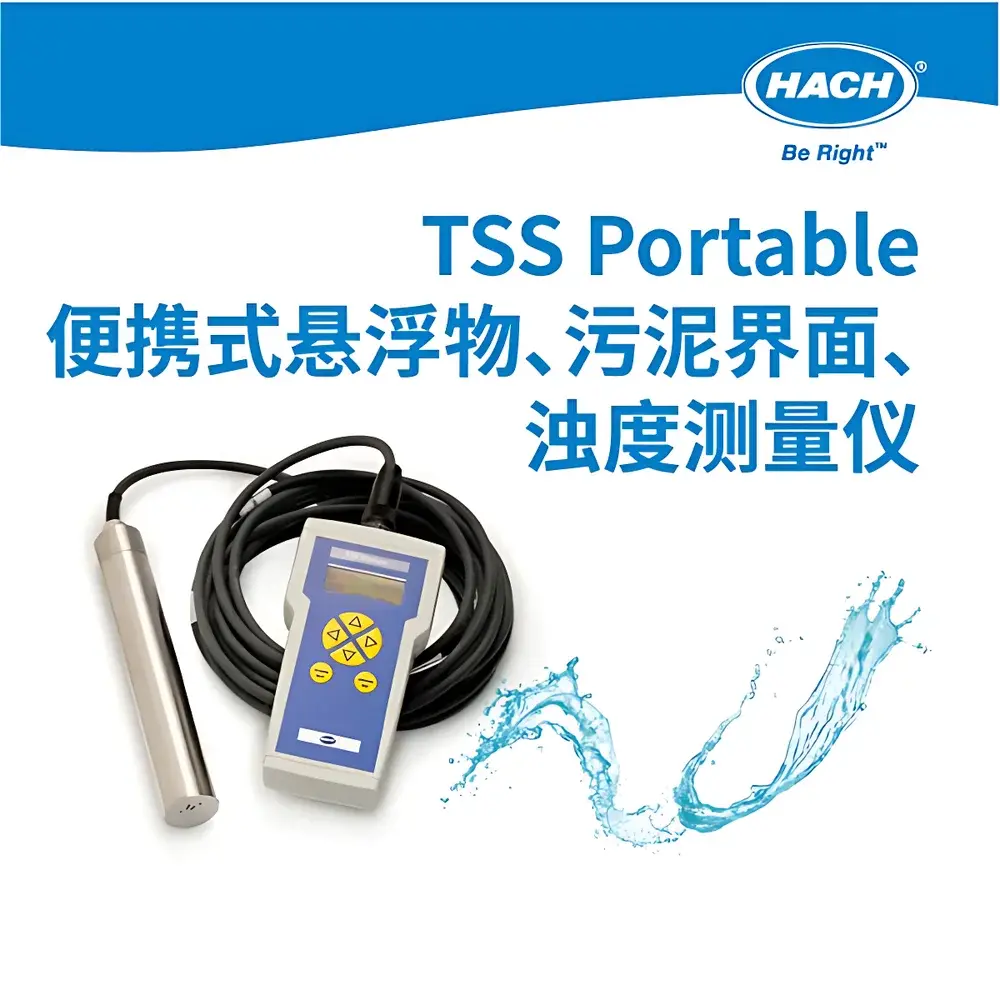
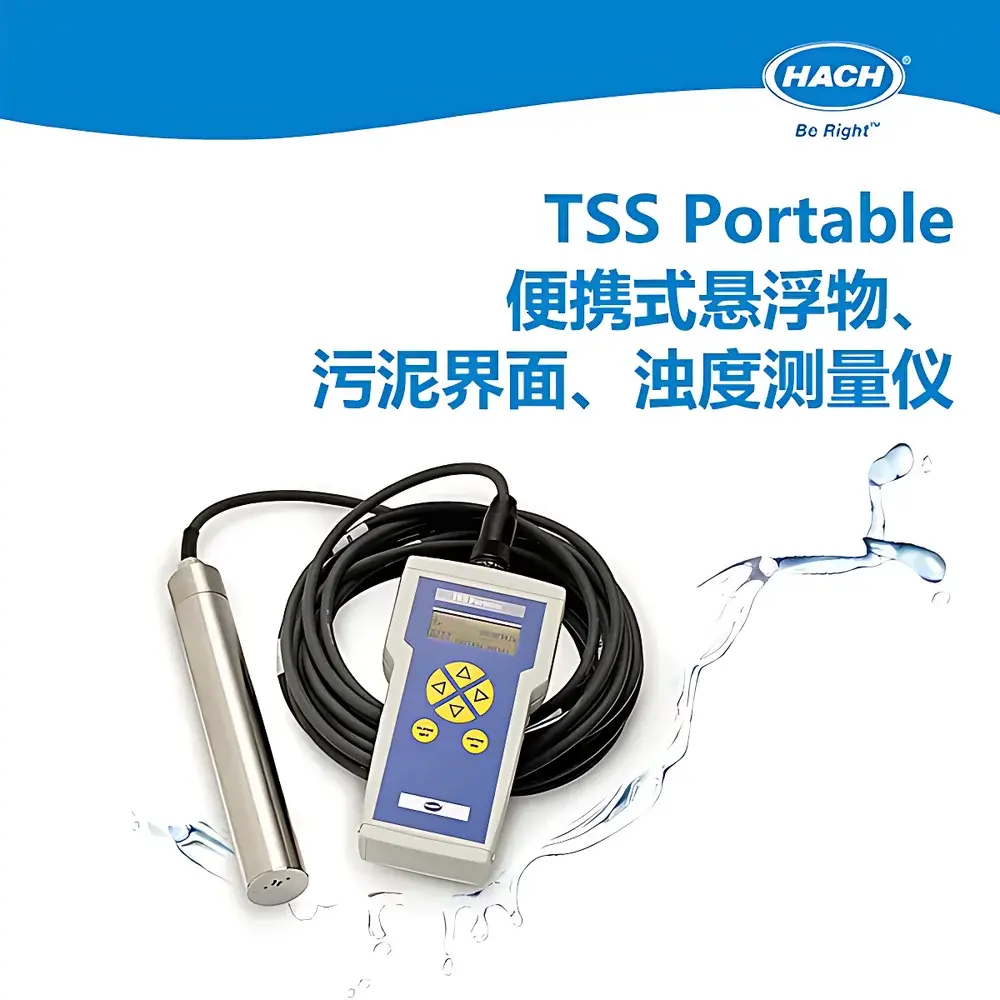
Hach TSS Portable Handheld Turbidity, Suspended Solids, and Sludge Interface Analyzer
| Brand | Hach |
|---|---|
| Model | TSS Portable |
| Measurement Principle | Multi-beam alternating light method with infrared diodes |
| Turbidity Range | 0.001–4000 NTU |
| Suspended Solids Range | 0.001–400 g/L (1–400,000 mg/L, upper limit sample-dependent) |
| Turbidity Accuracy | ±3% or ±0.02 NTU (whichever is greater) |
| Suspended Solids Accuracy | ±4% or ±0.001 g/L (whichever is greater) |
| Turbidity Resolution | 0.001 NTU (0–0.999), 0.01 NTU (1–9.99), 0.1 NTU (10–99.9), 1 NTU (>100) |
| Suspended Solids Resolution | 0.001 g/L (0–0.999), 0.01 g/L (1–9.99), 0.1 g/L (10–99.9), 1 g/L (>100) |
| Turbidity Units | NTU, FNU, EBC |
| SS Units | mg/L, g/L, ppm, % |
| Calibration | 4 pre-stored SS calibration curves + 1 turbidity curve |
| Bubble Compensation | Automated software-based correction |
| Sensor Material | Electropolished stainless steel housing with sapphire optical window |
| Data Storage | 290 measurement records (timestamp, location, value, homogeneity flag) |
| Operating Modes | Single-point, interval, or continuous measurement |
| Power | Rechargeable battery — up to 30 days in typical intermittent use, 4 hours in continuous mode |
| Display | Backlit graphical LCD with intuitive menu navigation |
Overview
The Hach TSS Portable Handheld Turbidity, Suspended Solids, and Sludge Interface Analyzer is an engineered field instrument designed for high-fidelity, real-time assessment of water clarity, particulate load, and settling behavior in municipal wastewater treatment plants, industrial effluent streams, drinking water distribution systems, and surface water monitoring applications. It operates on a robust multi-beam alternating light principle using infrared diodes—eliminating spectral interference from natural coloration while ensuring compliance with DIN EN 27027 and ISO 7027 for turbidity measurement. Unlike conventional single-angle nephelometers, the TSS Portable employs dual-channel 90° scattering detection for primary turbidity quantification, supplemented by six-angle multi-spectral analysis to cross-validate suspended solids (SS) concentration and dynamically resolve sludge interface depth during sedimentation profiling. Its physical architecture integrates optical stability, thermal drift mitigation, and mechanical resilience—enabling repeatable performance across temperature gradients (0–40 °C), variable flow regimes, and abrasive particulate environments.
Key Features
- Triple-parameter capability: Simultaneous quantification of turbidity (NTU/FNU/EBC), suspended solids (mg/L/g/L/%), and sludge interface depth—without hardware modification or sensor swapping.
- Multi-angle optical validation: Six independent detection channels enable angular scattering pattern analysis, improving SS accuracy in heterogeneous suspensions where particle size distribution deviates from standard calibration assumptions.
- Adaptive calibration architecture: Four user-selectable SS calibration curves stored onboard; each supports up to three-point span calibration plus zero offset—allowing traceable alignment to lab-grade gravimetric or spectrophotometric reference methods per ASTM D5907 or ISO 11923.
- Bubble compensation algorithm: Real-time signal correction for transient air entrainment, a known source of positive bias in submerged optical measurements—particularly critical during rapid drawdown or pump-induced turbulence.
- Durable optical interface: Sapphire viewport (Mohs hardness 9) bonded to electropolished 316 stainless steel housing resists abrasion, biofilm adhesion, and chemical corrosion in aggressive wastewater matrices.
- Intelligent power management: Rechargeable Li-ion battery with state-of-charge display; automatic sleep/wake cycling in interval mode extends operational field life to ≥30 days under typical utility workflows.
Sample Compatibility & Compliance
The TSS Portable accommodates a broad range of aqueous matrices—including activated sludge supernatants, anaerobic digester feedstocks, clarified effluents, raw river intake water, and potable distribution samples. Its optical design minimizes sensitivity to dissolved organic carbon (DOC) absorbance, enabling reliable SS estimation even in humic-rich surface waters. All turbidity measurements conform to ISO 7027:2016 and DIN EN 27027:1995 requirements for formazin-equivalent reporting. For regulatory reporting, data output supports audit-ready timestamping and location tagging—facilitating GLP-aligned documentation in accordance with EPA Method 180.1 and EU Directive 2000/60/EC Annex V. While not intrinsically certified for hazardous area use, its IP68-rated probe assembly meets IEC 60529 standards for submersion at depths up to 10 meters.
Software & Data Management
Measurements are stored locally in non-volatile memory with full metadata: date/time stamp (RTC-synchronized), GPS-assisted location tag (when paired with external GNSS module), operator ID, measurement mode, and homogeneity indicator (derived from inter-channel signal variance). Export occurs via USB-C to CSV or Hach-compatible .hdx format, preserving traceability for QA/QC review. Firmware supports over-the-air updates through Hach’s Unified Software Platform (USP), ensuring ongoing alignment with evolving metrological guidance—including USP particulate matter testing conventions for pharmaceutical water systems. Audit trail functionality complies with FDA 21 CFR Part 11 requirements when used with validated electronic signature protocols.
Applications
- Verification and field calibration of fixed-installation turbidimeters and online SS analyzers per ISO/IEC 17025 proficiency criteria.
- Routine sludge blanket profiling in secondary clarifiers—determining optimal withdrawal depth to prevent solids carryover.
- Emergency response monitoring following combined sewer overflows (CSOs) or industrial spills, delivering immediate quantitative insight without lab turnaround delay.
- Performance evaluation of coagulation/flocculation processes by tracking turbidity removal efficiency across treatment trains.
- Research-grade characterization of floc settleability (e.g., SVI approximation) through time-resolved interface descent velocity calculation.
FAQ
Can the TSS Portable be used for regulatory compliance reporting?
Yes—when operated within specified environmental limits and calibrated against traceable standards, its turbidity and SS outputs meet ISO 7027 and ASTM D5907 requirements for routine environmental monitoring. Documentation must include calibration certificates, raw data logs, and operator verification records.
How does the instrument handle highly viscous or fibrous sludges?
The sapphire window and smooth stainless steel geometry minimize fouling; however, manual cleaning with soft lint-free cloth and deionized water is recommended after exposure to filamentous biomass or grease-laden influents.
Is remote data transmission supported natively?
No built-in cellular or LoRaWAN radio is included; however, exported CSV files integrate seamlessly with SCADA historian systems, LIMS platforms, and cloud-based dashboards via standard file ingestion protocols.
What maintenance intervals are recommended for field deployment?
Optical window inspection before each use; full calibration verification every 30 days or after 100 immersion cycles; battery health check every 6 months per IEC 62133 guidelines.
Does the device support custom SS calibration curve import?
No—only the four factory-loaded curves are modifiable in-field; however, each can be fine-tuned using up to three user-defined span points and one zero point, enabling matrix-specific adaptation without firmware modification.







