
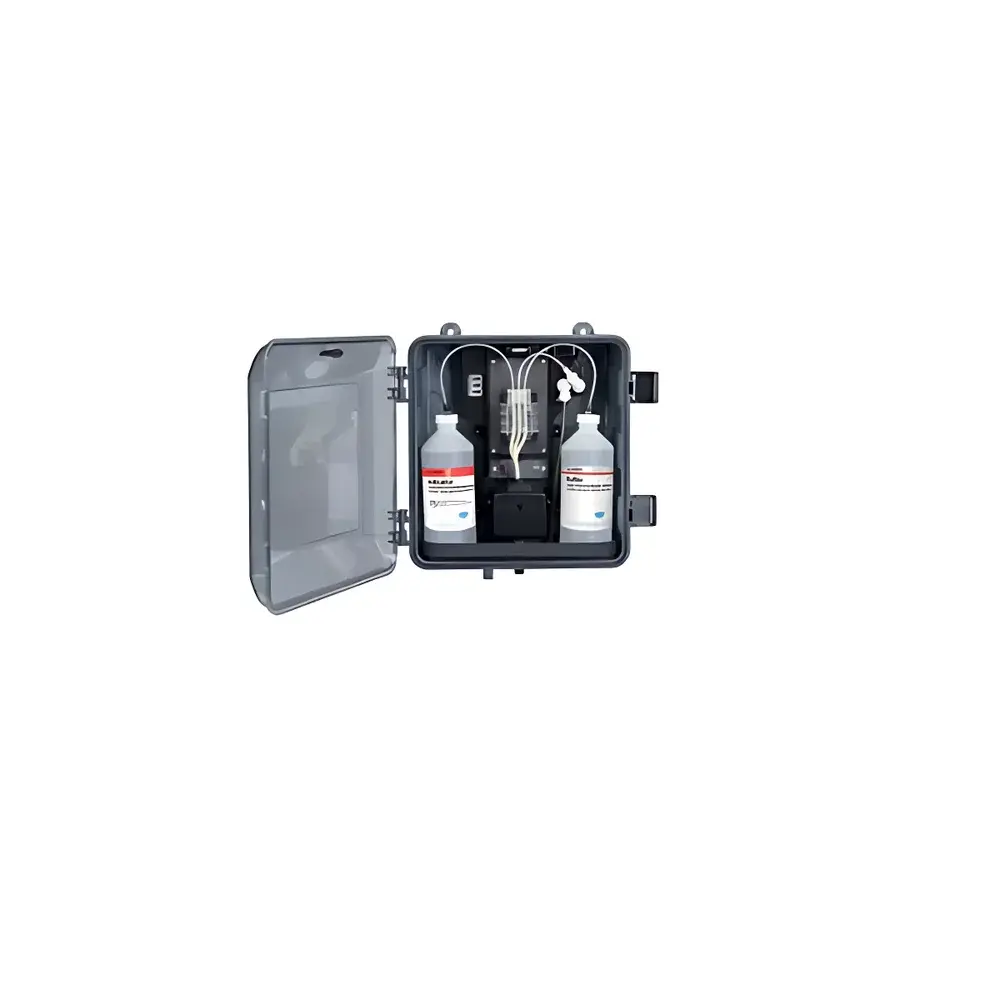
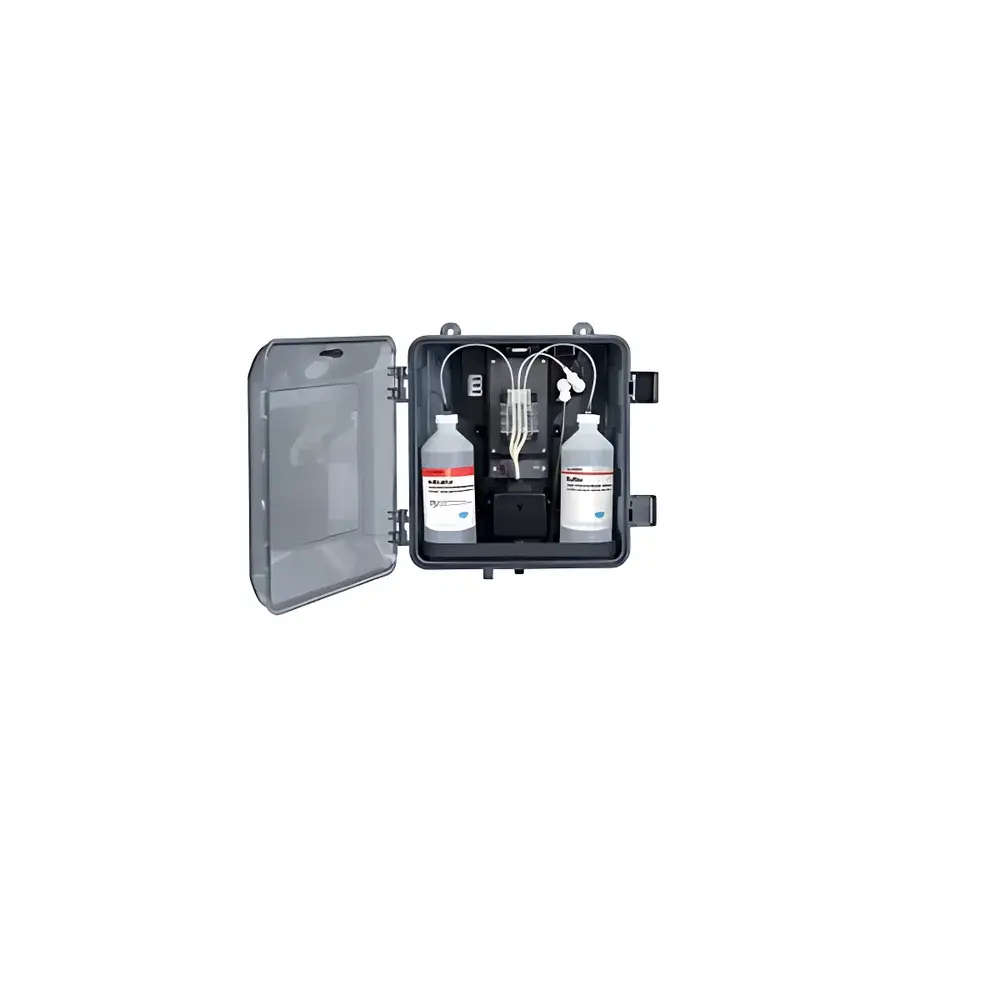
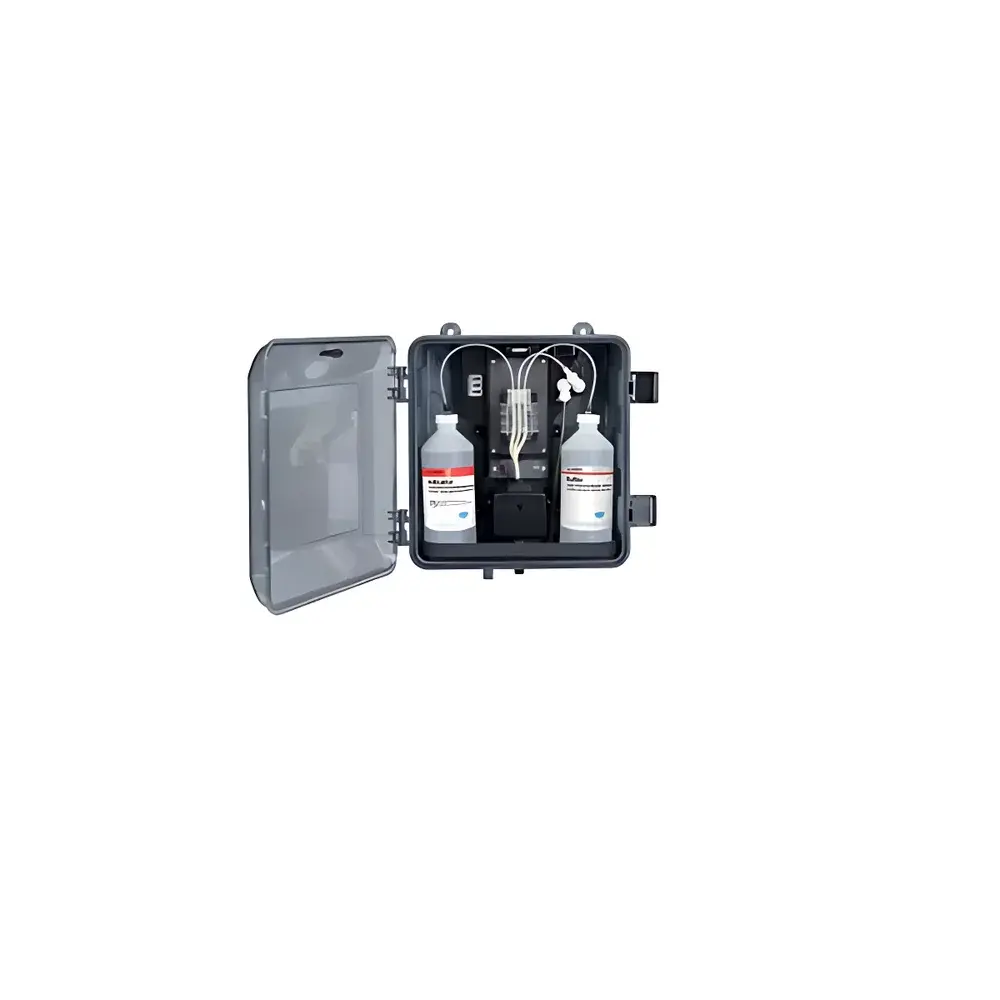
HACH ULR CL17sc Online Total Chlorine Analyzer
| Brand | HACH |
|---|---|
| Origin | USA |
| Model | ULR CL17sc |
| Measurement Principle | DPD (N,N-Diethyl-p-phenylenediamine) Colorimetric Method |
| Measurement Range | 0.008–5 mg/L Cl₂ |
| Accuracy | ±5% or ±0.01 mg/L (whichever is greater) for 0–4 mg/L |
| Detection Limit | 0.008 mg/L Cl₂ at 25°C |
| Cycle Time | 2.5 minutes |
| Sample Flow Rate | 60–200 mL/min |
| Inlet Pressure | 0.3–5.2 bar (to Y-strainer) |
| Sample Temperature | 5–40°C |
| Operating Temperature | 5–40°C |
| Operating Humidity | 0–90% RH, non-condensing |
| IP Rating | IP66 |
| Power Supply | 12 VDC, max. 400 mA |
| Dimensions (H×W×D) | 342 × 329 × 177 mm |
| Weight | 4.1 kg |
| Light Source | LED at 510 nm, 1 cm optical path |
| Certifications | CE (EN 61326-1, CISPR 11, EN 50581), ACMA RCM, Korea KC, FCC DoC, IEC/EN 60529, ICES-003 |
Overview
The HACH ULR CL17sc Online Total Chlorine Analyzer is a compact, wall-mountable photometric instrument engineered for continuous, real-time monitoring of total chlorine concentration in process water streams. It employs the standardized N,N-diethyl-p-phenylenediamine (DPD) colorimetric method—fully compliant with EPA Method 334.0 and ASTM D1253—where total chlorine oxidizes DPD to form a stable pink-colored complex quantified spectrophotometrically at 510 nm. Designed for integration into critical water quality control loops, the ULR CL17sc delivers high reproducibility in low-concentration regimes (down to 8 ppb Cl₂), making it especially suitable for feedwater monitoring upstream of reverse osmosis (RO) membranes, dechlorination verification in pharmaceutical utilities, and final rinse water validation in semiconductor tooling.
Key Features
- Sub-ppb detection capability (0.008 mg/L Cl₂) ensures early-stage detection of residual chlorine breakthrough in sensitive pretreatment applications.
- Fixed 1 cm optical pathlength and temperature-stabilized LED light source (510 nm) minimize drift and enhance long-term measurement stability.
- Integrated cumulative chlorine exposure calculation enables predictive maintenance of RO membranes by tracking integrated Cl₂ dose over time—supporting ISO 20426 and USP water system lifecycle management.
- Robust mechanical architecture includes IP66-rated enclosure, chemical-resistant fluidic path (PE tubing, quick-connect fittings), and built-in air purge option (3/8″ push-to-connect) for periodic cell cleaning.
- Low reagent consumption: ≤0.5 L each of DPD indicator and phosphate buffer per 31-day operational cycle—reducing consumables handling and waste generation.
- Minimal sample conditioning requirements: only a 40-mesh Y-strainer upstream; no external pumps or pressure regulators needed for standard installations.
Sample Compatibility & Compliance
The ULR CL17sc accepts aqueous samples within 5–40°C and requires no particulate load exceeding 40 mesh (≤425 µm). Interferences from bromide, chlorine dioxide, ozone, and permanganate are documented per Standard Methods 4500-Cl G and must be evaluated during method validation. The analyzer complies with international electromagnetic compatibility and safety standards including EN 61326-1 (industrial EMC), IEC/EN 60529 (IP66 ingress protection), and regulatory frameworks governing validated environments: FDA 21 CFR Part 11 (when paired with compatible HACH SC1000 or LAN-10 controllers), EU Annex 11, and ISPE Water and Steam Baseline Guide principles. Its CE marking confirms conformity with the EU Electromagnetic Compatibility and RoHS directives.
Software & Data Management
Data output is provided via 4–20 mA analog signal and Modbus RTU (RS-485) interface for seamless integration into DCS, SCADA, or MES platforms. When connected to HACH’s SC1000 controller or LAN-10 data logger, the ULR CL17sc supports audit-trail-enabled operation per ALCOA+ principles—including user action logging, calibration history, and event-triggered data snapshots. Raw absorbance values, calculated concentrations, and cumulative exposure metrics are timestamped and exportable in CSV format. Firmware updates follow controlled change management protocols aligned with GMP Annex 11 and ISO/IEC 17025 clause 5.9.
Applications
- Pharmaceutical water systems: Monitoring post-carbon filter effluent to ensure RO membrane protection per USP and EU GMP Annex 1.
- Food & beverage production: Verifying chlorine removal prior to product contact surfaces and CIP return lines.
- Power plant condensate polishing: Detecting trace chloramine carryover from makeup water treatment.
- Microelectronics ultrapure water (UPW) loops: Confirming chlorine absence downstream of UV oxidation and ion exchange units.
- Municipal wastewater reuse: Validating disinfectant residual decay across tertiary filtration trains.
FAQ
What sample filtration is required prior to analysis?
A 40-mesh (425 µm) Y-strainer must be installed upstream of the analyzer inlet. No additional particulate filtration is necessary under normal operating conditions.
Can the ULR CL17sc distinguish between free chlorine and combined chlorine?
No—it measures total chlorine exclusively via the DPD Method 1 protocol. Free and combined chlorine differentiation requires sequential DPD titration (Methods 2 and 3), which is not supported by this online analyzer.
Is the instrument suitable for outdoor installation?
Yes, when mounted on a sheltered wall surface with ambient temperature maintained between 5–40°C and relative humidity below 90% non-condensing. Direct solar exposure and rain ingress must be prevented despite its IP66 rating.
How often does the optical cell require manual cleaning?
Under typical low-turbidity municipal or purified water service, cleaning intervals exceed six months. Air purge functionality extends maintenance cycles further in applications prone to biofilm formation.
Does the analyzer support remote diagnostics or firmware updates?
Firmware updates require local physical access via micro-USB port and HACH ServiceTool software. Remote diagnostics are available only through integrated controllers (e.g., SC1000) with Ethernet connectivity and authorized network access.




