
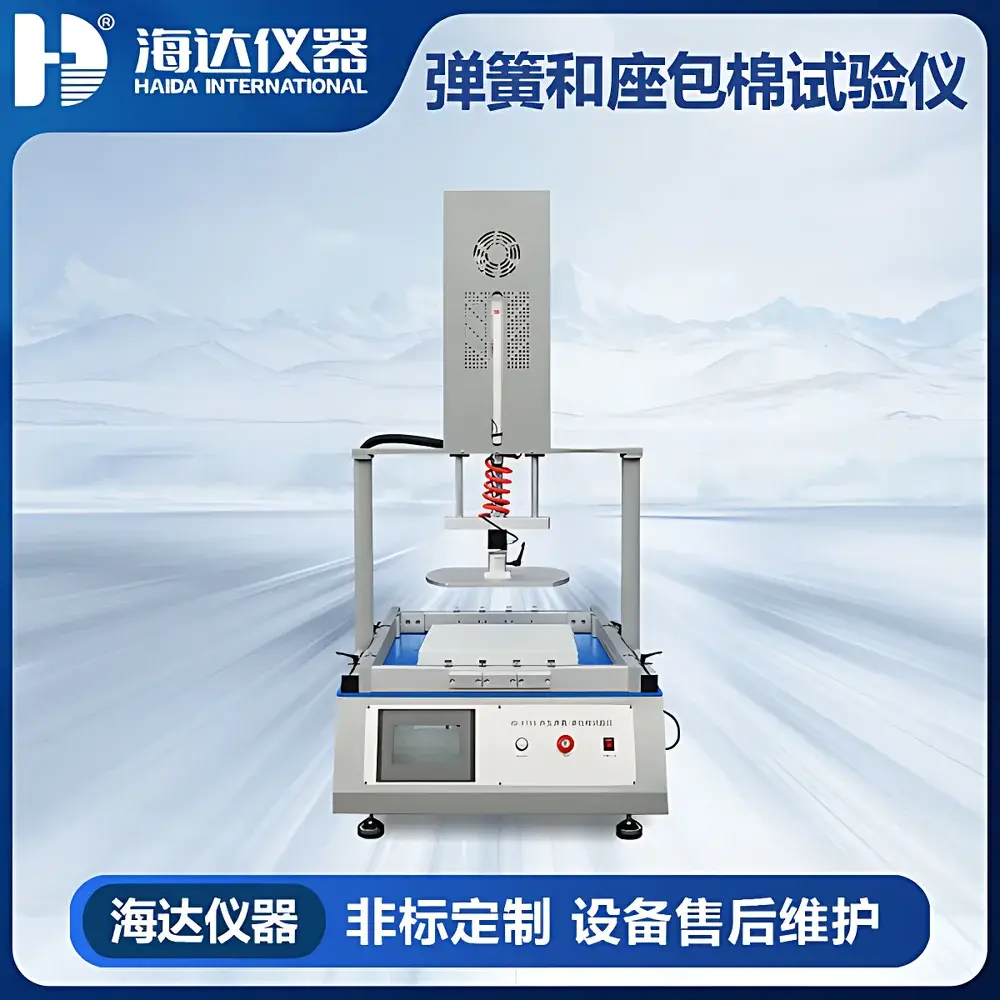
HAIDA HD-F753 Sofa Spring & Seat Cushion Fatigue Testing Machine
| Brand | HAIDA INTERNATIONAL |
|---|---|
| Origin | Guangdong, China |
| Manufacturer Type | Direct Manufacturer |
| Product Category | Domestic |
| Model | HAIDA HD-F753 Sofa Spring & Seat Cushion Fatigue Testing Machine |
| Instrument Type | Electro-Hydraulic Servo Fatigue Testing Machine |
| Maximum Test Load | 2 kN (single load cell) |
| Cycle Count Range | 1–999,999 cycles (user-definable) |
| Host Weight | ~100 kg |
| Motor | 400 W servo motor |
| Control System | PLC-based |
| Display | Touchscreen HMI |
| Test Speed | 1–80 mm/min |
| Actuator Stroke | 250 mm |
| Stroke Accuracy | ±0.25 mm |
| Power Supply | 1-phase AC 220 V |
| Total Power Consumption | ~450 W |
| Data Output | USB interface |
| Sample Dimensions (Foam) | Max. 400 × 400 × 120 mm (L×W×H) |
| Sample Dimensions (Serpentine Spring) | Width ≤70 mm |
| Overall Dimensions | 950 × 780 × 1550 mm (L×W×H) |
Overview
The HAIDA HD-F753 Sofa Spring & Seat Cushion Fatigue Testing Machine is a purpose-built electro-hydraulic servo-controlled mechanical testing system engineered for the precise evaluation of static and dynamic mechanical performance in upholstered furniture components. It operates on the principle of controlled cyclic compression loading—applying repeatable, programmable force-displacement profiles to simulate real-world usage conditions experienced by seat cushion foams and serpentine spring assemblies in domestic and commercial seating applications. The system complies with internationally recognized test methodologies including ISO 2439:2008 (foam indentation hardness), GB/T 10807-2006 (soft foam indentation load deflection), and GB/T 18269-2012 (fatigue resistance of metallic springs in furniture). Designed for laboratory and quality assurance environments, the HD-F753 delivers high reproducibility in both static hardness characterization and long-term endurance assessment under defined load amplitudes, frequencies, and displacement limits.
Key Features
- Robust structural frame fabricated from high-tensile steel with powder-coated finish, ensuring dimensional stability and long-term rigidity during high-cycle fatigue testing.
- High-accuracy 2 kN load cell (imported from Germany) calibrated to ISO 376 Class 1 standards, integrated with dual interchangeable indenter plates (φ200 mm and φ380 mm) for standardized foam indentation and spring support geometry.
- Precision servo-driven linear actuator with 250 mm stroke and ±0.25 mm positional repeatability, enabling accurate control of compression depth and dwell timing per cycle.
- Dedicated PLC-based controller with intuitive touchscreen HMI interface—supporting user-defined test sequences, automatic cycle counting, and immediate stop-on-failure logic.
- Integrated safety architecture featuring emergency stop circuitry, power-loss memory retention, short-circuit protection, and mechanical overload limit switches compliant with IEC 60204-1 safety standards.
- Heavy-duty adjustable leveling feet with vibration-damping rubber inserts, providing stable operation on standard laboratory flooring without anchoring requirements.
Sample Compatibility & Compliance
The HD-F753 accommodates two primary sample categories: polyurethane and viscoelastic foam blocks (max. 400 × 400 × 120 mm) and continuous-wire serpentine springs (width ≤70 mm, length 300–800 mm). Its modular fixture design allows rapid reconfiguration between indentation hardness mode (per ISO 2439 Annex A) and spring fatigue mode (per GB/T 18269-2012 Clause 6.3). All test protocols adhere to documented procedures traceable to national metrology institutes. The system supports full audit trail generation when operated in GLP-compliant laboratories, and its digital output (USB) enables raw data export for third-party statistical analysis software (e.g., Minitab, JMP). While not inherently 21 CFR Part 11 compliant, the machine’s deterministic control logic and non-volatile cycle logging facilitate validation documentation required for ISO 9001:2015 and IATF 16949 quality management systems.
Software & Data Management
The embedded firmware implements deterministic real-time control over all motion and force parameters, with no external PC dependency. Test configuration—including target load, stroke, speed, dwell time, and total cycle count—is stored in non-volatile memory. Upon completion or interruption, the system logs timestamped event records (start/stop times, max/min force values, cycle count at failure) directly to internal flash storage. USB export delivers CSV-formatted datasets containing time-stamped force vs. displacement traces for each completed cycle group. No proprietary drivers or cloud dependencies are required; exported files are compatible with Excel, MATLAB, and common LIMS platforms. Firmware updates are performed via USB stick using signed binary packages verified through SHA-256 checksums.
Applications
- Indentation Load Deflection (ILD) testing of flexible polyurethane foams per ISO 2439 and ASTM D3574.
- Cyclic compression fatigue assessment of serpentine seat springs used in sofas, armchairs, and office chairs.
- Quality conformance verification for Tier-1 automotive seating suppliers meeting OEM specifications (e.g., Ford WSS-M99P1111-A, GM GMW15303).
- R&D evaluation of new foam formulations, including bio-based polyols and flame-retardant additives, under accelerated aging protocols.
- Supplier qualification testing for contract furniture manufacturers requiring compliance with ANSI/BIFMA X5.1 and EN 1728:2020 durability clauses.
- Internal process capability studies (Cpk/Ppk) supporting Six Sigma initiatives in foam die-cutting and spring coiling operations.
FAQ
What standards does the HD-F753 directly support?
ISO 2439:2008, GB/T 10807-2006, GB/T 18269-2012, and ASTM D3574 (via configurable test parameters).
Can the system perform both static hardness and dynamic fatigue tests without hardware modification?
Yes—the dual indenter plate set and programmable stroke/force profile enable seamless transition between ILD measurement and multi-thousand-cycle spring endurance testing.
Is calibration certification included with shipment?
Each unit ships with a factory calibration report traceable to CNAS-accredited reference standards; optional UKAS-certified calibration is available upon request.
What maintenance intervals are recommended for sustained accuracy?
Load cell verification every 12 months; lubrication of linear guide rails every 6 months; visual inspection of electrical connections prior to each shift.
Does the HD-F753 meet CE marking requirements for EU deployment?
Yes—fully compliant with Machinery Directive 2006/42/EC and EMC Directive 2014/30/EU; Declaration of Conformity supplied with delivery documentation.



