
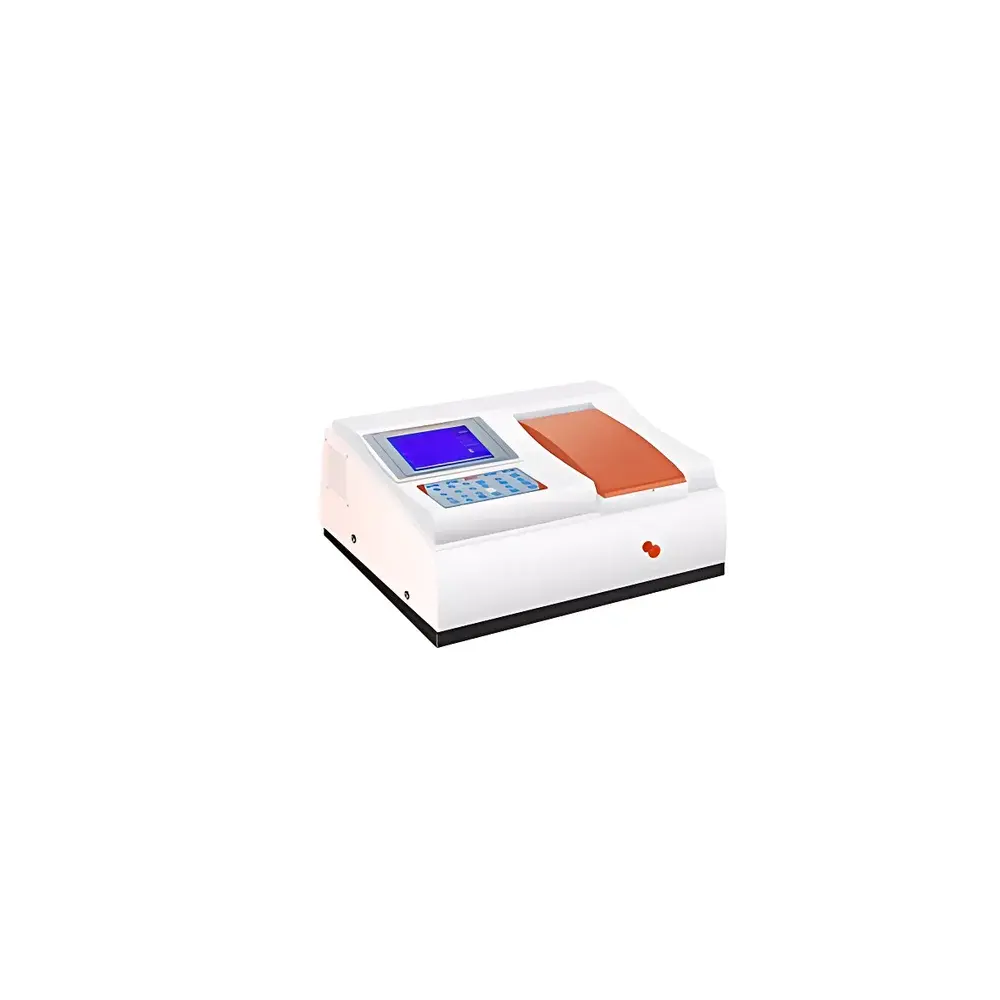
Haileong UV1801 / UV1800PC / TU1810 / UV1600PC-V7 Advanced Dual-Beam Ultraviolet-Visible Spectrophotometer
| Brand | Haileong |
|---|---|
| Origin | Shanghai, China |
| Instrument Type | Dual-beam UV-Vis spectrophotometer |
| Detector | Photomultiplier tube (PMT) |
| Wavelength Range | 190–1100 nm (UV1801/UV1800PC/TU1810), 325–1100 nm (UV1600PC-V7) |
| Spectral Bandwidth | 1 nm (UV1801), 1.8 nm (UV1800PC/TU1810), 4 nm (UV1600PC-V7) |
| Wavelength Accuracy | ±0.3 nm (UV1801), ±0.5 nm (others) |
| Wavelength Repeatability | 0.1–0.2 nm |
| Stray Light | ≤0.05% T at 220 nm and 360 nm |
| Photometric Accuracy | ≤±0.3% T (0–100% T), ±0.002 A (0–0.5 A), ±0.004 A (0.5–1 A) |
| Photometric Repeatability | ≤±0.15% T (0–100% T), ±0.001 A (0–0.5 A), ±0.002 A (0.5–1 A) |
| Baseline Flatness | ±0.002 A |
| Drift | ±0.001–0.002 A/h at 500 nm |
| Optical Design | Czerny-Turner monochromator with 1200 lines/mm grating |
| Light Sources | Deuterium lamp (D₂) and tungsten-halogen lamp (W) with automatic switching |
| Sample Compartment | Accommodates cuvettes from 5 mm to 100 mm pathlength |
| Data Interface | USB port for data export |
| Display | LCD screen |
| Power Supply | AC 90–240 V, 50 Hz |
| Dimensions | 470 × 370 × 240 mm |
| Weight | 13 kg |
Overview
The Haileong UV1801 / UV1800PC / TU1810 / UV1600PC-V7 series represents a line of dual-beam ultraviolet-visible (UV-Vis) spectrophotometers engineered for precision absorbance, transmittance, concentration, and energy measurements across academic, industrial, and quality control laboratories. These instruments operate on the principle of Beer-Lambert law-based quantitative spectroscopy, utilizing a Czerny-Turner monochromator with a high-efficiency 1200 lines/mm diffraction grating to deliver stable spectral resolution across broad wavelength ranges (190–1100 nm for most models; 325–1100 nm for UV1600PC-V7). The dual-beam optical architecture continuously compares sample and reference beams in real time, minimizing errors induced by source fluctuation or detector drift—critical for long-duration kinetic assays or low-concentration quantitation. Equipped with a photomultiplier tube (PMT) detector, the system ensures high signal-to-noise ratio and excellent sensitivity in both UV and visible regions. Automatic wavelength scanning, lamp switching (D₂ and W), zero adjustment (0% T), and full-scale calibration (100% T) are performed without manual intervention or black-body insertion, enhancing operational reproducibility and reducing operator dependency.
Key Features
- Dual-beam optical design with real-time reference beam compensation for enhanced photometric stability and reduced baseline drift.
- High-resolution Czerny-Turner monochromator featuring a 1200 lines/mm holographic grating, optimized for spectral fidelity and minimal aberration.
- Automated source management: seamless, software-controlled switching between deuterium (190–350 nm) and tungsten-halogen (325–1100 nm) lamps with lifetime tracking and diagnostic logging.
- Large sample compartment accommodating standard quartz or glass cuvettes with path lengths from 5 mm to 100 mm—ideal for dilute samples, turbid suspensions, or flow cell integration.
- Embedded microprocessor control enabling one-touch calibration, auto-zero, and 100% T normalization; no mechanical alignment or manual dark-current adjustment required.
- Onboard memory stores up to 100 user-defined calibration curves and 200 measurement datasets, supporting rapid reanalysis and offline review without external software.
- LCD display with intuitive menu navigation and direct parameter entry; USB interface for data export to PC; parallel port compatible with industry-standard thermal or dot-matrix printers.
Sample Compatibility & Compliance
The Haileong UV-Vis series supports a wide range of liquid-phase samples in standard 10 mm, 20 mm, 50 mm, and 100 mm cuvettes—including quartz (for UV transparency below 220 nm), fused silica, and high-quality optical glass. The instrument meets fundamental performance criteria aligned with ISO 9001 quality management systems and is routinely validated against ASTM E275 and USP guidelines for spectrophotometric system suitability. While not pre-certified for FDA 21 CFR Part 11 compliance, its audit-trail-capable software (in PC-connected configurations) supports GLP/GMP environments when deployed with validated third-party data acquisition platforms. All models undergo factory calibration traceable to NIST-standard reference materials, including potassium dichromate (K₂Cr₂O₇) solutions for absorbance accuracy verification at 235, 257, 313, and 350 nm.
Software & Data Management
The UV1800PC, TU1810, and UV1600PC-V7 variants include PC-based software for advanced spectral acquisition, kinetic profiling, multi-wavelength analysis, and derivative spectroscopy. Raw absorbance, transmittance, and concentration data are exported in CSV or TXT format for downstream statistical analysis in Excel, MATLAB, or Python-based workflows. The software supports method saving, user-level access control (administrator/operator modes), and electronic signature logging—facilitating documentation requirements in regulated QC/QA labs. Firmware updates are delivered via USB flash drive, ensuring long-term maintainability without hardware modification. All data files include embedded metadata: timestamp, instrument ID, operator name, calibration status, and lamp usage hours—enabling full traceability per ISO/IEC 17025 clause 7.7.
Applications
- Quantitative analysis of nucleic acids (DNA/RNA at 260 nm) and proteins (280 nm) using established extinction coefficients.
- Pharmaceutical assay development and dissolution testing per USP , including content uniformity and impurity profiling.
- Environmental water quality monitoring: nitrate (220 nm), phosphate (880 nm), and heavy metal complexation studies (e.g., Fe-phenanthroline at 510 nm).
- Chemical kinetics: real-time monitoring of reaction progress via time-scan mode with adjustable interval (100 ms–60 s).
- Colorimetric enzyme assays (e.g., ELISA, LDH, ALP) requiring high photometric repeatability and low stray light interference.
- Educational use in undergraduate chemistry and biochemistry laboratories due to robust construction, intuitive interface, and comprehensive teaching modules.
FAQ
What is the difference between the UV1801 and UV1800PC models?
The UV1801 features a narrower spectral bandwidth (1 nm) and higher wavelength accuracy (±0.3 nm), making it suitable for high-resolution applications such as fine-structure analysis. The UV1800PC offers PC connectivity and expanded software functionality while maintaining 1.8 nm bandwidth and ±0.5 nm accuracy.
Can this instrument measure samples with high absorbance (>2 A)?
Yes—the photometric range extends to –0.3 to 3.0 A, supporting measurements up to 3 A with verified linearity and low deviation per manufacturer validation reports.
Is the PMT detector replaceable in the field?
The photomultiplier tube is a sealed, factory-aligned component; replacement requires recalibration and is recommended only by authorized service personnel.
Does the instrument support GLP-compliant data archiving?
When used with the optional PC software and configured with timestamped file naming, electronic signatures, and version-controlled method storage, it satisfies core GLP documentation expectations—though formal validation remains the responsibility of the end-user lab.
How often should wavelength calibration be performed?
Initial calibration is performed at the factory using holmium oxide and didymium filters. Routine verification is recommended before each analytical session or at least daily in regulated environments; automated self-checks are available via built-in diagnostic routines.




