
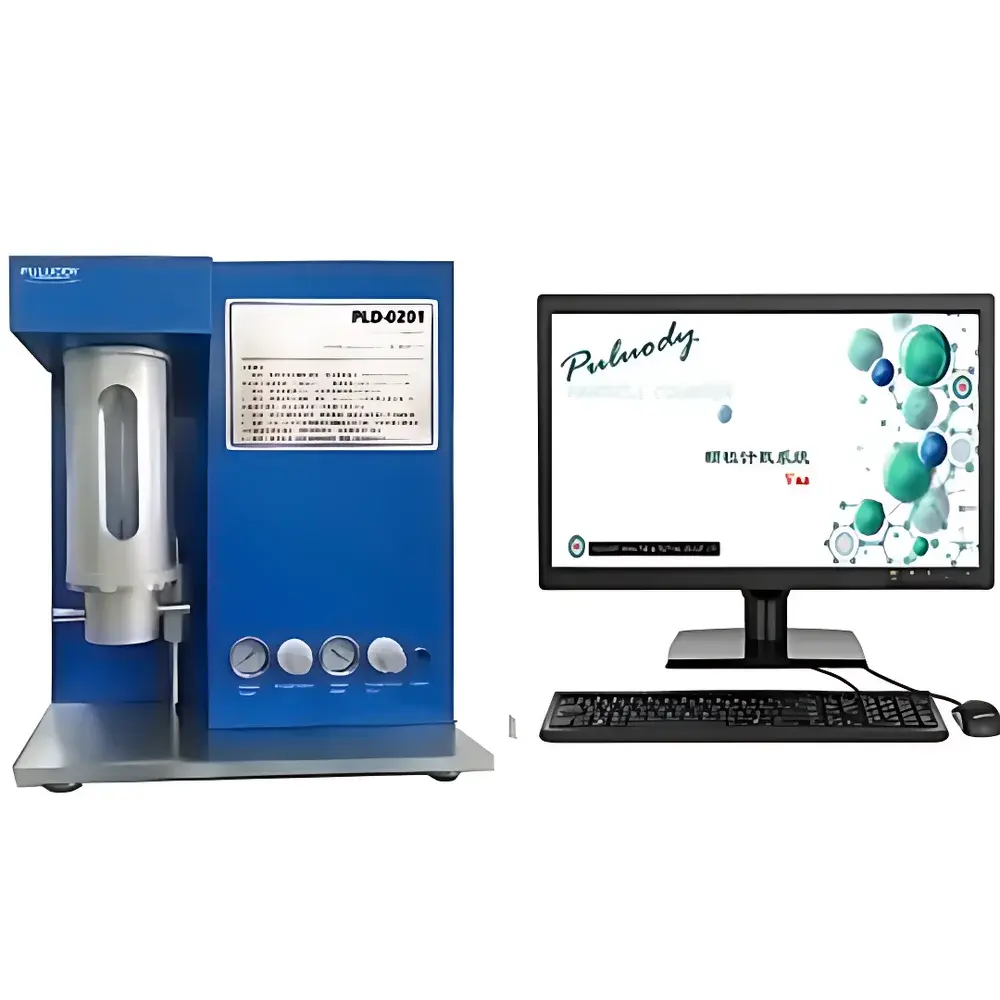
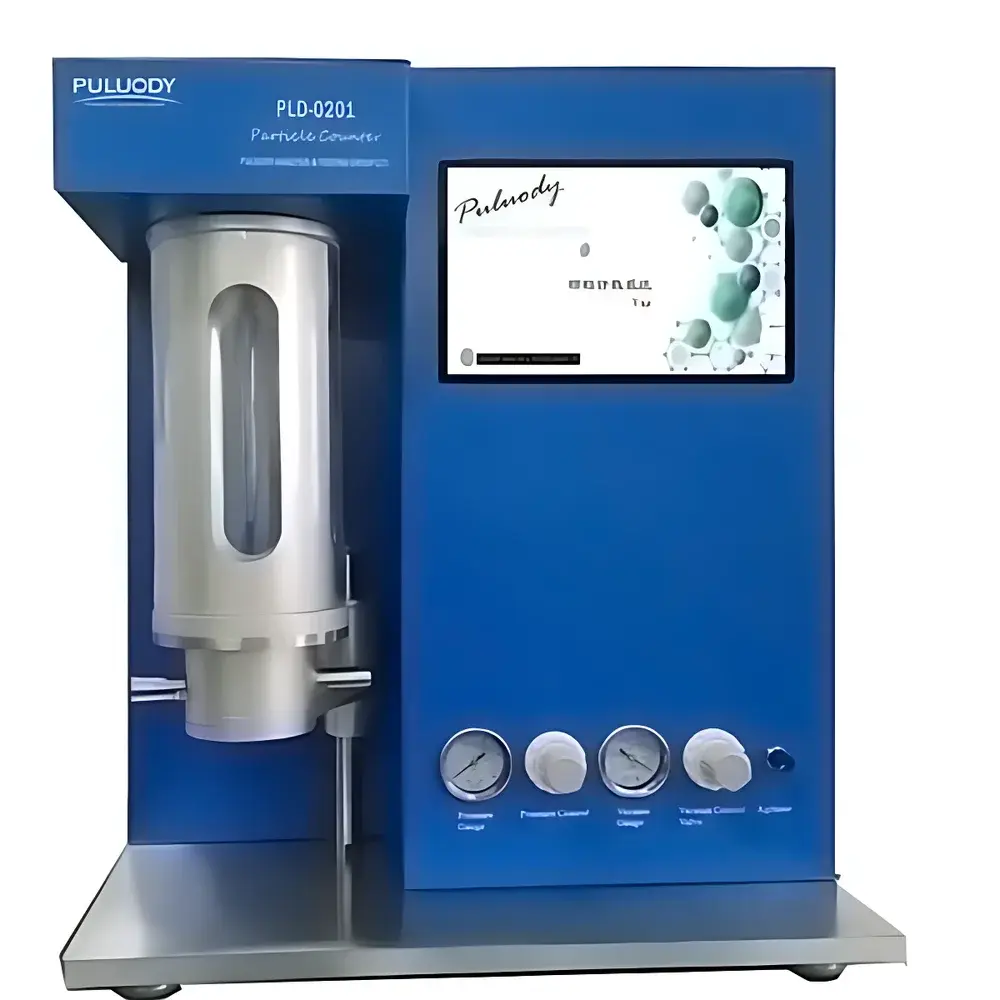
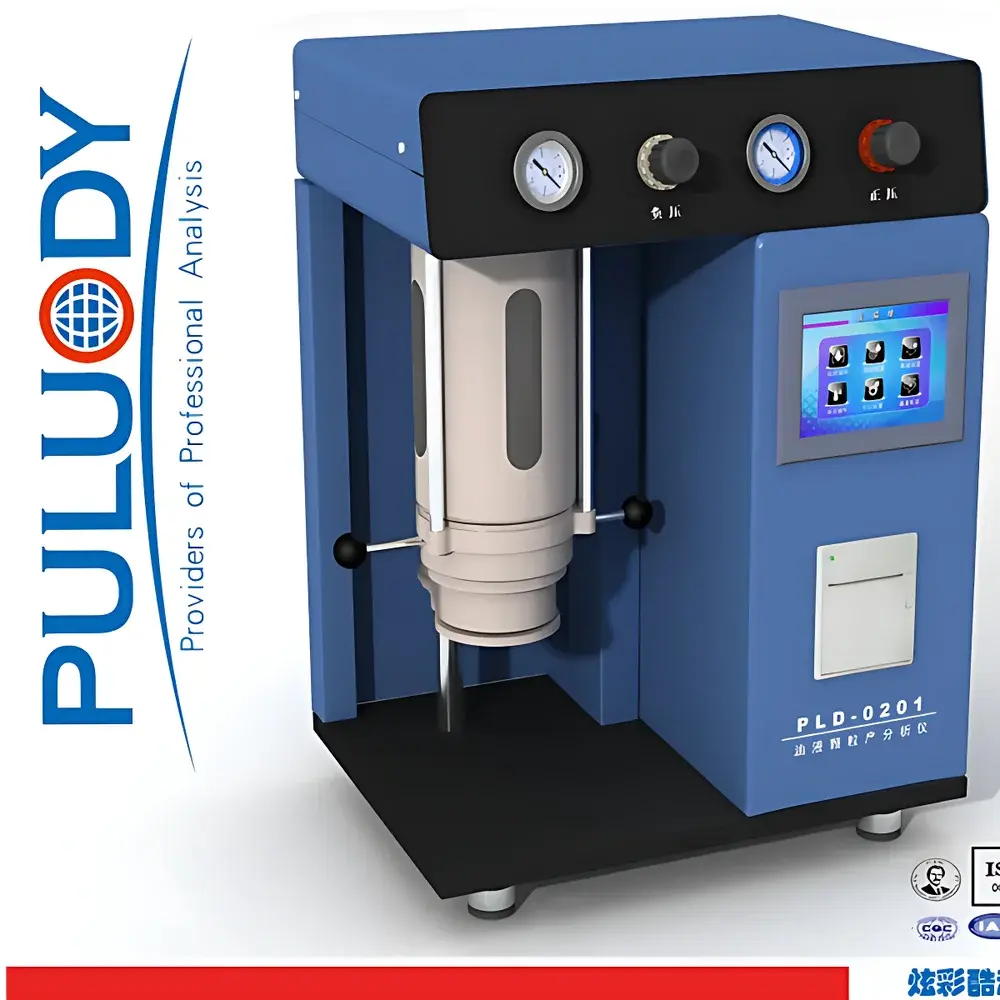
PULUODY PLD-0201-7 Optical Liquid Particle Counter for Wind Turbine Lubricant Monitoring
| Brand | PULUODY |
|---|---|
| Origin | Shaanxi, China |
| Model | PLD-0201-7 |
| Instrument Type | Optical Particle Counter |
| Detection Principle | Light Obscuration (LO) |
| Calibration Standards | ISO 11171, ISO 4402, ISO 4406, NAS 1638, DL/T 1096, GJB 380 |
| Measuring Range | 1–1000 µm (sensor-dependent |
| Sample Volume | 1 mL to unlimited (user-defined) |
| Coincidence Limit | ≤5% error at 10,000 particles/mL |
| Reporting | Particles/mL + ISO 4406/NAS 1638 contamination codes |
| Data Interface | RS232 |
| Control System | Integrated industrial PC with embedded OS |
| Display | Touchscreen LCD with dual input (touch + keypad) |
| Software | P6.4 Analysis Suite (embedded & PC versions) |
| Compliance | GB/T 18854, JJG/T 066, JJG 1061, ISO 11500, DL/T 432 |
Overview
The PULUODY PLD-0201-7 Optical Liquid Particle Counter is a laboratory-grade, benchtop instrument engineered for quantitative particulate contamination analysis in wind turbine gear oils, hydraulic fluids, and other high-value lubricants. It operates on the internationally standardized light obscuration (LO) principle—where particles suspended in a flowing liquid stream pass through a focused laser beam, generating transient reductions in transmitted light intensity proportional to particle cross-sectional area. These pulses are converted into calibrated size and count data per unit volume (particles/mL), enabling direct assessment of fluid cleanliness per ISO 4406:2017, NAS 1638:2015, and DL/T 1096–2008. Designed specifically for renewable energy asset integrity programs, the PLD-0201-7 supports predictive maintenance by detecting early-stage wear debris, oxidation byproducts, and ingress contaminants—including silica, metal oxides, and fiber fragments—that compromise bearing life, gear mesh efficiency, and hydraulic valve response in offshore and onshore wind turbines.
Key Features
- Optical detection architecture based on eighth-generation dual-laser narrow-beam sensors, delivering enhanced signal-to-noise ratio and improved stability across extended operational cycles.
- Integrated precision piston pump coupled with electromagnetic flow control, ensuring constant sample velocity (±0.5%) and volumetric accuracy (±1% full scale) over user-defined sampling volumes (1 mL to continuous flow).
- Onboard deaeration and homogenization system: pressurized sample chamber with magnetic stirring enables reliable analysis of viscous or aerated lubricants without pre-conditioning.
- Multi-standard compliance engine: configurable reporting against ISO 4406, NAS 1638, MOOG, ISO 11218, and DL/T 1096; automatic grade assignment with real-time pass/fail flagging relative to OEM-specified limits.
- Dual-input human-machine interface: 7-inch resistive touchscreen with physical keypad support; embedded operating system eliminates dependency on external computers during routine field or lab operation.
- Comprehensive data handling: built-in thermal printer for immediate hardcopy reports; RS232 serial port for traceable data export to LIMS or CMMS platforms with time-stamped audit logs.
Sample Compatibility & Compliance
The PLD-0201-7 is validated for use with mineral-based, synthetic, and bio-based lubricants commonly employed in wind turbine gearboxes (e.g., PAO, ester, and polyalkylene glycol formulations), as well as hydraulic fluids (HL, HV, HFD-U) and transformer insulating oils. Its optical path design minimizes refractive index sensitivity, supporting accurate measurement in fluids with dynamic viscosity up to 300 cSt at 40 °C. The instrument conforms to metrological requirements outlined in GB/T 18854–2015 (equivalent to ISO 11171), JJG/T 066–2020, and JJG 1061–2019. Calibration traceability is maintained using NIST-traceable latex sphere suspensions certified per ISO 4402 and ISO 11171 protocols. For regulated environments—including ISO 9001-certified maintenance facilities and GLP-compliant condition monitoring labs—the system supports 21 CFR Part 11–compliant electronic signatures when paired with P6.4 PC software and networked authentication.
Software & Data Management
The embedded P6.4 Analysis Suite provides real-time histogram generation, cumulative/differential particle distribution curves, and customizable report templates compliant with wind industry O&M documentation standards. Users may define up to 24 user-selectable size channels (e.g., ≥4 µm(c), ≥6 µm(c), ≥14 µm(c), ≥21 µm(c)) aligned with ISO 4406 coding logic. All raw pulse data—including amplitude, width, and inter-pulse interval—is retained locally for retrospective reprocessing. When connected to a host PC, the software enables trend analysis across fleets, statistical process control (SPC) charting, and integration with SAP PM or IBM Maximo via CSV/Excel export. Audit trails record operator ID, calibration events, parameter changes, and print actions—satisfying internal QA and third-party certification audits.
Applications
- Baseline and periodic oil cleanliness verification during turbine commissioning, scheduled maintenance, and post-repair validation.
- Wear debris trending in gearbox oil samples to identify abnormal gear tooth contact, bearing spalling, or filter bypass events.
- Hydraulic system contamination monitoring in pitch and yaw control circuits to prevent servo-valve stiction or actuator drift.
- Verification of filtration efficacy before and after offline kidney-loop systems or portable filtration units.
- Supporting ISO 12192-2:2021 (wind turbine oil analysis programs) and IEC 61400-25 cybersecurity-aligned data logging workflows.
- Contractor qualification testing per OEM technical specifications (e.g., Vestas V80/V112, Siemens Gamesa SG 14-222 DD, GE Cypress platform).
FAQ
How does the PLD-0201-7 ensure measurement repeatability across multiple operators and laboratories?
It employs factory-calibrated photodetectors traceable to ISO 11171 reference materials, automated flow compensation algorithms, and standardized sample preparation protocols embedded in the P6.4 workflow—enabling <±3% RSD for identical samples tested under controlled temperature (20–25 °C) and viscosity conditions.
Can the instrument differentiate between metallic wear particles and non-metallic contaminants like dust or seal debris?
While LO-based counters do not provide elemental identification, the PLD-0201-7’s high-resolution sizing (0.5 µm lower detection limit) and multi-channel counting enable morphological inference—for example, distinguishing angular metallic fatigue debris (>10 µm, irregular aspect ratio) from spherical oxide particles or fibrous gasket material via population distribution skewness and kurtosis metrics.
Is the system suitable for unattended operation in remote wind farm service cabins?
Yes—the integrated industrial PC, sealed enclosure (IP54-rated), wide ambient operating range (5–40 °C), and battery-backed real-time clock support autonomous daily sampling with scheduled self-diagnostics and error logging.
What validation documentation is provided for regulatory or certification body review?
Each unit ships with a Certificate of Conformance, ISO 11171 calibration report, traceable reference standard certificates, and a complete software validation package (IQ/OQ documentation for P6.4 v6.4.2) compliant with GAMP5 guidelines.
Does the instrument support custom channel definitions for OEM-specific cleanliness thresholds?
Yes—users may define arbitrary size bins and assign proprietary alarm thresholds within the P6.4 configuration module, with automatic alert generation and export-ready flags for integration into SCADA-linked condition monitoring dashboards.



