
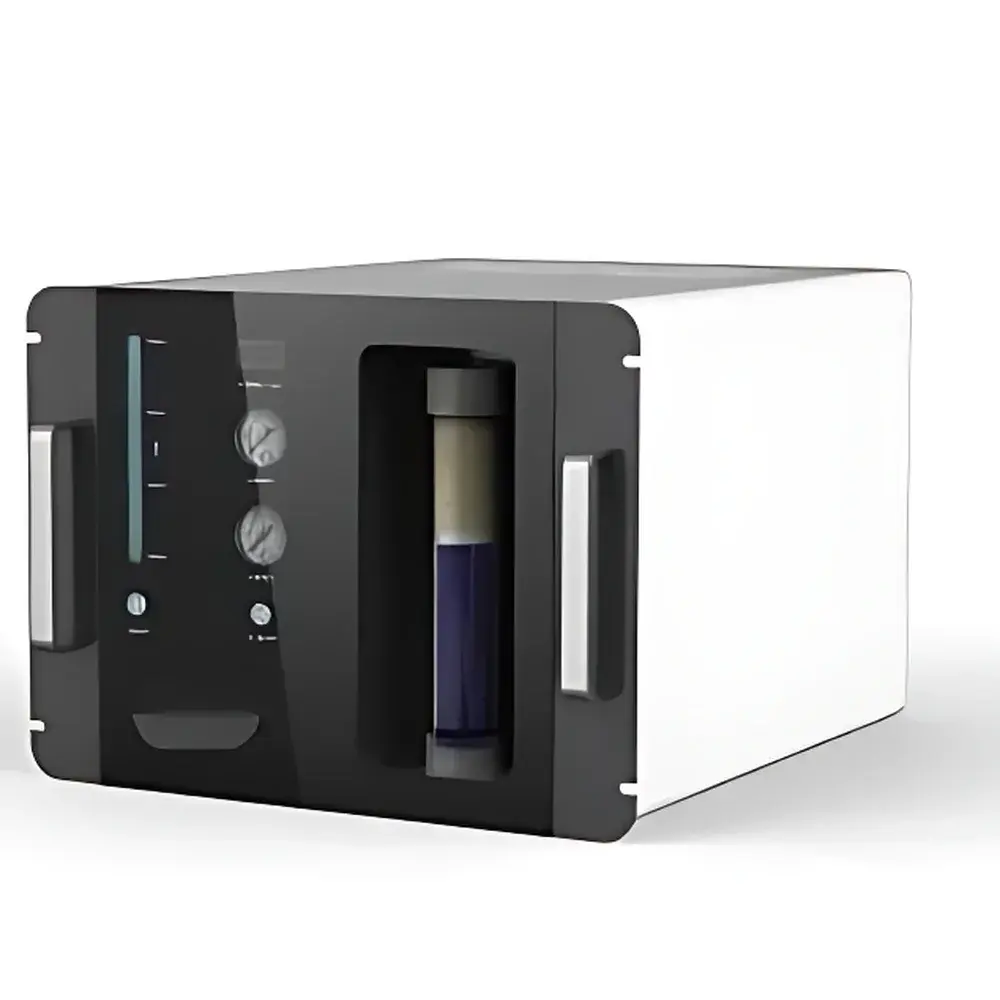
Hailong HLHA-300WZ Integrated Hydrogen & Zero-Air Generator for Online VOC Monitoring
| Brand | Hailong |
|---|---|
| Origin | Shanghai, China |
| Model | HLHA-300WZ |
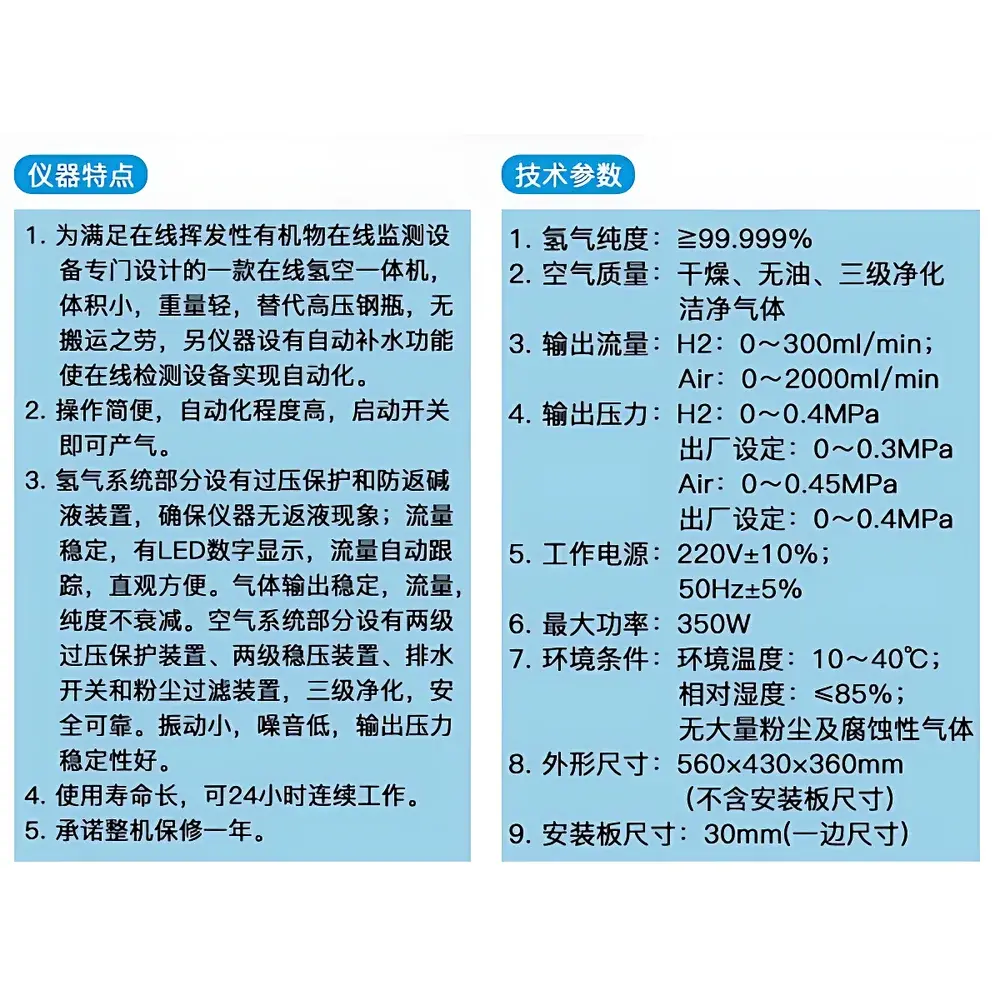
| Output Capacity | 300 mL/min H₂ / 300 mL/min Zero Air (typical) |
| Hydrogen Purity | ≥99.999% |
| Zero Air Purity | Hydrocarbon-free (<0.1 ppm THC), CO < 0.1 ppm, CO₂ < 1 ppm, H₂O dew point ≤ −40 °C |
| Operating Pressure | 0–0.4 MPa (adjustable) |
| Power Supply | AC 220 V ±10%, 50/60 Hz |
| Dimensions | 360 × 280 × 520 mm |
| Weight | ≤22 kg |
| Auto-refill Reservoir Capacity | 3.5 L |
| Compliance | CE-marked, RoHS-compliant, meets ISO 8573-1 Class 1 compressed air quality for analytical instrumentation |
Overview
The Hailong HLHA-300WZ is an integrated, on-demand hydrogen and zero-air generator engineered specifically for continuous operation with online volatile organic compound (VOC) analyzers—such as gas chromatography–flame ionization detectors (GC-FID), photoionization detectors (PID), and proton-transfer-reaction mass spectrometers (PTR-MS). Unlike conventional high-pressure cylinder systems, this generator eliminates manual handling, storage hazards, and supply-chain dependency by producing ultra-high-purity hydrogen and hydrocarbon-scrubbed zero air directly from deionized water and ambient air. Its core architecture employs membrane-based alkaline electrolysis for hydrogen generation and a multi-stage catalytic oxidation + molecular sieve + desiccant purification train for zero-air conditioning. Designed for unattended 24/7 deployment in environmental monitoring stations, industrial fence-line monitoring setups, and fixed-site laboratory networks, the HLHA-300WZ delivers stable, trace-level gas specifications required for regulatory-grade compliance measurements under EPA Method 25A, EN 13528, and ISO 16000-6.
Key Features
- Integrated dual-output design: Simultaneous, independent control of hydrogen and zero-air streams with real-time digital flow monitoring (LED display) and auto-tracking pressure compensation.
- Automatic water replenishment system: Integrated 3.5 L reservoir with level sensor and fail-safe shut-off prevents dry-electrolysis; compatible with standard deionized water (≥1 MΩ·cm resistivity).
- Hydrogen safety architecture: Dual overpressure relief valves, anti-backflow alkaline electrolyte barrier, and leak-tight PEM-compatible gas manifold ensure no liquid carryover into downstream analyzers.
- Zero-air purification cascade: Three-stage conditioning—particulate filtration (0.01 µm), catalytic oxidation (to convert CO/HCs to CO₂/H₂O), followed by dual-bed adsorption (CO₂ removal + deep desiccation)—meets ISO 8573-1 Class 1 for total hydrocarbons and moisture.
- Low-noise, low-vibration operation: Brushless DC compressors and elastomeric mounting reduce acoustic emissions to <52 dB(A) at 1 m; pressure stability maintained within ±0.01 MPa over 24 h under constant load.
- Embedded diagnostics: Self-monitoring firmware logs runtime hours, electrolyte temperature, pressure deviations, and maintenance intervals; alerts via front-panel indicator and optional RS-232/Modbus RTU interface.
Sample Compatibility & Compliance
The HLHA-300WZ is validated for use with commercial online VOC analyzers requiring carrier or fuel gas streams meeting ASTM D6216 (for FID fuel gas), IEC 61000-6-3 (EMC), and UL 61010-1 (safety). Its hydrogen output complies with ISO 8573-1:2010 Class 1.2.1 for particulates, water, and oil content—critical for preventing column contamination and detector fouling in GC systems. The zero-air stream satisfies EPA TO-15 and EU EN 14662 requirements for background hydrocarbon interference (<0.1 ppmv THC). All wetted materials are 316L stainless steel, PTFE, or EPDM-certified for chemical inertness; no copper or zinc components contact process gas. Unit carries CE marking per Machinery Directive 2006/42/EC and Low Voltage Directive 2014/35/EU.
Software & Data Management
While the HLHA-300WZ operates autonomously without host software, it supports optional integration into centralized lab infrastructure via its RS-232 serial port (Modbus RTU protocol). This enables remote status polling (gas pressure, reservoir level, fault codes), scheduled shutdown/startup, and event-triggered logging aligned with GLP/GMP audit trails. Firmware updates are performed via USB-C port using manufacturer-provided configuration utility (Windows/Linux compatible). All operational parameters—including cumulative runtime, number of auto-refill cycles, and thermal excursion history—are stored in non-volatile memory for 12 months and exportable as CSV for QA documentation.
Applications
- Continuous emission monitoring systems (CEMS) for stack VOC analysis using GC-FID or PID platforms.
- Ambient air quality networks deploying online speciated VOC monitors (e.g., benzene, toluene, xylene) per national air quality standards.
- Indoor air quality (IAQ) surveillance in smart buildings and cleanrooms where cylinder logistics are impractical.
- Mobile monitoring labs and trailer-mounted analyzer suites requiring compact, low-SWAP (size, weight, and power) gas supply solutions.
- Method validation laboratories conducting EPA Method 25A, ASTM D5504, or ISO 16017-1 interlaboratory studies requiring reproducible gas specifications across multiple instruments.
FAQ
What is the expected service life of the electrolysis cell?
Under normal operating conditions (24/7 duty cycle, DI water feed, ambient temperature 15–30 °C), the alkaline electrolyzer module is rated for ≥15,000 hours of continuous operation before scheduled refurbishment.
Can the unit be installed in an unheated outdoor enclosure?
No. Ambient operating temperature must be maintained between 5 °C and 35 °C. Sub-zero conditions risk freezing of internal condensate and reservoir water; temperatures above 35 °C degrade catalyst efficiency and accelerate membrane aging.
Is third-party calibration required prior to use?
No factory calibration is needed—the unit is pre-validated at production. However, users should verify hydrogen purity (via GC-TCD) and zero-air THC content (via calibrated PID) annually per ISO/IEC 17025 quality system requirements.
Does the generator support redundant gas supply configurations?
Yes. Dual-unit parallel operation is supported using external pressure-balancing manifolds and master-slave control logic (requires optional synchronization module).
What maintenance tasks are required during routine operation?
Monthly visual inspection of filters and drain valves; quarterly replacement of particulate and coalescing filters; annual replacement of catalytic oxidizer and desiccant beds. Electrolyte top-up is not required—only DI water replenishment via auto-refill system.



