
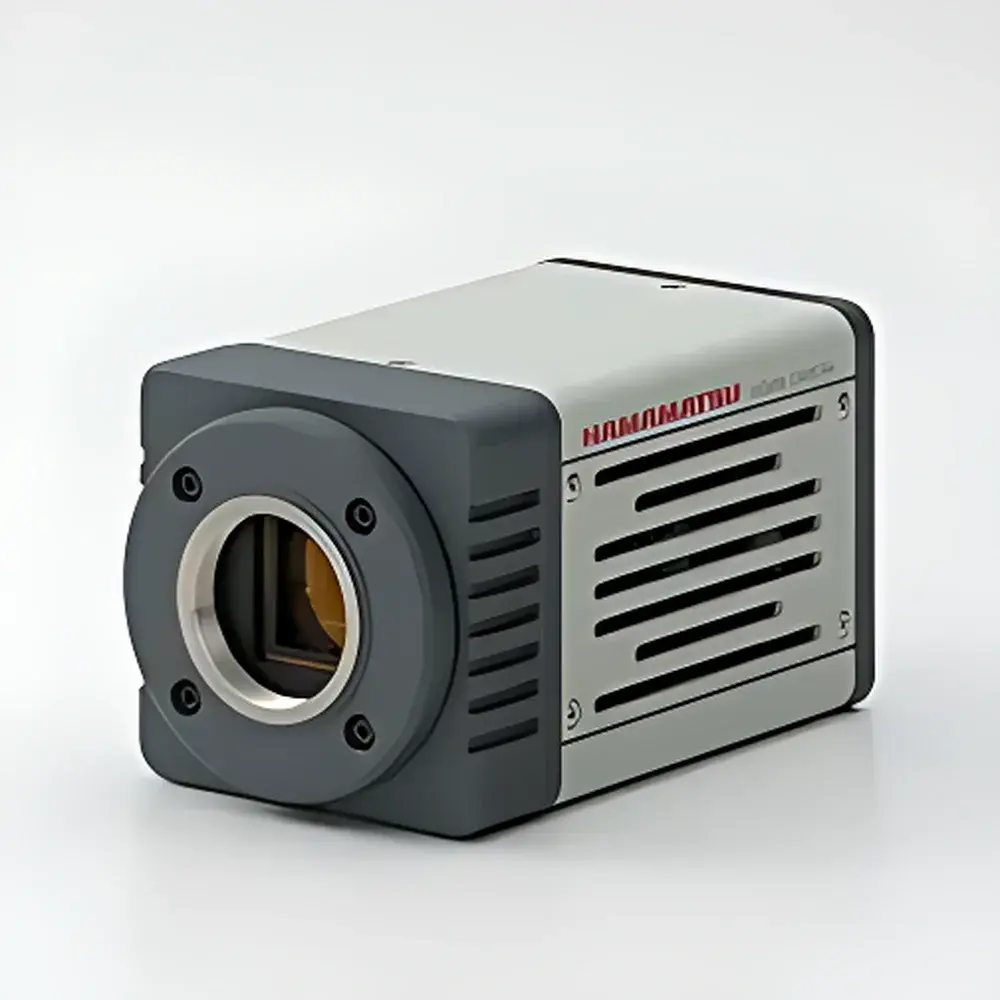
Hamamatsu C14041-10U-02 InGaAs SWIR Camera
| Brand | Hamamatsu |
|---|---|
| Origin | Japan |
| Manufacturer | Hamamatsu Photonics K.K. |
| Type | Imported |
| Model | C14041-10U-02 |
| Effective Pixels | 320 (H) × 256 (V) |
| Pixel Size | 20 µm (H) × 20 µm (V) |
| Cooling Method | Peltier (TEC) |
| Operating Temperature | +10 °C (ambient +25 °C, forced-air cooled) |
| Frame Rate | 216.6 fps (rolling shutter), 214.3 fps (global shutter) |
| Digital Output | 14-bit |
| Exposure Range | 4.6 ms – 1 s (rolling), 100 µs – 1 s (global) |
| Interface | USB 3.0 Micro-B (USB 3.1 Gen 1 compliant) |
| Lens Mount | C-mount |
| Power Supply | DC +12 V |
| Power Consumption | ~16 W |
| Operating Temp. | 0–40 °C |
| Humidity | 30–80% RH (non-condensing) |
Overview
The Hamamatsu C14041-10U-02 is a high-performance short-wave infrared (SWIR) imaging camera built around a thermoelectrically cooled indium gallium arsenide (InGaAs) focal plane array. Engineered for precision in the 950–1700 nm spectral range, it delivers quantitative, low-noise imagery critical for industrial inspection, scientific research, and photonics development. Unlike silicon-based visible/NIR sensors, the InGaAs detector enables direct detection of photons in the SWIR band—where silicon becomes transparent—making it indispensable for non-destructive evaluation of semiconductor wafers, laser beam profiling, photovoltaic cell characterization, and moisture-sensitive material analysis. Its integrated Peltier cooler stabilizes sensor temperature at +10 °C (under forced-air ambient conditions of +25 °C), significantly suppressing dark current and ensuring temporal stability over extended acquisitions. The camera operates via a USB 3.0 interface (compliant with USB 3.1 Gen 1 specifications), enabling high-bandwidth data transfer without external frame grabbers.
Key Features
- Monolithic InGaAs sensor with 320 × 256 active pixels and uniform 20 µm × 20 µm pixel pitch, yielding a 6.4 mm × 5.12 mm photosensitive area
- Two selectable readout modes: rolling shutter (216.6 fps max) and global shutter (214.3 fps max), supporting both high-speed transient capture and motion-artifact-free imaging
- 14-bit digitization with programmable exposure control—from 100 µs (global) to 1 s—enabling dynamic range optimization across diverse irradiance levels
- Onboard image processing including background subtraction and vignetting correction, reducing post-acquisition calibration burden
- C-mount lens interface compatible with standard SWIR optics; supports telecentric, macro, and collimated lens configurations for optical system integration
- Hardware-triggered acquisition with SMA input supporting edge/level/start triggering, plus configurable trigger delay (0–1 s, 10 µs resolution) for synchronization with lasers, pulse generators, or motion stages
- Robust thermal management architecture: two-stage Peltier cooling with closed-loop temperature regulation and active airflow design ensures consistent sensor performance across ambient fluctuations
Sample Compatibility & Compliance
The C14041-10U-02 is routinely deployed in environments requiring traceable, repeatable SWIR measurements under ISO/IEC 17025-aligned workflows. Its stable quantum efficiency profile (peak >70% at 1550 nm) and calibrated linearity (±1% over 90% of full scale) support quantitative reflectance and transmittance analysis per ASTM E1317 (Standard Test Method for Calibration of Infrared Thermometers) and IEC 62676-3 (surveillance imaging standards). While not intrinsically certified for medical or aerospace use, its design adheres to IPC-A-610 Class 2 mechanical robustness criteria and meets CE marking requirements for EMC (EN 55032) and safety (EN 62368-1). For GLP/GMP applications, metadata embedding—including timestamp, exposure, gain, and sensor temperature—is preserved in each acquired frame, facilitating audit-ready documentation.
Software & Data Management
Hamamatsu provides the HCImage Live software suite (Windows 10/11, 64-bit), offering real-time display, histogram analysis, region-of-interest (ROI) statistics, and batch export in TIFF, HDF5, and raw binary formats. SDKs for C/C++, Python (via PyHamamatsu), and MATLAB enable custom automation—critical for integration into automated wafer sorters, inline solar cell testers, or laser diagnostics platforms. All image files embed EXIF-like metadata headers containing sensor temperature, exposure time, gain setting, and firmware revision. For regulated environments, optional logging modules support FDA 21 CFR Part 11-compliant electronic signatures, user access controls, and immutable audit trails when paired with validated LIMS or MES systems.
Applications
- Semiconductor metrology: Visualization of subsurface defects, dopant distribution mapping, and through-silicon via (TSV) inspection in 300-mm wafers
- Laser characterization: M² measurement, beam centroid tracking, and hot-spot detection in fiber-coupled 1064 nm/1550 nm sources
- Photovoltaics R&D: Electroluminescence (EL) and photoluminescence (PL) imaging of PERC, TOPCon, and tandem cells under bias or illumination
- Food & agricultural quality control: Spatially resolved moisture content estimation in grains, fruits, and leaf tissue using 1450 nm and 1900 nm water absorption bands
- Cultural heritage analysis: Underdrawing revelation beneath paint layers, pigment identification, and varnish thickness assessment in museum conservation labs
- Thermal anomaly detection: Low-contrast hot-spot localization in power electronics and battery modules operating near ambient temperature
FAQ
What is the typical dark current specification at +10 °C sensor temperature?
At stabilized +10 °C, the median dark current is ≤0.5 e⁻/pixel/s, measured at 10 ms exposure. Dark frame variability remains within ±2% RMS across 100-frame averages.
Can the camera operate continuously for >8 hours without thermal drift?
Yes—when mounted on a vibration-isolated surface with unobstructed airflow, long-term baseline drift in mean pixel value remains <0.3% over 12-hour acquisitions, verified per Hamamatsu’s internal reliability testing protocol HT-IGA-2023.
Is lens calibration included with purchase?
No. C-mount lenses require separate calibration for geometric distortion and spectral transmission; Hamamatsu recommends NIST-traceable SWIR collimators (e.g., Edmund Optics #86-322) for radiometric validation.
Does the USB 3.0 interface support isochronous streaming at full frame rate?
Yes—the device implements UVC-compliant isochronous transfer mode with guaranteed bandwidth reservation, sustaining 216 fps at 14-bit depth without packet loss on host systems meeting Intel xHCI 1.0+ specifications.
How does the camera handle cosmic ray-induced pixel spikes in long-exposure SWIR imaging?
The firmware includes real-time outlier rejection using a 3-frame median filter (configurable off/on); raw frames retain unfiltered data for offline cosmic ray removal using Laplacian-of-Gaussian algorithms.




