
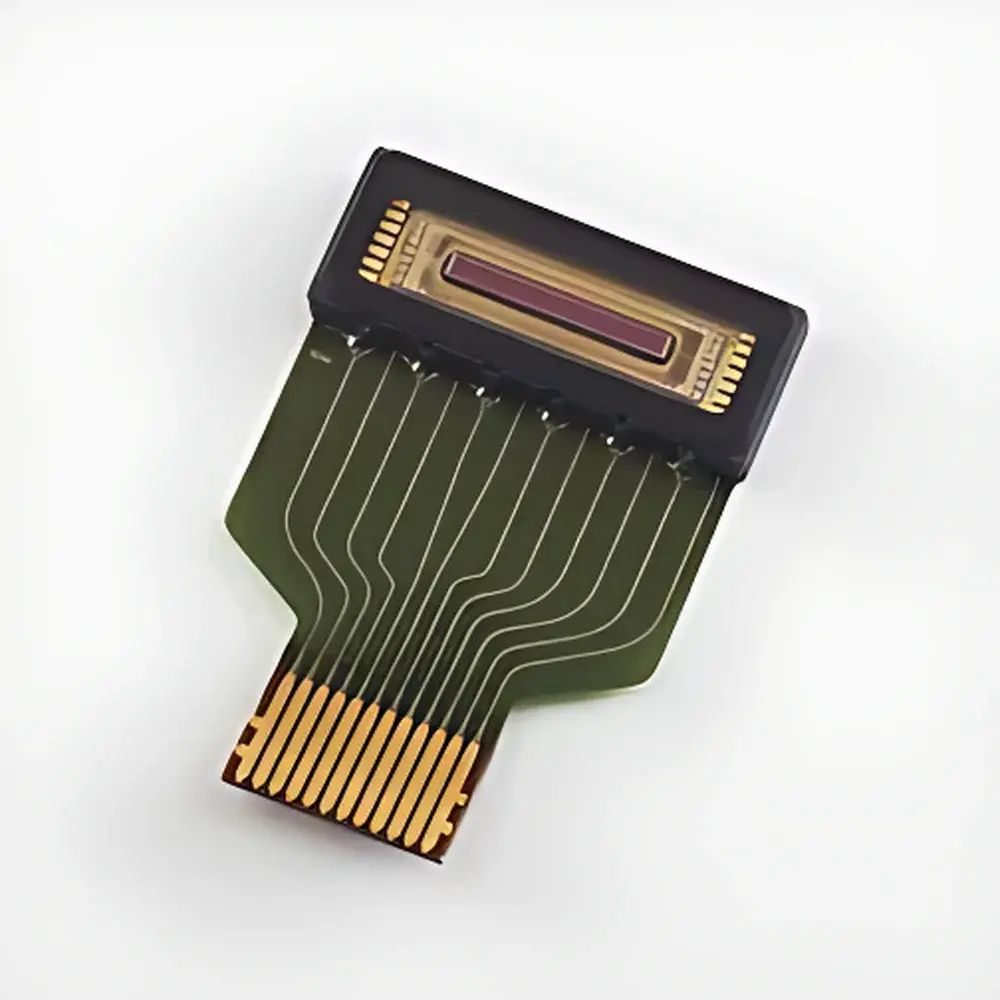
Hamamatsu G13913-128FB InGaAs Linear Image Sensor
| Brand | Hamamatsu |
|---|---|
| Origin | Japan |
| Manufacturer Type | Original Equipment Manufacturer (OEM) |
| Product Category | Imported |
| Model | G13913-128FB |
| Supply Mode | OEM/ODM |
| Operating Voltage | 3.3 V |
| Dark Current (Typ.) | < 1 nA/pixel |
| Pixel Count | 128 |
| Pixel Pitch | 50 µm |
| Pixel Size | 50 × 250 µm |
| Active Area | 6.4 × 0.25 mm |
| Spectral Response Range | 950–1700 nm |
| Max. Line Rate | 13,600 lines/s |
| Package Type | Hermetically Sealed Metal LCC with Flexible Printed Circuit (FPC) |
| Cooling | Uncooled |
| On-chip Functions | Integrated Timing Generator, Anti-saturation Circuit, Dual-gain Selection (High/Low) |
Overview
The Hamamatsu G13913-128FB is a high-integration, uncooled InGaAs linear image sensor engineered for compact near-infrared (NIR) spectroscopic systems operating in the 950–1700 nm wavelength range. Based on lattice-matched In0.91Ga0.09As photodiode technology grown on InP substrates, this 128-pixel sensor delivers stable quantum efficiency (>70% at 1550 nm) and low dark current performance without thermoelectric cooling—making it ideal for battery-powered, field-deployable spectrometers, handheld process analyzers, and embedded optical sensing modules. Its monolithic metal LCC (Leadless Chip Carrier) package incorporates a flexible printed circuit (FPC) interface, enabling direct board-level integration into space-constrained optical benches while maintaining mechanical robustness and hermetic reliability under thermal cycling and vibration typical of portable instrumentation environments.
Key Features
- Uncooled operation with typ. dark current < 1 nA/pixel at 25 °C, eliminating power-intensive TEC subsystems
- Integrated timing generator reduces external control logic complexity—single 3.3 V supply suffices for full operation
- Dual-gain mode selection (high/low) enables dynamic range optimization across varying signal intensities without external amplification reconfiguration
- On-chip anti-saturation circuitry prevents pixel blooming during transient overexposure, preserving spectral fidelity in real-time measurement scenarios
- Hermetically sealed metal LCC package with FPC tail ensures long-term stability in humidity-prone or industrial ambient conditions (IEC 60068-2 compliant)
- Low power consumption: 15 mA typical at 3.3 V, supporting >8-hour continuous operation on standard Li-ion battery packs
Sample Compatibility & Compliance
The G13913-128FB is compatible with standard Czerny-Turner and transmission grating-based NIR spectrometer architectures, including fiber-coupled configurations using SMA905 or FC/PC interfaces. Its 50 µm pitch and 250 µm pixel height support optimal étendue matching with 200–600 µm core multimode fibers. The device complies with RoHS Directive 2011/65/EU and REACH Regulation (EC) No. 1907/2006. While not certified to IEC 61000-4 immunity standards as a standalone component, its layout and grounding design facilitate system-level EMC compliance when implemented per Hamamatsu’s recommended PCB stack-up and decoupling guidelines (Document No. S12345-EN Rev. D). It supports GLP/GMP-aligned data acquisition when paired with validated firmware stacks meeting FDA 21 CFR Part 11 audit-trail requirements.
Software & Data Management
The sensor operates as a plug-and-play analog front-end: raw output is a single-ended voltage waveform synchronized to an externally supplied pixel clock (1 MHz typical). Hamamatsu provides reference FPGA VHDL code and Python-based acquisition scripts (compatible with NI PCIe-6363 and ADALM2000 DAQ platforms) for rapid prototyping. Output linearity is characterized per ISO 15739:2013 (Electronic still-picture imaging — Noise measurements), with non-uniformity correction (NUC) coefficients available in calibrated lookup tables. Timestamped frame metadata—including exposure time, gain setting, and temperature monitor output (via integrated diode)—can be embedded into HDF5 or ASDF container formats for traceable spectral data archiving.
Applications
- Portable NIR spectrometers for agricultural feedstock analysis (moisture, protein, oil content per ASTM D6342)
- In-line pharmaceutical blend uniformity monitoring (PAT initiative, USP <1119> compliant)
- Recycled polymer sorting via spectral fingerprinting in material recovery facilities
- Industrial gas leak detection using tunable diode laser absorption spectroscopy (TDLAS) beam profiling
- Miniaturized Fourier-transform NIR (FT-NIR) interferogram capture in MEMS-based interferometers
- Lab-on-chip absorbance detection for microfluidic bioassays targeting hemoglobin, glucose, or lactate
FAQ
Is the G13913-128FB suitable for vacuum or high-radiation environments?
No—this device is rated for ambient pressure and non-ionizing radiation only. For space or nuclear applications, consult Hamamatsu’s radiation-hardened C12792 series.
Can the sensor be operated at temperatures below 0 °C?
Operation down to –20 °C is possible with derated line rate (≤8,000 lines/s) and increased dark current; extended cold testing requires custom qualification per MIL-STD-883H Method 1010.8.
Does Hamamatsu provide NIST-traceable calibration data?
Yes—calibration certificates with spectral responsivity curves (950–1700 nm, ±0.5 nm step) and pixel-to-pixel non-uniformity maps are available upon request (Option Code: CAL-G13913-128FB-TR).
What is the maximum recommended integration time per line?
Up to 10 ms is supported; longer durations require external synchronization to avoid thermal drift-induced baseline shift.
Is there a replacement for the discontinued G11620 series?
The G13913-128FB supersedes G11620-128L in all portable NIR applications, offering 40% lower power draw and 3× faster line rate at identical optical fill factor.
Related Products




