
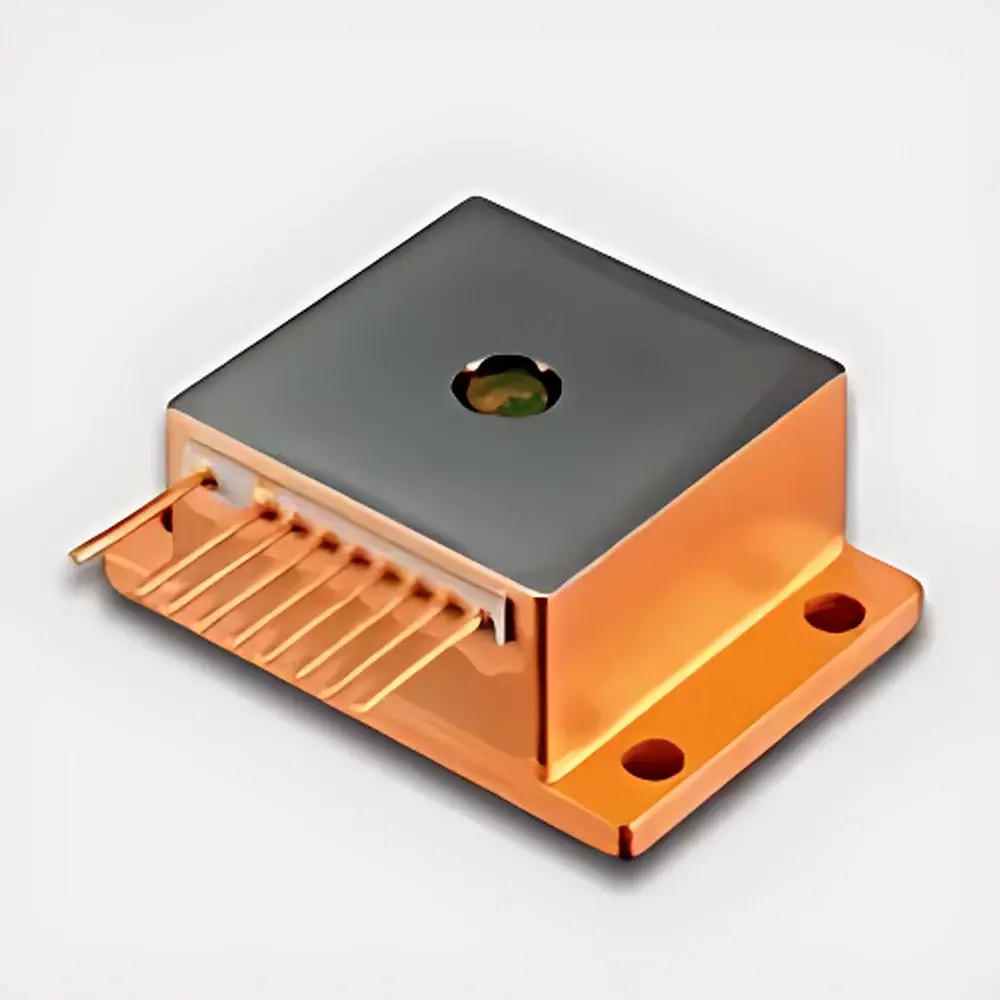
Hamamatsu L12005-1900H-C Distributed Feedback Quantum Cascade Laser (DFB-QCL)
| Brand | Hamamatsu |
|---|---|
| Origin | Japan |
| Manufacturer Type | Original Equipment Manufacturer (OEM) |
| Import Status | Imported |
| Model | L12005-1900H-C |
| Core Component | Semiconductor Laser Device |
| Laser Type | DFB, Continuous-Wave (CW) |
| Typical Peak Emission Wavelength | 5.26 µm |
| Operating Temperature Range (QCL) | 10–50 °C |
| Spectral Linewidth (Max) | 0.2 cm⁻¹ |
| Tuning Range (Min) | ±1.0 cm⁻¹ |
| Minimum Output Power | 20 mW |
| Maximum Threshold Current | 1 A |
| Side Mode Suppression Ratio (Min) | 25 dB |
| Package Type | HHL (Hermetically Sealed High-Power Laser Housing) |
Overview
The Hamamatsu L12005-1900H-C is a distributed feedback quantum cascade laser (DFB-QCL) engineered for high-stability, narrow-linewidth continuous-wave emission in the mid-infrared (MIR) spectral region. Unlike conventional interband semiconductor lasers, QCLs operate on intersubband transitions within engineered quantum well heterostructures—enabling precise, wavelength-specific photon generation between 4 and 10 µm. This model is specifically optimized for spectroscopic applications requiring high spectral purity and thermal robustness, with a typical emission peak at 5.26 µm—a region of strong fundamental vibrational absorption for numerous trace gases including CO, NO, NO₂, CH₄, N₂O, and volatile organic compounds (VOCs). Its monolithic DFB grating design ensures single-mode operation without external cavity components, minimizing optical alignment complexity while maintaining long-term wavelength stability under controlled thermal conditions.
Key Features
- Monolithic DFB architecture enabling intrinsic single-longitudinal-mode (SLM) emission without external optics
- Continuous-wave (CW) operation with minimum output power of 20 mW at 5.26 µm—suitable for direct absorption and wavelength-modulation spectroscopy (WMS)
- Narrow spectral linewidth ≤ 0.2 cm⁻¹ (FWHM), supporting high-resolution gas detection with sub-ppb sensitivity in optimized optical path configurations
- Thermally tunable over ±1.0 cm⁻¹ via integrated thermoelectric cooler (TEC) control—enabling scanning across molecular absorption features
- Side mode suppression ratio ≥ 25 dB, ensuring minimal interference from parasitic longitudinal modes during spectral interrogation
- Hermetically sealed HHL (High-Heat-Load) package with integrated TEC and thermistor—designed for industrial integration and long-term reliability in ambient environments from 10 to 50 °C
- Maximum threshold current ≤ 1 A, compatible with standard QCL driver electronics meeting IEC 61000-6-3 EMC requirements
Sample Compatibility & Compliance
The L12005-1900H-C is designed for use in gas-phase spectroscopic analysis systems where optical path lengths range from 10 cm to 10 m (multipass or Herriott cells). It interfaces directly with standard fiber-coupled or free-space MIR optics (e.g., ZnSe, Ge, or KBr lenses/windows) and is compatible with photoacoustic, cavity-enhanced, or direct absorption detection schemes. The device complies with RoHS Directive 2011/65/EU and meets IEC 60825-1:2014 Class 1M laser safety requirements when operated within specified electrical and thermal limits. Its hermetic HHL housing satisfies MIL-STD-883H Method 1014.10 for moisture resistance, supporting deployment in field-deployable environmental monitoring platforms subject to GLP-compliant validation protocols.
Software & Data Management
While the L12005-1900H-C operates as a hardware-level light source, it is fully compatible with industry-standard QCL control software suites—including Hamamatsu’s proprietary QCL Driver Control GUI (v3.2+) and third-party platforms such as LabVIEW-based DAQ systems (NI PXIe-6363), MATLAB Instrument Control Toolbox, and Python-controlled drivers using VISA or Modbus TCP interfaces. All operational parameters—including drive current, TEC setpoint, thermistor feedback, and real-time power monitoring—are accessible via analog voltage outputs and digital RS-232/UART commands. Audit-trail-capable logging (per FDA 21 CFR Part 11 Annex 11 guidelines) is achievable when integrated into validated spectroscopic data acquisition frameworks that enforce user authentication, electronic signatures, and immutable timestamped records.
Applications
- Trace gas monitoring in ambient air quality networks (e.g., EPA Method TO-15 compliant VOC speciation)
- In-line process control for semiconductor fabrication—real-time detection of etch byproducts (e.g., HF, SiF₄) and chamber cleanliness verification
- Industrial emissions monitoring per ISO 14064-1 and EN 15267-3 standards for continuous emissions monitoring systems (CEMS)
- Medical breath analysis research targeting biomarkers such as acetone (diabetes), ammonia (renal dysfunction), and ethane (oxidative stress)
- Security screening for explosives and chemical warfare agent simulants via standoff or point-sampling IR absorption fingerprinting
- Calibration source for Fourier-transform infrared (FTIR) spectrometers and tunable diode laser absorption spectrometers (TDLAS)
FAQ
What is the recommended drive current range for stable CW operation?
The device is rated for continuous operation up to its maximum threshold current of 1 A; optimal stability and lifetime are achieved between 0.65 A and 0.95 A, depending on target output power and thermal management.
Is fiber coupling supported out-of-the-box?
No—the L12005-1900H-C is provided in a free-space HHL package; fiber coupling requires external collimation and MIR-optimized lensed fiber (e.g., chalcogenide or fluoride fiber) with AR coatings for 5.26 µm.
Can this QCL be used in pulsed mode?
This model is specified exclusively for CW operation; pulsed performance (e.g., gain-switched or Q-switched) is not characterized or guaranteed by Hamamatsu.
Does the HHL package include integrated temperature sensing?
Yes—a calibrated NTC thermistor is embedded within the HHL baseplate, providing real-time junction temperature feedback with ±0.5 °C accuracy over the 10–50 °C operating range.
What mounting interface does the HHL package use?
The housing conforms to standard 25.4 mm (1 inch) optical post compatibility with four M2.5 threaded holes on a 20 mm square pattern, facilitating rigid kinematic mounting in optical breadboards and OEM instrument chassis.





