
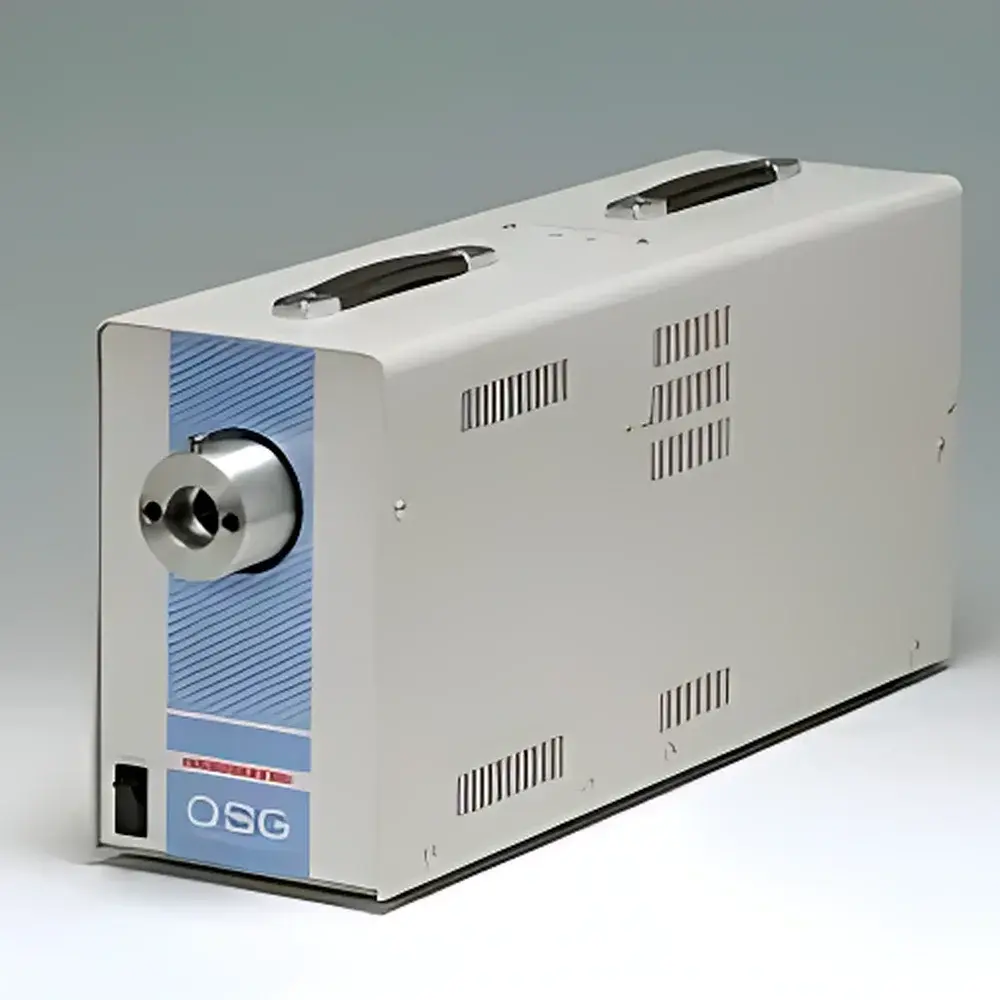
Hamamatsu L12194 Optical Spectrum Generator
| Brand | Hamamatsu |
|---|---|
| Origin | Japan |
| Manufacturer Type | Original Equipment Manufacturer (OEM) |
| Product Origin | Imported |
| Model | L12194 |
| Light Source Type | Infrared-Compatible Tunable Broadband Source |
| Illumination Configuration | Internal Illumination Design |
| Spectral Range Options | 340–540 nm, 390–700 nm, or 430–790 nm (user-selectable standard configurations) |
| Spectral Resolution | 1 nm step tuning |
| Tuning Speed | ≤ 50 nm/s |
| Spectral Bandwidth (FWHM) | ≈ 20 nm |
| Wavelength Reproducibility | ±0.5 nm (typical, after thermal stabilization) |
Overview
The Hamamatsu L12194 Optical Spectrum Generator (OSG) is a compact, internally illuminated broadband light source engineered for high-fidelity spectral selectivity in optical characterization, photometric calibration, and spectroscopic system validation. Unlike conventional monochromator-based or LED-array sources, the L12194 employs a thermally stabilized grating-based wavelength selection mechanism coupled with a high-radiance broadband emitter—enabling continuous, stepwise tuning across user-defined spectral windows without mechanical filter wheels or external optics. Its core architecture supports precise, repeatable irradiance delivery at discrete 1 nm intervals within three factory-configured ranges: 340–540 nm (UV-Vis), 390–700 nm (extended Vis), and 430–790 nm (Vis-NIR). With a typical full-width-at-half-maximum (FWHM) bandwidth of ≈20 nm, the L12194 delivers sufficient spectral purity for responsivity mapping of CCD/CMOS sensors, quantum efficiency verification of photodetectors, and spectral mismatch correction in solar simulator validation—while maintaining radiometric stability under controlled ambient conditions.
Key Features
- Internally integrated illumination path minimizes stray light and eliminates alignment dependency during system integration.
- 1 nm wavelength stepping resolution with ≤50 nm/s tuning speed enables rapid spectral scanning for time-resolved optical testing protocols.
- Thermal stabilization circuitry ensures wavelength reproducibility better than ±0.5 nm after 30-minute warm-up, meeting requirements for ISO/IEC 17025-compliant calibration laboratories.
- Three pre-aligned spectral range options support application-specific deployment without recalibration: UV-Vis (340–540 nm), full visible (390–700 nm), and visible-to-NIR (430–790 nm).
- Rugged OEM-grade housing (120 × 80 × 55 mm) features SMA905 fiber-coupled output and TTL-compatible trigger I/O for synchronization with data acquisition systems.
- No moving parts in the optical path beyond the precision rotation stage—ensuring long-term reliability and low maintenance in 24/7 operation environments.
Sample Compatibility & Compliance
The L12194 is designed for use with standard optical bench components including integrating spheres, monochromators, spectroradiometers (e.g., Ocean Insight HDX, Instrument Systems CAS 140D), and reference photodiodes traceable to NIST SRM standards. It complies with IEC 61000-4-3 (radiated immunity) and IEC 61326-1 (EMC for laboratory equipment). While not classified as a laser product per IEC 60825-1, its output irradiance falls within Class 1 LED safety limits per IEC 62471 when operated within specified duty cycles. The device supports GLP/GMP-relevant operational logging via its digital interface, and firmware versions ≥v2.3 include timestamped wavelength position records suitable for audit trails under FDA 21 CFR Part 11–aligned quality systems.
Software & Data Management
Hamamatsu provides the OSG Control Suite (v3.1+), a Windows-based application supporting USB 2.0 communication, scriptable wavelength sweeps (Python API included), and real-time power monitoring via integrated photodiode feedback. All wavelength commands are logged with UTC timestamps and instrument serial ID; exported datasets conform to ASTM E308-19 spectral data format conventions. For integration into LabVIEW, MATLAB, or Python-based test automation frameworks, the SDK includes DLLs and header files compliant with ANSI C and .NET Standard 2.0. Raw spectral power data is recorded in CSV and HDF5 formats, preserving metadata such as ambient temperature, lamp hours, and calibration epoch.
Applications
- Quantum efficiency (QE) mapping of scientific CMOS and sCMOS image sensors across visible and near-infrared bands.
- Calibration source for hyperspectral imaging systems requiring NIST-traceable spectral irradiance references.
- Spectral mismatch factor (MMF) evaluation in PV module testing per IEC 60904-9 Ed. 3.
- Optical filter transmission profiling using double-beam referencing against a stabilized broadband baseline.
- Fluorescence excitation spectrum acquisition where narrow-band tunability avoids photobleaching artifacts common with fixed-wavelength lasers.
- Development and verification of colorimetric algorithms in display metrology (CIE 1931 xy, u’v’ chromaticity space).
FAQ
Is the L12194 suitable for absolute spectral irradiance measurements?
Yes—when paired with a NIST-traceable spectroradiometer and calibrated using Hamamatsu’s optional SR-CL-1 calibration certificate (valid for 12 months), it meets the uncertainty requirements of CIE Publication 69 for reference source characterization.
Can multiple L12194 units be synchronized for multi-spectral illumination setups?
Yes—the built-in TTL trigger input/output supports master-slave daisy-chaining with sub-microsecond jitter, enabling coordinated sweeps across up to eight units in a single control loop.
What is the expected lifetime of the broadband emitter under continuous operation?
Rated for ≥5,000 hours at 80% of maximum output power; lumen depreciation follows IES LM-80 methodology, with end-of-life defined as 70% initial radiant flux.
Does the L12194 require external cooling or forced airflow?
No—it operates passively within ambient temperatures of 15–30 °C; internal thermal management maintains junction temperature within ±1.5 °C of setpoint during extended scans.
Is firmware update capability available in the field?
Yes—updates are delivered via signed binary packages through the OSG Control Suite; all updates preserve user calibration coefficients and retain audit log integrity.






