
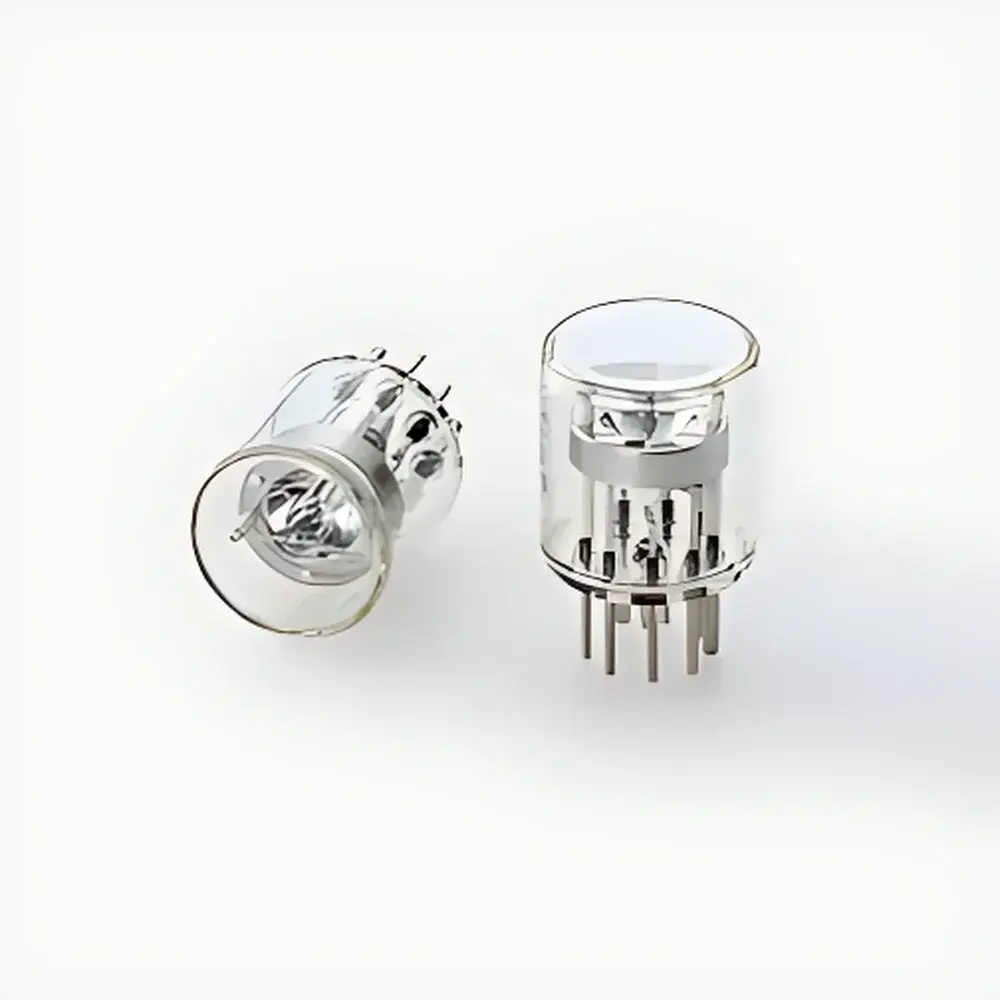
Hamamatsu L4633/L4634 15 W Pulsed Xenon Flash Lamp Module
| Brand | Hamamatsu |
|---|---|
| Origin | Japan |
| Manufacturer Type | Original Equipment Manufacturer (OEM) |
| Import Status | Imported |
| Model | L4633, L4634 |
| Light Source Type | Pulsed Xenon Lamp |
| Illumination Mode | External Illumination |
| Reflector Options | Focusing or Collimating Integrated Reflector |
| Recommended Minimum Repetition Rate | ≥10 Hz |
| Output Stability (≥10 Hz) | ≤±1.5% CV, ≤±3.0% p-p |
| Typical Energy per Flash | 0.05–0.15 J |
| Lifetime Definition | Time until integrated spectral output (190–1100 nm) degrades to 50% of initial value or stability exceeds specified limits under rated energy conditions |
| Measurement Detector | Hamamatsu S1336-8BQ Silicon Photodiode |
| Average Power Dissipation (Continuous Operation) | ≤15 W |
| Spectral Range | 190–1100 nm |
| Cooling Requirement | Passive convection (no forced air or liquid cooling required) |
Overview
The Hamamatsu L4633 and L4634 are compact, high-stability pulsed xenon flash lamp modules engineered for precision optical instrumentation requiring broadband UV-Vis-NIR excitation. Operating at a nominal average power of 15 W, these lamps utilize a sealed quartz envelope filled with high-purity xenon gas and generate intense, nanosecond-to-microsecond duration flashes via controlled capacitor discharge. Their integrated elliptical or parabolic reflector—selectable as focusing or collimating—enables efficient light coupling into optical fibers, light guides, monochromators, or sample compartments. Unlike continuous-wave (CW) sources, the pulsed architecture minimizes thermal load on downstream optics and samples, making them ideal for time-resolved spectroscopy, fluorescence lifetime measurements, and photometric assays where duty-cycle control and heat management are critical.
Key Features
- Compact OEM module design (L4633: focusing reflector; L4634: collimating reflector) optimized for integration into analytical instruments
- Broadband spectral output spanning 190–1100 nm—covering deep UV through near-infrared—without mercury-line artifacts
- High pulse-to-pulse stability: ≤1.5% coefficient of variation (CV) and ≤3.0% peak-to-peak (p-p) fluctuation when operated at ≥10 Hz repetition rate
- Low thermal dissipation: Engineered for passive convection cooling—no external fans or chillers required
- Defined lifetime metric: Rated for operational longevity until integrated radiant flux (190–1100 nm) decays to 50% of initial value under specified energy-per-flash conditions (0.05–0.15 J)
- OEM-ready electrical interface: Compatible with standard trigger inputs (TTL/CMOS), supporting synchronization with data acquisition systems and gated detectors
Sample Compatibility & Compliance
These xenon flash lamps are compatible with a wide range of optically transparent and semi-transparent samples—including aqueous solutions, thin-film coatings, biological fluids, and solid-state materials—provided exposure parameters remain within photostability thresholds of the specimen. The absence of mercury eliminates regulatory constraints associated with RoHS-restricted heavy metals. Modules comply with IEC 61000-6-3 (EMC emission standards) and IEC 61000-6-2 (immunity requirements) for industrial environments. When integrated into diagnostic or analytical platforms subject to regulatory oversight (e.g., IVD devices), the lamp’s deterministic pulse timing, traceable calibration history (via Hamamatsu’s certified photodiode reference S1336-8BQ), and stable energy delivery support alignment with ISO 13485 design controls and FDA 21 CFR Part 11 audit-trail readiness in software-managed systems.
Software & Data Management
While the L4633/L4634 operate as hardware-level light sources without embedded firmware, they are fully interoperable with third-party instrument control software (e.g., LabVIEW, Python-based PyVISA, MATLAB Instrument Control Toolbox) via standard TTL/CMOS trigger signaling. Pulse timing, repetition rate, and energy per flash are externally governed by the host system’s power supply and capacitor bank configuration. For GLP/GMP-compliant applications, users may log operational parameters—including flash count, average power, trigger latency, and measured photodiode response—using timestamped CSV or HDF5 data formats. Hamamatsu provides detailed electrical interface schematics and timing diagrams in the official datasheet (Rev. D, 2023), facilitating validation documentation for IQ/OQ/PQ protocols.
Applications
- UV-Vis-NIR spectrophotometry (including microvolume and flow-cell configurations)
- HPLC and UHPLC absorbance detection (200–800 nm range)
- Multiplexed plate readers (MTP) for kinetic ELISA and cell viability assays
- Imaging flow cytometry illumination—enabling high-speed, low-phototoxicity excitation
- Gas and water quality monitoring (e.g., NOx, SO2, TOC analysis via UV absorption)
- Mineralogical and gemological spectral identification (LIBS pre-ionization support, reflectance mapping)
- Colorimetric food safety testing (e.g., nitrite, sulfite, pesticide residue quantification)
- In vitro diagnostics (IVD)—including hematology analyzers and urinalysis systems requiring pulsed broadband excitation
FAQ
What is the recommended minimum repetition rate for stable operation?
The lamp achieves optimal radiometric stability only when operated at ≥10 Hz. Below this threshold, statistical variation in plasma ignition and thermal equilibration increases output drift.
Can the L4633/L4634 be used in vacuum or inert-gas environments?
No. These modules are designed for ambient air operation only. Quartz envelope outgassing and reflector coating integrity are not rated for vacuum or purged enclosures.
How is lamp lifetime defined and validated?
Lifetime is defined as the operational duration until integrated radiant flux (190–1100 nm) falls to 50% of its initial calibrated value—or until pulse-to-pulse stability exceeds ±3.0% p-p—under specified energy-per-flash conditions (0.05–0.15 J). Accelerated aging tests follow Hamamatsu internal protocol HLP-XT-2022.
Is spectral calibration data provided with each unit?
No. Absolute spectral irradiance calibration is not included as standard; however, Hamamatsu supplies NIST-traceable relative spectral responsivity curves and recommends pairing with an S1336-8BQ photodiode for in-situ system-level calibration.
What power supply specifications are required?
Users must provide a programmable high-voltage DC source (up to 1.5 kV), a low-inductance main discharge capacitor (typically 0.05–0.2 µF), and a synchronized TTL trigger generator. Detailed electrical interface requirements are specified in the L4633/L4634 Application Note AN-XEN-07.



