
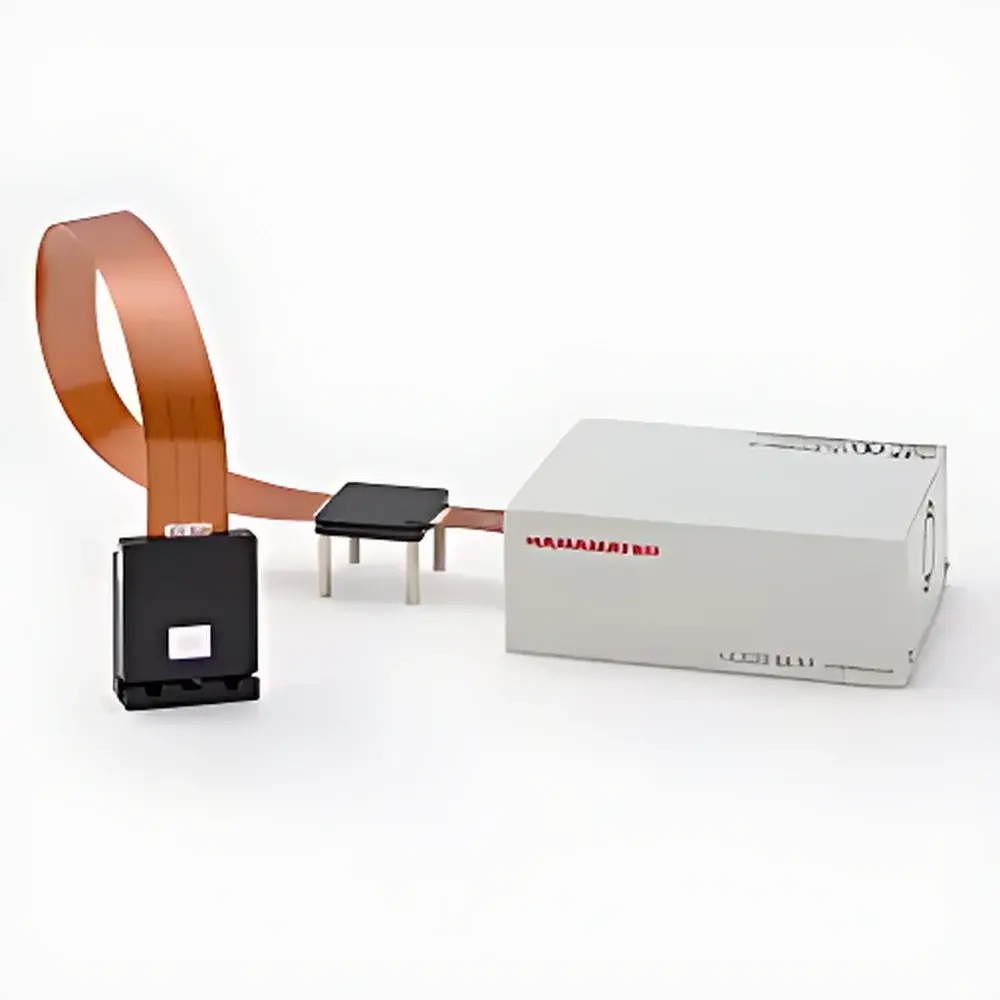
Hamamatsu LCOS-SLM X15213-16L
| Brand | Hamamatsu |
|---|---|
| Origin | Japan |
| Manufacturer Type | Original Equipment Manufacturer (OEM) |
| Import Status | Imported |
| Model | X15213-16L |
| Pricing | Available upon Request |
| Pixel Pitch | 12.5 µm |
| Input Interface | DVI-D + USB-B (USB 2.0 High-Speed) |
| Native Resolution | SXGA (1280 × 1024 pixels) |
| Active Area | 15.9 mm × 12.8 mm |
| Fill Factor | 96% |
| Maximum Spatial Resolution | 40 lp/mm |
| Rise Time | 11 ms |
| Fall Time | 34 ms |
| Operating Wavelength Range | 510 ± 50 nm |
| Optical Efficiency (at λ = 532 nm) | 97% |
| Phase Modulation Depth | 2π (full-wave, linearized) |
| DVI Frame Rate | 60 Hz |
| Gray Levels | 256 (8-bit) |
| Device Type | Reflective Pure-Phase Liquid Crystal on Silicon Spatial Light Modulator |
Overview
The Hamamatsu LCOS-SLM X15213-16L is a high-performance reflective pure-phase spatial light modulator engineered for precision wavefront control in advanced optical systems. Built on silicon-based liquid crystal on silicon (LCOS) technology, this device enables voltage-driven, pixel-level modulation of the optical phase profile without introducing significant amplitude variation—making it ideal for applications demanding high-fidelity phase-only manipulation, such as adaptive optics, holographic beam shaping, optical trapping, and ultrafast pulse shaping. Its operational wavelength window centers at 510 nm with a ±50 nm bandwidth, optimized for visible-light lasers including frequency-doubled Nd:YAG (532 nm), diode-pumped solid-state (DPSS), and tunable dye or Ti:sapphire sources operating within this spectral region. The device features a high fill factor (96%) and minimal pixel structure-induced diffraction noise, contributing to >97% optical efficiency at 532 nm—critical for power-sensitive setups involving high-intensity laser beams.
Key Features
- Reflective pure-phase modulation architecture with negligible amplitude coupling—enabling high-contrast interference and diffraction-limited beam control
- Native SXGA resolution (1272 × 1024 active pixels) over a 15.9 mm × 12.8 mm active area, supporting fine spatial sampling and high angular resolution in Fourier-plane applications
- 12.5 µm pixel pitch and 40 lp/mm maximum resolvable spatial frequency—optimized for compatibility with standard microscope objectives and telecentric relay lenses
- DVI-D interface (60 Hz frame rate) for direct, low-latency PC video output; supplemented by USB-B 2.0 for firmware updates, calibration data loading, and real-time parameter configuration
- Integrated phase response linearization and wavefront distortion correction via factory-characterized look-up tables (LUTs), compensating for intrinsic LC nonlinearity and substrate-induced aberrations
- Robust thermal management design validated for continuous operation under high-power illumination (up to 5 W/cm² average irradiance at 532 nm, per Hamamatsu specification)
Sample Compatibility & Compliance
The X15213-16L is designed for integration into ISO-standard optical benches and OEM laser systems compliant with IEC 60825-1:2014 (laser safety) and EN 61326-1:2013 (EMC for laboratory equipment). Its reflective geometry supports standard kinematic mounting (M4 threaded holes, 25 mm spacing) and is compatible with common optical alignment protocols used in interferometry and wavefront sensing workflows. While not certified for medical or industrial process control out-of-the-box, the device meets GLP-relevant traceability requirements when paired with Hamamatsu’s calibration report (NIST-traceable phase map verification available upon request). It is suitable for use in Class 1–3B laser environments when installed behind appropriate beam attenuation and interlock interfaces.
Software & Data Management
Hamamatsu provides the proprietary SLM Control Studio software suite (Windows 10/11, 64-bit), which supports real-time phase pattern generation—including Zernike polynomial decomposition, Gerchberg-Saxton algorithm iteration, and kinoform encoding—with hardware-synchronized DVI output. All phase maps are stored in IEEE 754-compliant 32-bit floating-point format, ensuring reproducibility across sessions. Audit trails—including timestamped pattern uploads, LUT versioning, and system temperature logs—are retained locally and exportable in CSV or HDF5 format. For regulated environments, optional validation packages support 21 CFR Part 11 compliance through digital signature enforcement, user role-based access control, and immutable electronic records.
Applications
- Adaptive optics in astronomy and ophthalmology—real-time correction of atmospheric turbulence or ocular aberrations
- Holographic optical tweezers and multi-point trapping with dynamic reconfiguration of trap geometries
- Programmable diffractive optical elements (DOEs) for structured illumination microscopy (SIM) and super-resolution imaging
- Ultrafast laser pulse shaping via 4f zero-dispersion compressors with spatial-spectral mapping
- Quantum optics experiments requiring deterministic single-photon path modulation and entanglement engineering
- Industrial laser material processing—beam homogenization, multi-spot drilling, and selective laser sintering pattern generation
FAQ
Is the X15213-16L compatible with third-party SLM control software?
Yes—its DVI-D interface accepts standard VGA/SXGA video signals; users may generate phase patterns using MATLAB, Python (with OpenCV or PyGame), or LabVIEW, provided gamma and phase-response LUTs are applied externally.
What is the recommended optical alignment procedure for maximizing diffraction efficiency?
Use a collimated input beam with M² < 1.1, incident at 45° to the SLM surface; align the zero-order reflection to the optical axis using a kinematic mirror mount, then optimize focus using a Shack-Hartmann sensor or far-field camera.
Does Hamamatsu provide phase calibration data for custom wavelengths outside 510 ± 50 nm?
Yes—wavelength-specific phase-response characterization (including dispersion-corrected LUTs) is available as an optional service, subject to minimum order quantity and lead time.
Can the device operate in vacuum or inert gas environments?
The standard X15213-16L is rated for ambient air operation only; hermetically sealed variants with fused silica windows and outgassing-controlled encapsulation are available under custom part number X15213-16L-VAC.




