
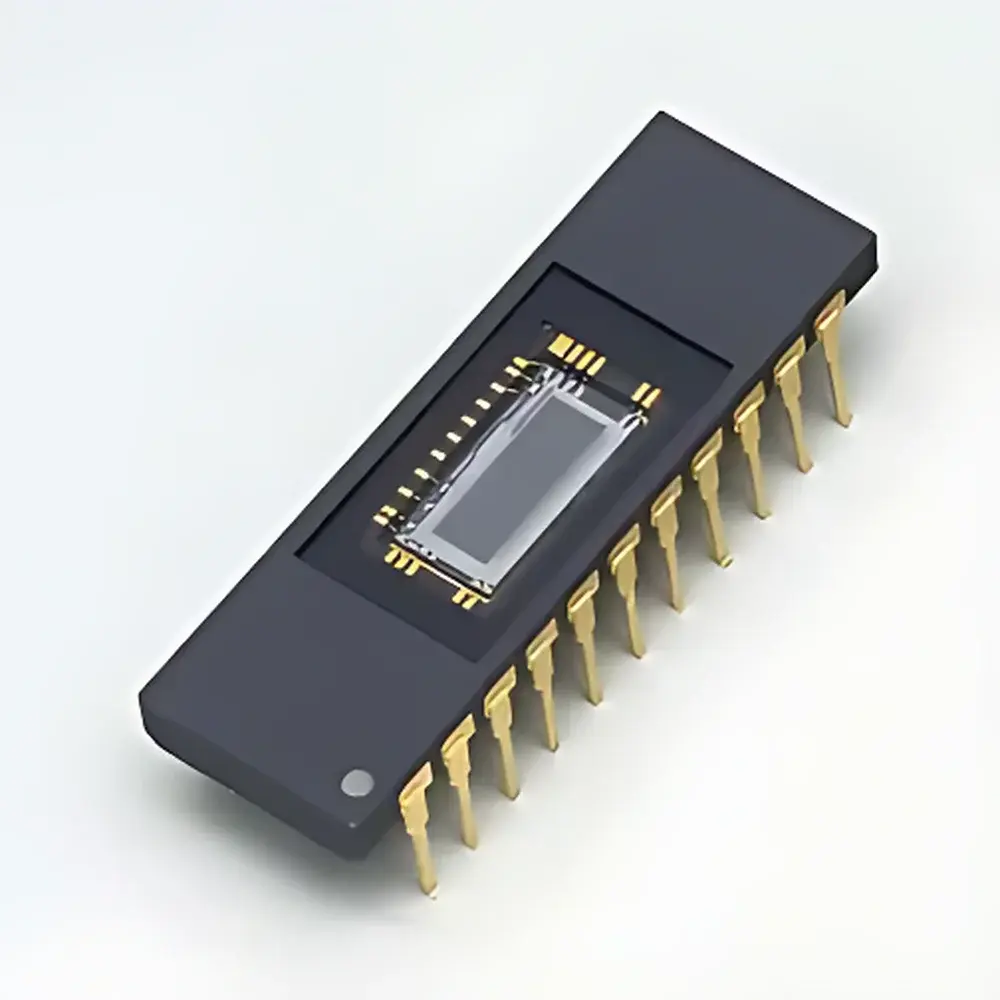
Hamamatsu S10121-128Q-01 CMOS Linear Image Sensor
| Brand | Hamamatsu |
|---|---|
| Origin | Japan |
| Manufacturer Type | Original Equipment Manufacturer (OEM) |
| Product Category | Imported Optical Component |
| Model | S10121-128Q-01 |
| Component Type | Optical Detector Element |
| Pixel Count | 128 |
| Pixel Pitch | 50 µm |
| Pixel Height | 2.5 mm |
| Output Type | Current-Mode Analog Output |
| Spectral Range | UV-enhanced (190–1100 nm, peak responsivity in UV) |
| Integration Time | Programmable per-pixel |
| Power Consumption | Low-power self-scanning operation |
| Package | Ceramic DIP with quartz window |
Overview
The Hamamatsu S10121-128Q-01 is a high-performance, UV-optimized CMOS linear image sensor designed specifically for spectroscopic applications requiring stable quantum efficiency and low-noise analog current output across the deep ultraviolet to near-infrared spectrum. Built upon a monolithic CMOS process with back-thinned, UV-enhanced photodiode architecture, this 128-pixel self-scanning array delivers uniform spectral response—particularly critical in UV-VIS spectrometers where conventional silicon detectors exhibit steep responsivity roll-off below 300 nm. Its current-mode output eliminates pixel-to-pixel voltage gain variation, enabling high linearity and dynamic range without external transimpedance amplification at the sensor level. The device operates via integrated shift-register control, allowing precise synchronization with external timing signals—a key requirement for lock-in detection, time-resolved spectroscopy, and multi-channel spectral averaging.
Key Features
- UV-enhanced spectral response: Optimized quantum efficiency from 190 nm to 1100 nm, with <±3% deviation in responsivity across 200–400 nm—critical for accurate UV absorbance quantification in analytical chemistry and semiconductor metrology.
- Programmable per-pixel integration time: Enables adaptive exposure control to accommodate wide irradiance gradients typical in polychromator slit images or Raman scattering spectra.
- Large active area per pixel: 50 µm pitch × 2.5 mm height provides high photon collection efficiency and improved signal-to-noise ratio (SNR) in low-light applications such as fluorescence lifetime imaging or weak-emission plasma diagnostics.
- Low-power self-scanning architecture: Integrated CMOS shift register and reset circuitry reduce system-level complexity; typical operating current < 5 mA at 5 V supply, compatible with portable and battery-powered OEM spectrometer designs.
- Ceramic dual-in-line package (DIP) with fused silica window: Ensures hermetic sealing, thermal stability (−40°C to +70°C operational range), and transmission >90% down to 185 nm—meeting ISO 17025-compliant calibration traceability requirements.
Sample Compatibility & Compliance
The S10121-128Q-01 is engineered for integration into optical bench systems, modular spectrometers (Czerny-Turner, Littrow, and Offner configurations), and OEM analytical platforms compliant with IEC 61000-6-3 (EMC emissions) and RoHS Directive 2011/65/EU. Its UV-transmissive quartz window satisfies ASTM E275-22 standards for UV optical component qualification. As a bare-die sensor module, it supports custom optical coupling—including fiber-optic butt-coupling (SMA905), lenslet array illumination, and free-space collimated beam alignment—without introducing chromatic aberration or polarization sensitivity. No built-in ADC or digital interface; thus, full compliance with FDA 21 CFR Part 11 audit trail requirements is achieved only when integrated with validated data acquisition firmware and calibrated reference sources per NIST-traceable protocols.
Software & Data Management
The sensor requires external timing generation (e.g., FPGA or microcontroller-based pulse trains) for clock, start, and reset signals. Hamamatsu provides comprehensive timing diagrams, bias voltage recommendations, and dark-current characterization data in its official datasheet (C12821-01 Rev. F). For spectral data acquisition, users typically implement custom LabVIEW, Python (PyVISA + NumPy), or C++ drivers interfacing with analog front-end circuits (e.g., low-noise current-to-voltage converters followed by 16-bit ADCs). Raw pixel current outputs are digitized and corrected using pixel-wise dark offset subtraction and non-uniformity correction (NUC) matrices—routines commonly embedded in spectrometer OEM software suites compliant with ISO/IEC 17025 clause 7.7 (measurement uncertainty estimation).
Applications
- UV-VIS-NIR benchtop and portable spectrometers for pharmaceutical assay validation (USP <857>)
- Plasma emission monitoring in semiconductor etch chambers (OES systems)
- Flame photometry and atomic absorption spectroscopy (AAS) detector arrays
- UV laser-induced fluorescence (LIF) detection in combustion research
- Quality control of UV-curable resins and photopolymers in additive manufacturing
- Environmental monitoring of ozone, NO₂, and SO₂ via differential optical absorption spectroscopy (DOAS)
FAQ
Is the S10121-128Q-01 compatible with standard USB spectrometer interfaces?
No—it is an analog current-output sensor requiring external biasing, timing control, and signal conditioning. Integration necessitates custom electronics design.
What is the recommended operating temperature range for long-term stability?
−40°C to +70°C ambient; for optimal spectral calibration repeatability, maintain ±0.5°C thermal stability during measurement sequences.
Does Hamamatsu provide NIST-traceable spectral responsivity calibration data?
Yes—certified calibration reports (part number C12821-CAL) are available separately, covering 190–1100 nm at 1 nm intervals under collimated 10° f/4 illumination.
Can this sensor be used in vacuum environments?
The ceramic DIP package is not rated for high vacuum; outgassing may occur above 10⁻⁴ Pa. For UHV applications, consider Hamamatsu’s S14233 series with metal-sealed packages.
How is pixel non-uniformity corrected in production systems?
Through factory-measured gain and offset coefficients stored in EEPROM or loaded at system boot—implemented in firmware per ISO/IEC 17025 clause 6.4.6 (equipment calibration verification).




