
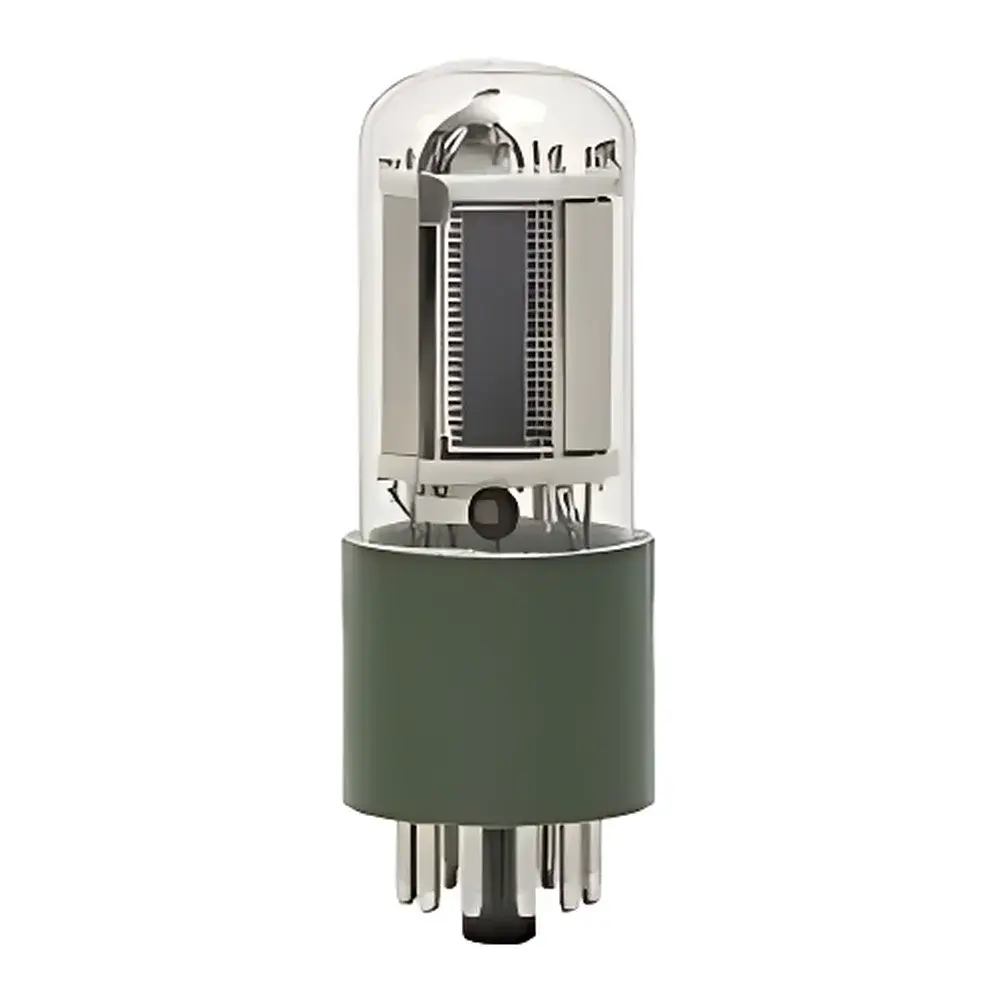
Hamamatsu Side-Window Photomultiplier Tube (PMT) R-Series
| Brand | Hamamatsu |
|---|---|
| Origin | Japan |
| Manufacturer Type | Original Equipment Manufacturer (OEM) |
| Product Origin | Imported |
| Model Series | R-Series |
| Pricing | Available Upon Request |
Overview
The Hamamatsu Side-Window Photomultiplier Tube (PMT) R-Series is a high-performance, vacuum-sealed electron multiplier device engineered for ultra-low-light detection in demanding spectroscopic and analytical applications. Operating on the principle of photoemission followed by secondary electron multiplication via a dynode chain, this side-window configuration enables optimal coupling with optical components—such as monochromators, spectrometers, and scintillation detectors—where lateral light incidence is required. The R-Series PMTs feature borosilicate or fused silica entrance windows, enabling broad spectral response from deep ultraviolet (down to 115 nm) to near-infrared (up to 1700 nm), depending on photocathode material (e.g., bialkali, multialkali, GaAs, or solar-blind Cs-Te). Designed and manufactured in Japan under stringent ISO 9001-certified processes, these PMTs deliver exceptional quantum efficiency, low dark current, high gain (typically 10⁵–10⁷), and nanosecond-level time response—critical for time-resolved fluorescence, LIDAR, radiation monitoring, and single-photon counting.
Key Features
- Side-window geometry optimized for orthogonal light entry and compact optical integration in spectrometers, fluorometers, and OEM analytical instruments
- Multiple photocathode formulations supporting tailored spectral responsivity: UV-enhanced (115–400 nm), visible-optimized (300–750 nm), and NIR-sensitive (600–1700 nm)
- Standardized package dimensions ranging from miniature 10 × 10 mm to large-format 132 mm diameter units—compatible with industry-standard PMT sockets and magnetic shielding housings
- High gain stability and pulse linearity across wide dynamic ranges, validated per IEC 60681 and JIS C 5502 standards
- Low-noise operation with typical dark count rates < 100 cps at 25 °C (dependent on cathode area and cooling configuration)
- Hermetically sealed ceramic/metal construction ensuring long-term vacuum integrity and resistance to environmental humidity and thermal cycling
Sample Compatibility & Compliance
The R-Series PMTs are compatible with a wide range of light sources and sample interfaces—including scintillation crystals (NaI:Tl, LaBr₃, BGO), luminescent probes, chemiluminescent reagents, and synchrotron beamlines. Their spectral response characteristics support compliance with ASTM E131 (standard terminology relating to molecular spectroscopy), ISO 17025 (for accredited calibration laboratories), and USP (photometric absorption and fluorescence measurement). When integrated into regulated instrumentation (e.g., clinical analyzers or environmental monitors), the devices meet essential requirements for traceability, repeatability, and electromagnetic compatibility per EN 61326-1. Optional thermoelectric cooling modules enable operation under GLP/GMP conditions where temperature-controlled signal stability is mandated.
Software & Data Management
While the PMT itself is an analog detector element, its integration into modern analytical platforms typically occurs via standardized analog output (0–10 V or ±5 V) or digital pulse-counting interfaces (NIM/TTL/RS-422). Hamamatsu provides comprehensive datasheets, spectral response curves, and SPICE-compatible models for system-level simulation. For OEM integration, Hamamatsu offers application engineering support—including bias voltage optimization guides, noise budgeting tools, and grounding best practices—to ensure conformance with FDA 21 CFR Part 11 when deployed in regulated diagnostic or pharmaceutical QA/QC systems. Firmware-agnostic signal conditioning solutions (e.g., gated integrators, photon-counting scalers) are widely available from third-party vendors compliant with IEC 62304 for medical device software lifecycle management.
Applications
- Spectroscopy: UV-Vis-NIR absorbance, fluorescence, phosphorescence, and Raman detection in benchtop and portable spectrometers
- Clinical Diagnostics: Chemiluminescent immunoassay (CLIA) readers, flow cytometry detectors, and gamma camera photodetection arrays
- Nuclear & Particle Physics: Scintillation-based radiation dosimetry, neutrino observatories (e.g., Super-Kamiokande heritage architecture), and cosmic ray detection
- Industrial Process Control: Real-time plasma emission monitoring in semiconductor etch chambers, thin-film thickness metrology via interferometric reflectance
- Environmental Monitoring: Low-level pollutant quantification in air/water using laser-induced fluorescence or chemiluminescent NOₓ analyzers
- Life Sciences: Confocal and multiphoton microscopy photon detection, bioluminescence imaging, and time-correlated single-photon counting (TCSPC)
FAQ
What distinguishes side-window PMTs from end-window configurations?
Side-window PMTs accept incident light perpendicular to the tube axis, enabling flexible optical path design in space-constrained spectrometers and multi-channel detection arrays—unlike end-window types that require axial illumination.
Can R-Series PMTs be operated in photon-counting mode?
Yes—when paired with appropriate preamplifiers and discriminators, R-Series tubes support single-photon resolution with timing jitter < 1 ns (depending on dynode structure and operating voltage).
Are Hamamatsu R-Series PMTs suitable for vacuum-ultraviolet (VUV) applications?
Select models with MgF₂ or LiF windows and Cs-Te photocathodes are rated for operation down to 115 nm; consult individual datasheets for window transmission cutoff and cathode quantum efficiency curves.
How is gain calibrated and maintained over time?
Gain is stabilized via precision high-voltage power supplies (±0.01% regulation); long-term drift is minimized through baked-out vacuum processing and stable dynode alloy composition—typical gain variation is < ±3% over 10,000 hours at rated current.
Do these PMTs comply with RoHS and REACH directives?
Yes—all R-Series devices manufactured after 2018 conform to EU Directive 2011/65/EU (RoHS2) and Regulation (EC) No 1907/2006 (REACH), with full material declarations available upon request.





