
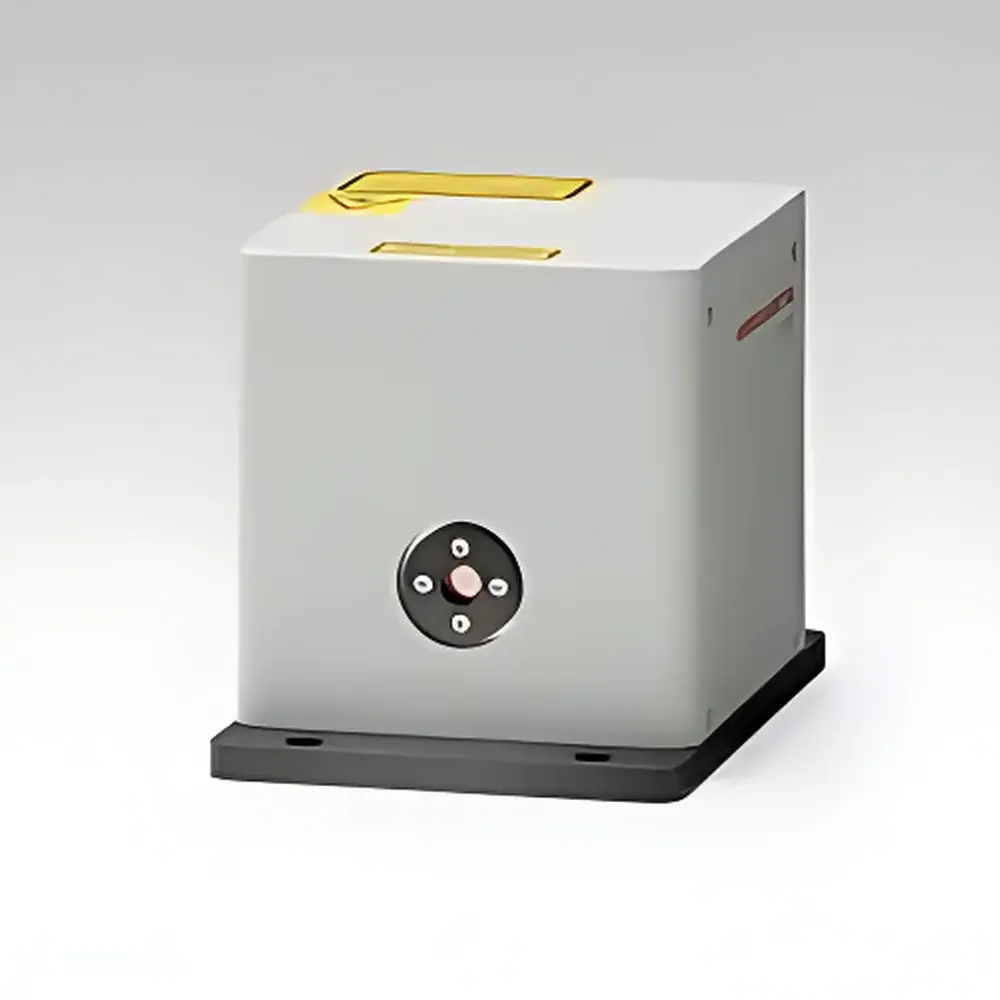
Hamamatsu Tunable Quantum Cascade Laser (QCL) Module L14890-09
| Brand | Hamamatsu |
|---|---|
| Origin | Japan |
| Manufacturer Type | Original Equipment Manufacturer (OEM) |
| Product Category | Imported Instrument |
| Model | L14890-09 |
| Core Component | Pulsed Semiconductor QCL Source |
| Pulse Output Power (Max) | 900 mW |
| Pulse Repetition Frequency (Typ.) | 180 kHz |
| Integrated Collimating Lens | Yes |
| Dimensions (W × H × D) | 82 mm × 88 mm × 112 mm |
| Weight | 1.2 kg |
| Central Wavenumber (Typ.) | 1075 cm⁻¹ |
| Wavenumber Tuning Range (Typ.) | 200 cm⁻¹ |
| Tuning Mechanism | MEMS-based External Cavity |
Overview
The Hamamatsu Tunable Quantum Cascade Laser (QCL) Module L14890-09 is a compact, pulsed mid-infrared laser source engineered for high-resolution, rapid-scan spectroscopic applications. Based on quantum cascade gain media and an external cavity configuration incorporating a micro-electromechanical systems (MEMS) diffraction grating, this module enables precise, continuous wavenumber tuning across a 200 cm⁻¹ spectral window centered at 1075 cm⁻¹ (~9.3 µm). Unlike Fourier-transform infrared (FT-IR) spectrometers—whose performance is limited by mechanical scanning speed and signal-to-noise trade-offs—the L14890-09 leverages the coherence, brightness, and narrow instantaneous linewidth of QCL emission to deliver superior spectral radiance and measurement throughput. Its pulse operation (180 kHz repetition rate, peak power up to 900 mW) supports time-resolved detection schemes including photoacoustic spectroscopy, cavity-enhanced absorption, and heterodyne detection. The integrated collimating lens ensures beam quality suitable for free-space coupling into multipass cells, gas cells, or fiber-coupled accessories without additional optical alignment.
Key Features
- MEMS-driven external cavity architecture enabling millisecond-scale wavenumber sweeps with high repeatability and long-term stability
- Monolithic DAU (Driver–Amplifier–Unit) platform integrating temperature-controlled QCL chip, driver electronics, and thermoelectric cooler (TEC) for optimized thermal management
- Factory-aligned collimated output beam (M² < 1.3) with adjustable divergence via integrated lens assembly
- Compact OEM form factor (82 × 88 × 112 mm, 1.2 kg) designed for integration into portable analyzers, process monitors, and research-grade spectroscopic platforms
- Compliance with IEC 60825-1:2014 Class 4 laser safety requirements; includes interlock interface and status monitoring pins for system-level safety integration
Sample Compatibility & Compliance
The L14890-09 is optimized for gas-phase molecular spectroscopy in the fingerprint region (9–11 µm), where strong fundamental vibrational absorptions occur for compounds including NO, CO, CH₄, NH₃, SO₂, and volatile organic compounds (VOCs). It is compatible with standard multi-pass absorption cells (e.g., White or Herriott configurations), photoacoustic resonators, and quantum cascade detector (QCD)-based detection modules. While not certified for direct medical device use, its design adheres to general principles outlined in ISO 13485 for instrumentation used in analytical development under GLP environments. Note: Export of this module to the United States is prohibited under current Japanese export control regulations (Foreign Exchange and Foreign Trade Act); Hamamatsu Photonics K.K. disclaims liability for technical incompatibility, regulatory nonconformance, or operational failure arising from unauthorized deployment in U.S.-jurisdiction systems.
Software & Data Management
The module communicates via TTL-compatible digital I/O and analog voltage inputs for wavelength setpoint and trigger synchronization. Hamamatsu provides a Windows-based SDK (C/C++, LabVIEW, Python wrappers) supporting real-time scan control, waveform logging, and calibration table loading. All spectral data acquisition—including wavenumber timestamping, pulse timing markers, and TEC temperature telemetry—is structured to support traceability in regulated environments. Audit trails, user access control, and electronic signature capabilities are implementable through third-party SCADA or LIMS integration using OPC UA or Modbus TCP protocols. Firmware updates preserve backward compatibility and include checksum-verified bootloaders compliant with IEC 62443-3-3 security requirements for industrial control systems.
Applications
- Real-time emissions monitoring in combustion exhaust streams and semiconductor fab cleanrooms
- Portable environmental sensors for ambient air quality mapping of greenhouse gases and toxicants
- Lab-based high-throughput screening of catalytic reaction intermediates via step-scan absorption kinetics
- Calibration reference source for FT-IR and dispersive spectrometer validation (NIST-traceable line positions achievable via internal wavenumber calibration routine)
- Mid-IR pump-probe experiments requiring synchronized tunable excitation and broadband detection
FAQ
Is the L14890-09 suitable for continuous-wave (CW) operation?
No—it is designed exclusively for pulsed operation at 180 kHz repetition frequency; CW mode is not supported due to thermal constraints of the QCL chip and DAU architecture.
Can the tuning range be extended beyond 200 cm⁻¹?
The specified 200 cm⁻¹ range reflects the guaranteed performance envelope under factory calibration. Extended scans may be possible but require user recalibration and are not covered by warranty or metrological traceability.
Does Hamamatsu provide spectral calibration certificates?
Yes—each unit ships with a NIST-traceable wavenumber calibration report based on HCl and N₂O reference lines measured in a stabilized vacuum cell.
What cooling method is required?
The integrated TEC operates from a +15 V DC supply and requires forced-air convection; no liquid cooling or chiller is needed for nominal operation within 15–30 °C ambient.
Is remote firmware update supported over USB?
Yes—firmware updates are performed via USB 2.0 using Hamamatsu’s certified utility; all updates undergo cryptographic signature verification prior to installation.




